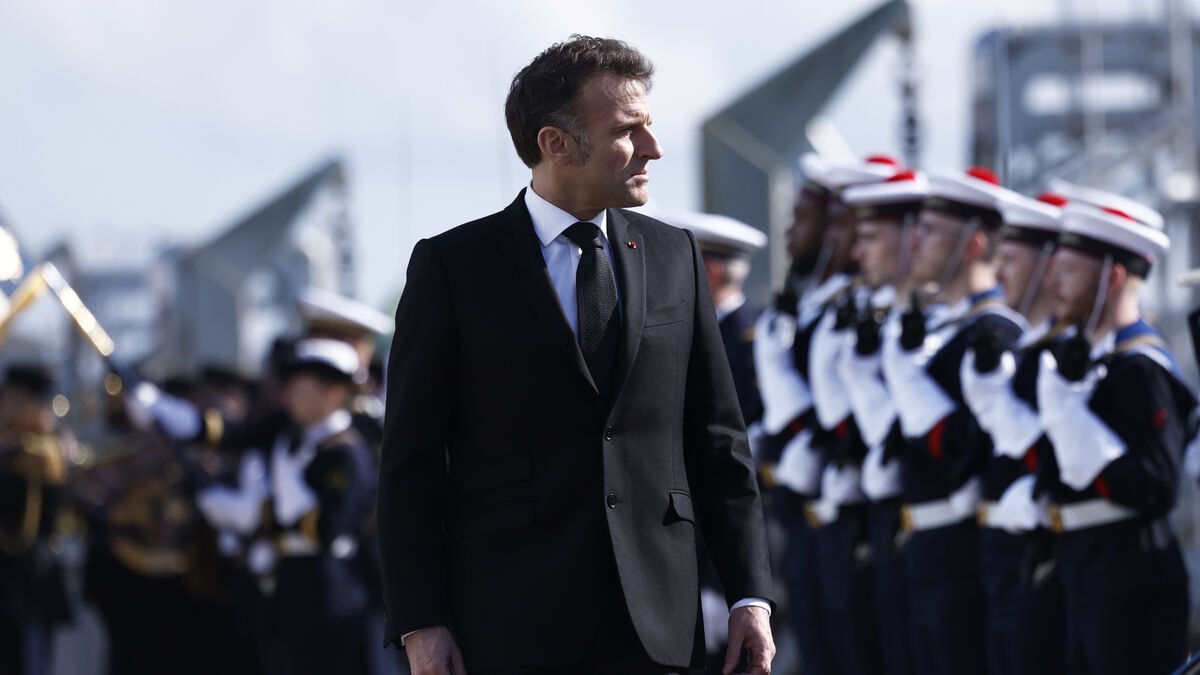
Sighs of relief were heard from both the French right and left after the president's major nuclear weapons speech on Monday.
Fears that Macron would let other European countries - or even the EU - take part in deciding on the country's nuclear weapons were dispelled.
"France remains the sole master of . . . the use of nuclear weapons. It is a good decision," writes left-wing leader Jean-Luc Mélenchon in a blog post, for example.
“Threat to peace”
Macron's new "advanced deterrence" still has a distinctly European character. It is not only about other countries being offered to join in the exercises, but also about being able to move French nuclear weapons around to other countries to make it more difficult for the other side - in practice, Russia.
Macron sees rearmament as necessary and speaks of Europe facing a "half-century of nuclear weapons."
Organizations and others working for disarmament disagree.
“President Macron’s announcement is a direct threat to peace and security in the region and the entire world. . . A nuclear arms race that no one can afford,” Melissa Parke of the peace-prize-winning ICAN (Campaign to Abolish Nuclear Weapons) condemned it in a statement.
Other interests?
At the same time, it is possible to sense both energy and industrial policy interests behind France's new strategy.
France is the EU's most pro-nuclear country and in his speech Macron also talked about an upcoming summit in Paris on March 10 to "encourage the development, use and financing" of civil nuclear power.
France is also the country pushing hardest for EU countries to arm themselves with domestic weapons, rather than buying from companies with ownership interests in the US or UK.
Want to see counter-purchase requirements
To put it bluntly, it's not so much about making French weapons more European as it is about making European weapons more French.
The far-right National Rally - which could well decide on France's nuclear weapons after next year's presidential election - wants to see counter-purchase requirements to keep the nuclear umbrella open.
"It is difficult to see any other advantage than the symbolic in the spread of these resources (nuclear weapons) when no reciprocal performance is linked to it - especially not regarding European countries' purchases of French equipment," party leaders Jordan Bardella and Marine Le Pen write in a statement about Macron's new strategy.
In 1960, France became the fourth country to acquire nuclear weapons after the United States, the Soviet Union, and Great Britain.
The country is estimated to have a total of just under 300 warheads, mostly placed on submarines, but to a lesser extent also on aircraft.
France currently has four nuclear-powered submarines named Le Triomphant (The Triumphant), Le Téméraire (The Bold), Le Vigilant (The Vigilant) and Le Terrible (The Terrible). A fifth new submarine, to be named L'Invincible (The Invincible), is due to be completed in 2036.
In the 1990s, French nuclear tests in the South Seas led to widespread protests and boycotts. However, no tests have been conducted since 1996.