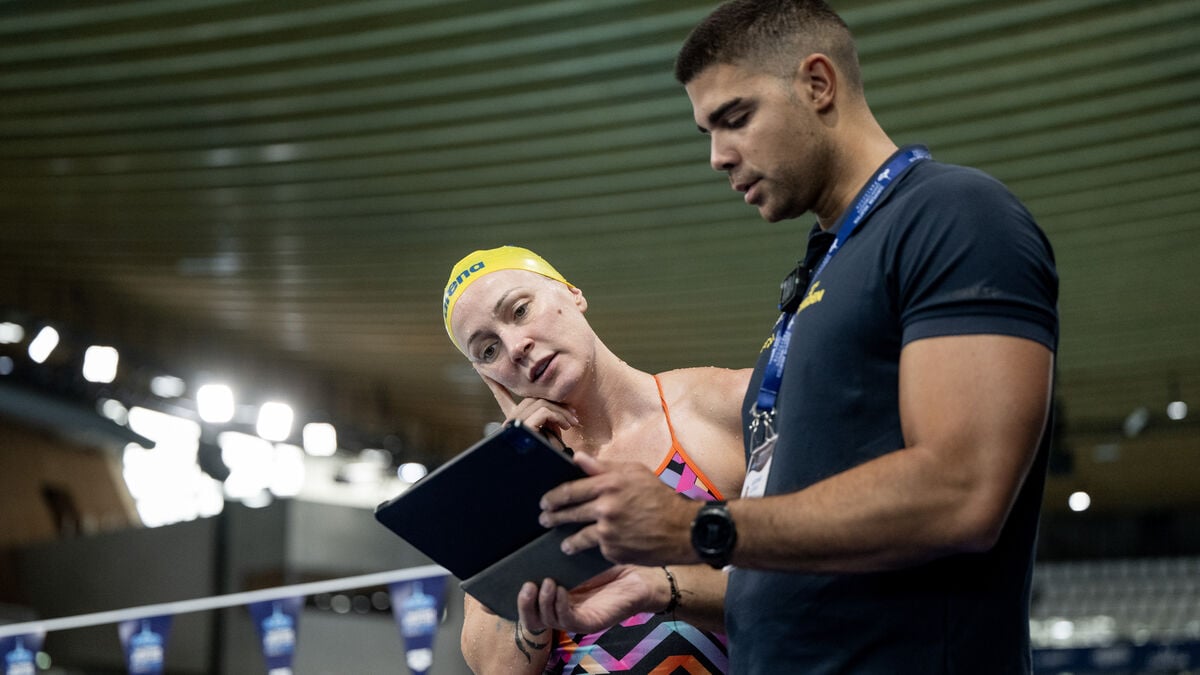
On Tuesday, Sarah Sjöström makes a championship comeback when she swims the 50-meter butterfly at the European Championships in Paris.
It has been just over two years since her last championship, her Olympic success in the French capital, where she won two gold medals - a stunning victory in the 100-meter freestyle, the distance she had not planned to swim, and a favoured win in the 50-meter freestyle.
After the Olympics, Sjöström took a break. In early 2025, she and her husband Johan de Jong Skierus announced that they were going to become parents, and at the end of August last year, their son Adrian was born in an ambulance outside Södersjukhuset in Stockholm.
“Never surprised”
In January this year, Sarah Sjöström resumed training in earnest.
She has competed in two meets, the Swim Open at home in April and the Sette Colli in Rome in June, and enters the European Championships as the European number one in both the 50-meter butterfly and the 50-meter freestyle.
"You're never surprised by anything when it comes to Sarah," says Lykke Tamm, the doctor in charge of the 2024 Olympic team, who emphasises that she did not help Sjöström with any advice either before or after the pregnancy.
But she says that pregnancy can have a positive effect on female athletes.
I've seen that many times, and some of it is probably that you have something else that is important so you can relax from sport in a different way.
There are physiological effects after childbirth, such as increased lung capacity and increased blood volume for some. But it is more individual than general, Tamm points out, and she highlights former Norwegian biathlete Liv Grete Skjelbreid as an example of one of the athletes who got better after giving birth.
"I was the doctor for the French national biathlon team for many years and at that time Raphael Poirée was married to the Norwegian (Liv Grete Skjelbreid). A year after she had her first child, she won four out of five gold medals at the World Championships (2004) and I have seen that several times," she says.
“Megadevelopment”
Sarah Sjöström kept up training, both swimming and strength training, until just a few weeks before giving birth.
Something her coach Antonio Lutula highlights as a key to the comeback.
"It's a huge advantage to be in as good shape as possible when you're about to have a baby. The start-up distance was much shorter and the level was significantly higher once you got going," he says.
When Sjöström started in earnest in January this year, it was under the supervision of Lutula and with a focus on building strength after giving birth. He puts the rapid development into words:
She has had a mega development, if you just think about chins, she had difficulty doing chins with body weight in the beginning and now she does it with 15 kilos in addition to her body weight.
Dara Torres, USA: At the age of 41, she won three Olympic silver medals, including an individual 50-meter freestyle, in Beijing in 2008. This was after giving birth to her first child in 2006.
Dana Vollmer, USA: Won three Olympic medals in Rio de Janeiro in 2016 at the age of 28, including gold in the team event (4x100 meter medley) and an individual bronze in the 100 meter butterfly (the event that Sarah Sjöström won), 16 months after giving birth to her first child.
Therese Alshammar, Sweden: One of Sweden's greatest swimming stars of all time. Made a comeback at age 36 in 2014 after giving birth to her first child. She made it to her sixth Olympics in Rio de Janeiro in 2016, where she was the Swedish flag bearer, but did not reach the same level as before childbirth due to injuries.