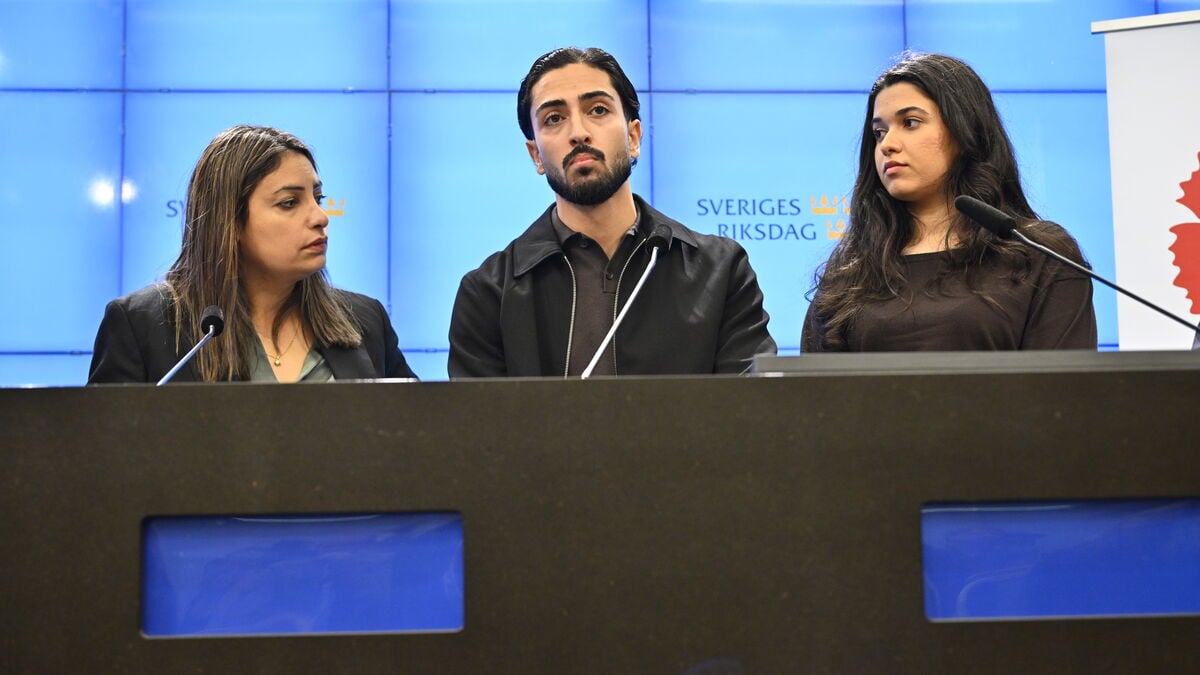
"It was an election promise from us. If we win the election, the first thing we will do is stop the expulsions of teenagers. We must also ensure that those who have been expelled are allowed to come home," says Samuel Gonzalez Westling, group leader for the Left Party.
Last term, the Tidö parties came up with a "valve" to stop the expulsions of teenagers. In short, it means that the age limit for the group in question to receive a residence permit on the basis of ties is raised from 18 to 21 years.
The new law will come into effect tomorrow, October 1.
We can be expelled at any time. The valves that have been presented so far do not seem to help any of us, says Diya Hassan at a press conference in the Riksdag together with others from the Network who are threatened with teenage expulsion.
V: An emergency stop
She is 21 years old, has lived in Sweden for much of her life and is threatened with deportation to Iraq, where she has no relatives. Her mother and father have permanent residence permits.
V is now demanding a temporary law and will present a committee initiative in the Social Insurance Committee on Tuesday.
"It's about an emergency stop," says V leader Nooshi Dadgostar.
The red-green parties have entered into a cartel that ensures they secure the majority in the committees.
Therefore, the proposal could receive support, believes V's group leader Samuel Gonzalez Westling. The Social Democrats should also be able to get behind it, he thinks.
We see that they have also promised this, the Center Party has promised this, we and the Green Party have promised this. So this should reasonably be something that we could agree on.
MP: The clock is ticking.
The Green Party has recently submitted a motion that the government should urgently come up with a permanent stop to teenage expulsions.
"The Riksdag can make decisions even if we have a transitional government and urge it to act," says MP's group leader Annika Hirvonen.
They demand that the provision be reinstated in particularly distressing circumstances for adults with strong ties to Sweden, that young people who have already been expelled be given the opportunity to return, and that young people who have grown up here be given the same right to free education as Swedes and EU citizens.
For Diya Hassan, the issue of education is crucial, because she wants to study further and would have to pay up to 100,000 kronor.
The clock is ticking for those who will not be able to stay on the government's valve, says Hirvonen.
The government's proposal will enter into force on October 1, 2026.
1. Anyone between the ages of 18 and 21 can apply for and be granted a residence permit based on ties to their parents. Even people between the ages of 18 and 21 who have already left Sweden will be able to be granted a residence permit under the new provision. The permit is usually valid for two years and can also run after the 21st birthday.
2. Anyone who has a final deportation order from 1 January 2025 or later can be granted a residence permit in accordance with point 1 or on another basis from within Sweden. There is no restriction on which permits can be applied for. This can be, for example, due to work or studies.
3. Anyone who does not have a final deportation order but who cannot be granted a residence permit according to point 1 may be granted a residence permit on another basis from within Sweden if he or she has had a residence permit on the basis of ties at some point in the past three years. There is no restriction on which permits can be applied for.
Point 1 applies until further notice.
Paragraphs 2 and 3 are a time-limited provision until 31 December 2027, while permanent legislation is being prepared.
Source: Government Offices