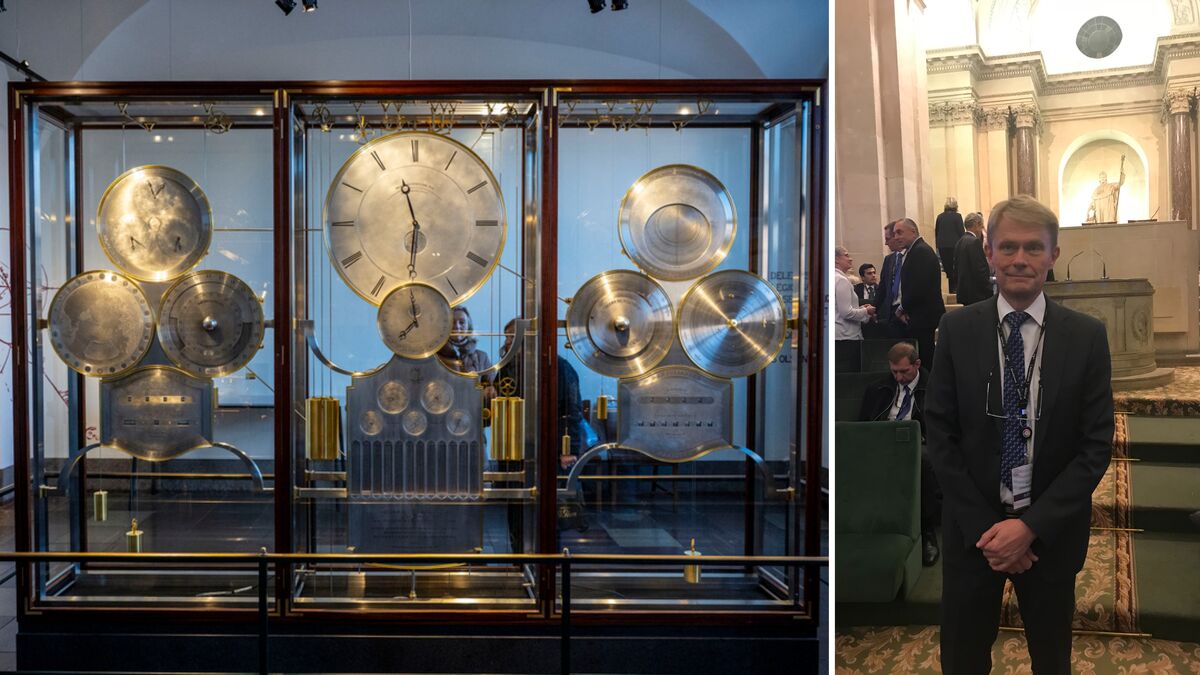
The General Conference on Weights and Measures (CGPM) is meeting in Versailles, France, to discuss how to eliminate the leap second. It may have passed most people by, but on 27 occasions since the 1970s, an extra second has been added to the UTC world clock.
In the past, the definition of the second and our time system were based on the Earth’s rotation, explains Jan Johansson.
Earth’s rotation and atomic clocks
One second was defined as 1/86,400 of the average time it takes the Earth to rotate once, so that the Sun is in the same position in the sky. But that proved too imprecise. The Earth’s rotation changes, albeit marginally.
Then they switched to atomic time, using cesium atomic clocks, which are much more stable, says Johansson.
For a long time, people wanted atomic time and the Earth’s rotation to be synchronized. Since the Earth usually slowed down, the solution was to occasionally add a leap second when the difference between the two became too large.
It has to do with our perception of night and day and when the sun is highest in the sky and things like that. They wanted to keep this thing about the rotation of the earth and the length of the day anyway, even though they had atomic time.
Leap seconds were introduced following a decision by the IERS (International Earth Rotation and Reference Systems Service), with six months’ notice, and clockmakers around the world then had to comply. But in recent years, leap seconds have caused problems. In 2012, Reddit, LinkedIn and airline Qantas’ booking system crashed.
Several tech companies and organizations have protested against leap seconds. None have been introduced since 2016, and the current proposal is that none will be introduced in the future either.
Missed by no one
What is particularly troubling is that the Earth has been accelerating in recent years, which could mean a negative leap second is needed for the first time - meaning that a second is removed.
It has never been tested, so there is a big risk that something could go wrong somewhere in all these systems, says Jan Johansson.
So who will miss the leap second?
"Probably no one," he says with a laugh.
There is still a limit to how much the time of day can be allowed to drift.
You can let the seconds tick away until they add up to 3,600 seconds, or one hour, before correcting for it, says Johansson.
A possible leap hour could then be introduced sometime in the future - perhaps in the next millennium.
Fact: Three different clocks show the time
Earth’s rotation: Time was long based on the Earth’s rotation. A second was then defined as one 86,400th (60 x 60 x 24) of a day.
Atomic time: Atomic clocks have measured time since the 1950s. Since the 1960s, one second has been defined as 9,192,631,770 oscillations of the cesium-133 atom. The difference between an Earth day and an atomic-time day can be a few milliseconds per day, which add up to seconds over time. Atomic time is calculated using data from hundreds of atomic clocks around the world.
UTC: Coordinated Universal Time was introduced on January 1, 1960, to align atomic time with the Earth’s rotation. Leap seconds have been added 27 times since 1972. The most recent was introduced in 2016. The difference between atomic time and UTC is 37 seconds.








What do you think?