The camera pans from high-rise to high-rise, from window to window, where everyday life goes on in the Israeli metropolis of Tel Aviv.
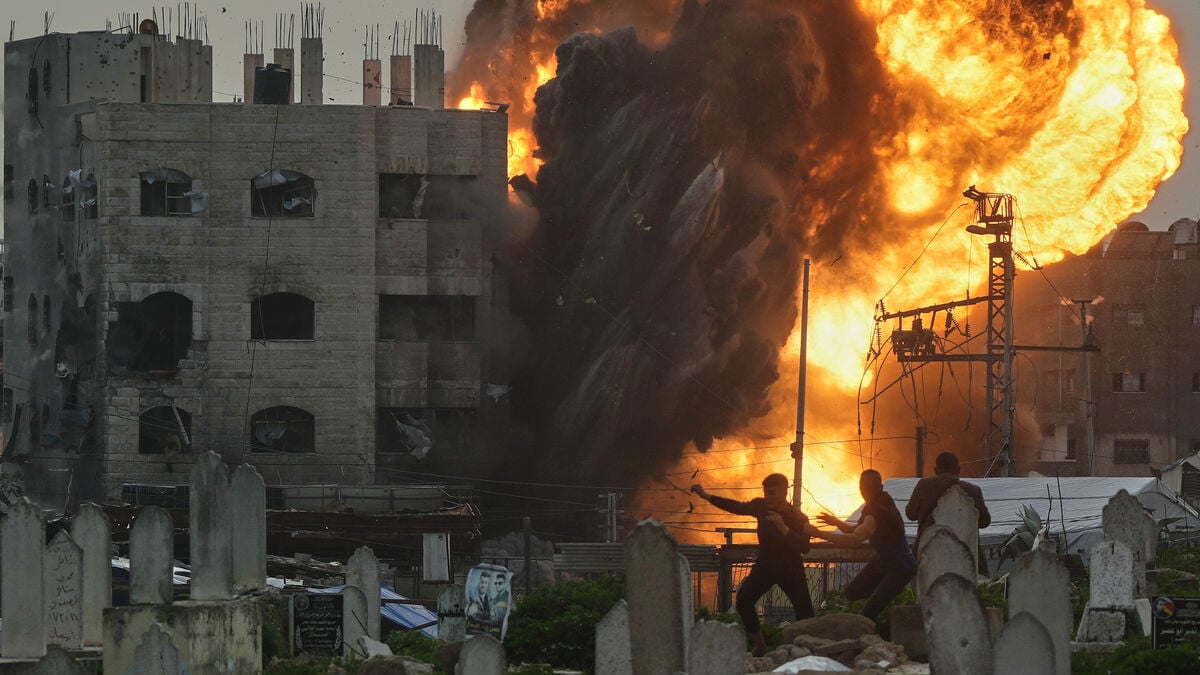
Sixty miles away, in the Gaza Strip, almost every high-rise building has been razed to the ground. More than 73,000 people have been reported killed in a war that has left Palestinian communities in ruins.
The attacks have been carried out in a systematic and calculated manner, 24 anonymous Israeli military personnel testify in the acclaimed documentary film "Naza".
"We could bomb an entire house filled with 'Naza' to kill a single insignificant Hamas person," one of them says in the film.
Monitored in detail
"Naza" roughly means collateral damage and is a label that the Israeli military reportedly applies to civilian deaths - in detailed calculations made of how many people are thought to be killed in bombings of individual buildings.
The military explains how it works. Through mass surveillance of phones, individual Palestinians are followed and graded based on how likely they are to be considered targets. Algorithms are fed information - conversations, movements, contacts - to assess whether there is a connection to Hamas.
One interface tracks Gaza's streets and buildings in real time ahead of the attacks. In one case, the military hacked a twelve-year-old girl's phone and learned from her when her father would be home. The family was then bombed.
Every 30 minutes or so I received a notification that there was a Hamas person who could be bombed, says one of the sources in the film, and several of them testify that a large margin of error was allowed, sometimes with tens or hundreds more deaths.
Record applause
When the documentary was shown at the Venice Film Festival recently, the filmmakers were applauded for about 25 minutes afterwards. In Israel, they were branded as traitors at the highest political level, even before anyone there had seen the film.
The military will investigate the whistleblowers and Prime Minister Benjamin Netanyahu is open to revoking the citizenship of anyone who “defames the military.” Angry protesters have gathered outside the parental home of one of the filmmakers.
Israel goes to the polls at the end of October, and even opposition leaders challenging Netanyahu have condemned the film. The military rejects the film's testimonies and insists it is doing everything it can to minimize civilian deaths.
In the film, the whistleblowers support many accusations that have been made against Israel during the war, such as that they have deliberately bombed Gaza's settlements and shot dead scores of unarmed people who have been queuing for supplies.
“Naza” is directed by Yuval Abraham and Rachel Szor, who previously directed the documentary “No other land” (2024) about Israeli settlements and forced displacement in the occupied West Bank.
The directors say they are starting from two questions that have been asked for generations: "How can one group of people allow another group to be completely dehumanized? What do the internal mechanisms of such a system look like?"
The film is produced by the British newspaper The Guardian and producer James Wilson's company JW Films. It is also based on media reporting from The Guardian, +972 Magazine and the Hebrew news site Local Call.
Executive producer is Jonathan Glazer, award-winning for, among other things, "Zone of Interest" (2023).
“Naza” will have its international theatrical release around the turn of September/October and will be released in Swedish cinemas from October 1, through Folkets Bio. At the end of November, it will be available to watch on The Guardian’s website.