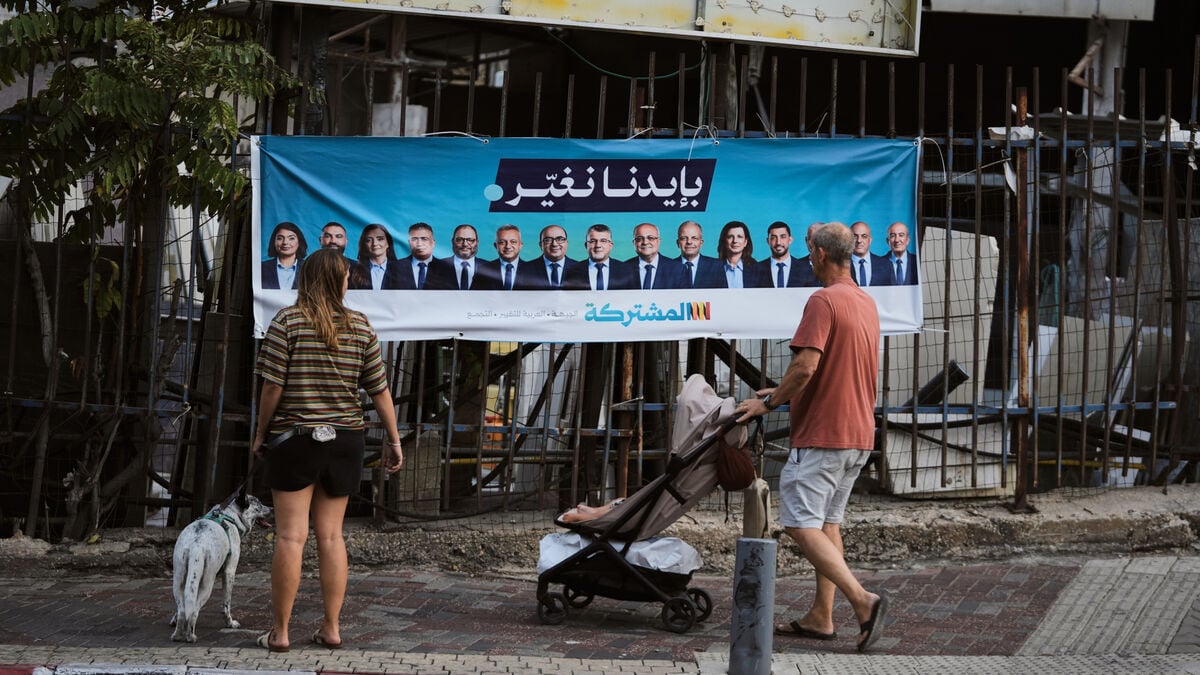
There appears to be a stalemate in the Knesset between Israel’s two blocs - those for and against incumbent Prime Minister Benjamin Netanyahu. But alongside them, a third bloc has emerged: the Arab parties Joint List and Ra’am.
They are part of Israeli society and want greater political influence, says Isabell Schierenbeck, professor of political science at the University of Gothenburg.
Gadi Eisenkot, an opposition leader, will be forced to cooperate with the Arab parties or enter a coalition government with Netanyahu, notes Anders Persson, lecturer in political science at Linnaeus University.
“Democratic success”
Israel is often described as the Middle East’s only democracy. The fact that the Arab minority is increasing its number of seats in parliament is a victory in that sense, according to Persson.
It is considered a major democratic success when minority groups vote in large numbers.
No main bloc was open to cooperating with the Arab Israelis during the election campaign, even though they appear to be kingmakers. Most of the votes on the Arab side went to the Joint List - an alliance of three different parties.
One party is almost communist, and the other two are nationalist, says Persson.
Ra’am, in turn, is a conservative Islamist party and was the first Arab party to be part of an Israeli government, for a short period in 2021.
A divided country
Israelis of Arab, often Palestinian, origin make up just over 20 percent of the population. Yousef Jabareen, leader of Hadash, part of the Joint List, is calling for greater Jewish-Arab cooperation.
"We will need to be talked to to secure the path to change that the Israeli public longs for," he said on election day.
Yair Golan, leader of the opposition Democratic Party, has appealed for such cooperation - to “serve all” Israelis.
He is the only one who extends a hand, but he also stands farthest to the left, says Persson of Golan.
Another complicating factor in forming a government is Israel’s war in Gaza and the region - something the Arab parties are believed to oppose, even if they do not talk about it much.
More Arabs vote
The Netanyahu government’s cuts to crime prevention measures in Arab-Israeli communities are one reason for the rise of the Arab parties, according to Isabell Schierenbeck.
"Crime in these cities and towns has gone up a lot and the death toll has completely skyrocketed. People are extremely worried and very angry," she says.
Facts: Israel’s population
Israel has just over 10 million inhabitants, according to statistics compiled in 2024.
So-called Arab Israelis make up 21 percent of the population. Just over 17 percent have Israeli citizenship and 4 percent live in East Jerusalem and have permanent residency.
There are a total of 163 Arab local governments in Israel. The two largest Arab cities are Rahat and Nazareth.
A majority of Arab Israelis are Muslim (83.2 percent). Other groups are Druze, Christians and Bedouins. Many Arab Israelis identify as Palestinian, but this varies.
Israel’s parliament, the Knesset, has 120 seats. After Tuesday’s election, the Arab parties Joint List and Ra’am look set to win a combined 19 seats. Neither of the two main blocs - Prime Minister Benjamin Netanyahu’s and an opposition “change bloc” - looks set to win a majority of its own (61 seats).
Source: The Israel Democracy Institute, Israel Central Bureau of Statistics (CBS).