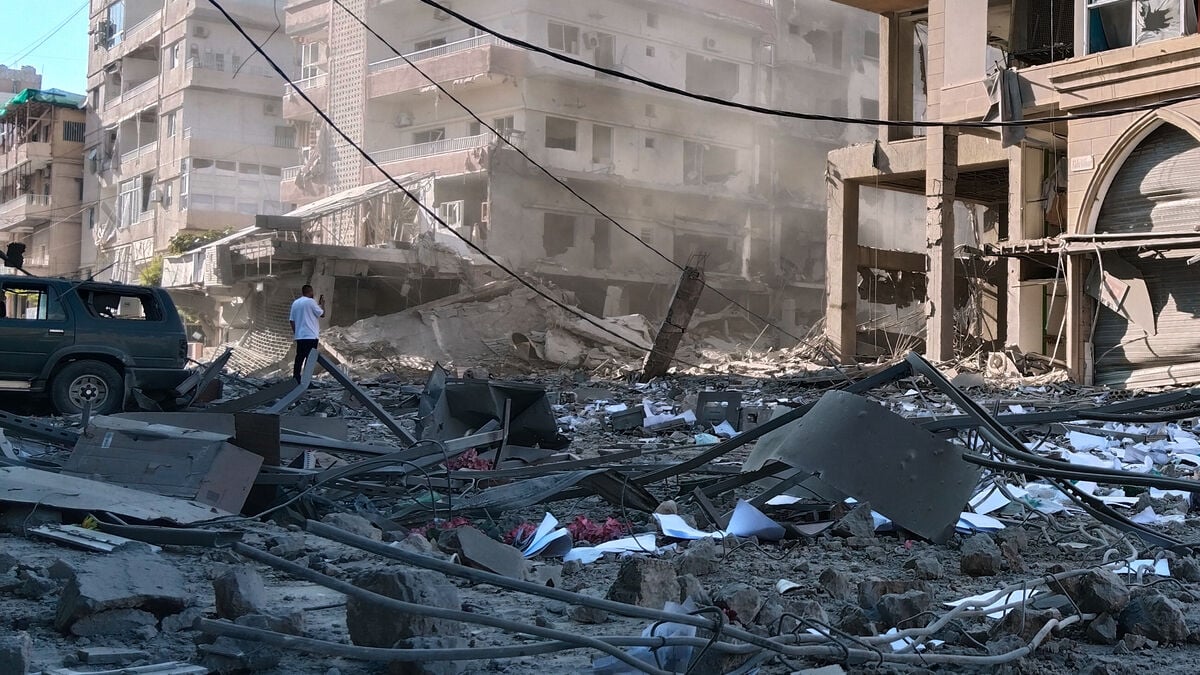
Israeli forces are advancing further into southern Lebanon, beyond previous border demarcations.
The IDF (Israeli military) is operational with large forces on the ground and occupying forward positions, Prime Minister Benjamin Netanyahu said in a video clip.
Over a million people have been displaced northward in Lebanon. Buildings are being bulldozed. The divided country's government accuses Israel of wanting to destroy everything so that no one can live there.
Iran was reported on Monday to have suspended negotiations with the United States in protest against Israel's military actions.
“Positive side effect”
The US-brokered ceasefire between Israel and Lebanon in April has not played a major role. It did not include Israel's main adversary, the Shiite movement Hezbollah, and Israel launched new offensives after rocket attacks from Lebanese soil.
All of this is happening on the sidelines of the war with Iran and has a major bearing on the protracted negotiations between the US and Iran. The US has wanted to keep the two wars separate, while Iran has demanded that an agreement bring peace to Lebanon as well.
This gives Israel a strong reason to try to secure as much territory and benefits as possible before any demands come from Washington, says Aron Lund, Middle East analyst at the Swedish National Defense Research Institute.
And besides, Israel doesn't want an agreement between the US and Iran, so if the situation in Lebanon escalates it could disrupt the negotiations - a kind of positive side effect for Israel.
More offensive
Israel is not close to its overall goal of completely subduing Hezbollah. The Shiite movement has begun attacking Israel with harder-to-stop drones.
They fight for Iran on some level, but since Israel's invasion, they are also fighting in a very concrete way for their home areas. I think that, to a greater extent than Iran, is something that motivates many of the members, says Aron Lund.
Where previous US administrations have advocated relative stability in Lebanon, the current government seems to see influential Hezbollah as a problem that needs to be eliminated rather than managed, according to Lund:
It is unclear whether this can be done without tearing Lebanon apart or starting a civil war there. The US has previously wanted to avoid this, but the Trump administration is not so careful about such things.