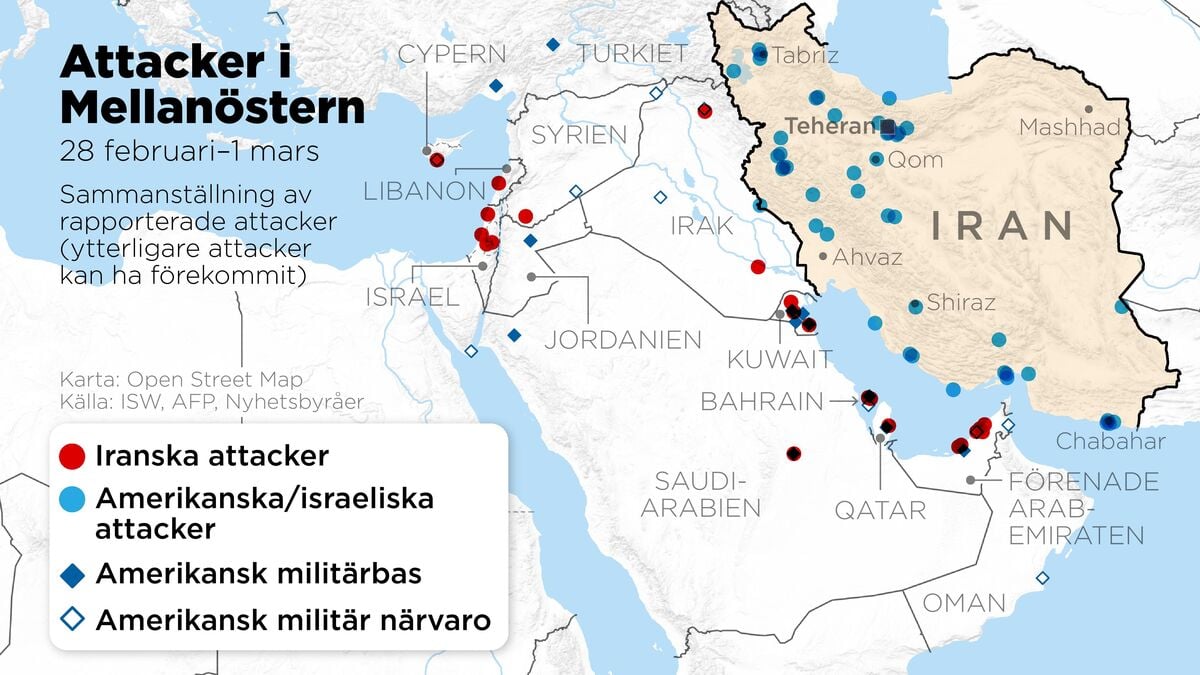
The Israeli military is again warning of attacks against Iran, posting messages about further waves of strikes after recent attacks, including hits on more than ten targets belonging to the Iranian intelligence service and military.
Explosions were also heard during the day in an area of Isfahan that houses a nuclear power plant and an air base, Reuters reports. Iran also accuses the United States of attacking the Natanz nuclear facility twice on Sunday, state Iranian media reports. However, the UN atomic energy agency, the IAEA, says it has seen no signs that any nuclear power plants have been hit.
US President Donald Trump warns that more and much more powerful attacks are to be expected.
"We haven't even started hitting them with force yet. The big wave hasn't come. It's coming soon," he tells CNN, claiming the US is "beating the crap out of" Iran.
Does not rule out ground troops
Trump also tells the New York Post that he is not completely ruling out sending American ground troops to Iran.
"As every president says, 'there will be no ground troops.' I'm not saying that. I'm saying, 'We probably don't need them,'" Trump told the newspaper.
The Iranian regime has vowed to fight back with greater force than ever before. However, a large part of the country's leadership has been killed in the attacks, as well as the Supreme Leader, Ayatollah Ali Khamenei, and his wife.
It is clear that the death of the ayatollah does not mean that Iran will stop attacking. On the contrary, they will become more reckless and ruthless, Prime Minister Keir Starmer said in the British Parliament.
Closing the Strait of Hormuz
Iran's counterattacks have been directed at American targets and bases in the region, but missiles and drones have struck in more places: an oil tanker in the Gulf of Oman, a power plant in Qatar, a British air base in Cyprus, and an air base and oil refinery in Saudi Arabia.
Iran's Revolutionary Guard also states, according to state Iranian media, that it is closing the Strait of Hormuz and will "set fire to" any ships that try to pass through.
"We will not allow a single drop of oil to leave the region," said Ebrahim Jabbari, an adviser to the Revolutionary Guard, according to Bloomberg.
At least six American soldiers stationed in the Persian Gulf have been killed in Iran's counterattack so far, with two new deaths reported on Monday evening.
The aid organization Red Crescent in Iran stated on Monday morning that at least 555 people have been killed there since Saturday.
Background: How the Iran War Started
On February 28, the United States and Israel attacked Iran without the support of the UN Security Council. The attack was described as a preemptive strike to prevent the country from developing nuclear weapons. Iran's Supreme Leader Ayatollah Ali Khamenei and several other leaders were killed in the bombings.
A year earlier, in March 2025, US President Donald Trump had sent a letter to the Ayatollah to initiate new negotiations over Iran's suspected nuclear weapons program. Five meetings were held but with no results.
On June 22, the United States entered the war between Israel and Iran and bombed three nuclear energy facilities in Iran.
In September, previous UN sanctions on Iran were reimposed. The economy deteriorated and popular protests erupted before the turn of the year. Trump said he was prepared to intervene on the side of the protesters when they were killed in their thousands - but that did not happen.
In early 2026, US military forces gathered in Iran's vicinity. New negotiations began on February 3, without results.