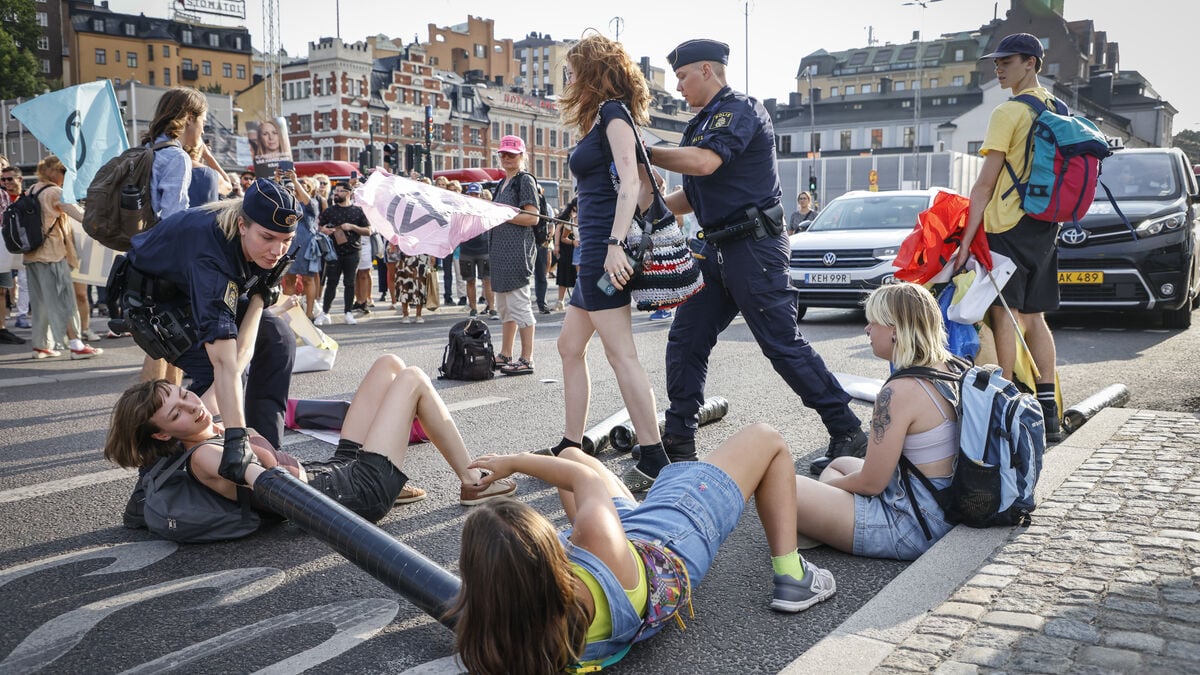
The activists accuse Sweden of violating freedom of expression and assembly by putting activists on trial, and call the case Rosamålet.
The case's representative, Viktor Jonsson, believes this is legal persecution that makes people afraid to protest.
"We see that people no longer dare to demonstrate. We are being fined, detained and now, as we have seen in recent years, people are actually receiving prison sentences," he says in connection with the application being submitted to Stockholm District Court on Tuesday.
Has been indicted four times
Janine O'Keeffe is one of the climate activists who hopes the lawsuit will lead to substantial damages. She has participated in several demonstrations. These included preventing traffic on the E4 and the Central Bridge in Stockholm, a protest that forced the bank SEB to cancel its general meeting, and an action at Bromma Airport.
"They said we had committed sabotage, but we hadn't. All I had done was hold a microphone. So I was one of 15 who were acquitted," says O'Keeffe.
Two people were convicted earlier in May for the action against Bromma, where red paint was thrown at a building, an airplane and several cars.
Criticism of Sweden
The Rosamålet claims that the police's actions at several demonstrations, as well as the legal cases themselves, violate laws and international conventions. According to the press release, 388 activists have been suspected of crimes since 2020.
Sweden has also been criticized by human rights organizations. John Stausser, chief legal officer for Civil Rights Defenders, describes a trend where demonstrations are being criminalized as protesters face increasingly harsh prosecutions.
It affects the willingness and ability to participate in demonstrations and to exercise one's freedom of expression, which is a threat to constitutionally protected rights, says John Stausser, chief legal officer for Civil Rights Defenders.
The Chancellor of Justice, who usually represents the state in damages cases, declined to comment on the case.