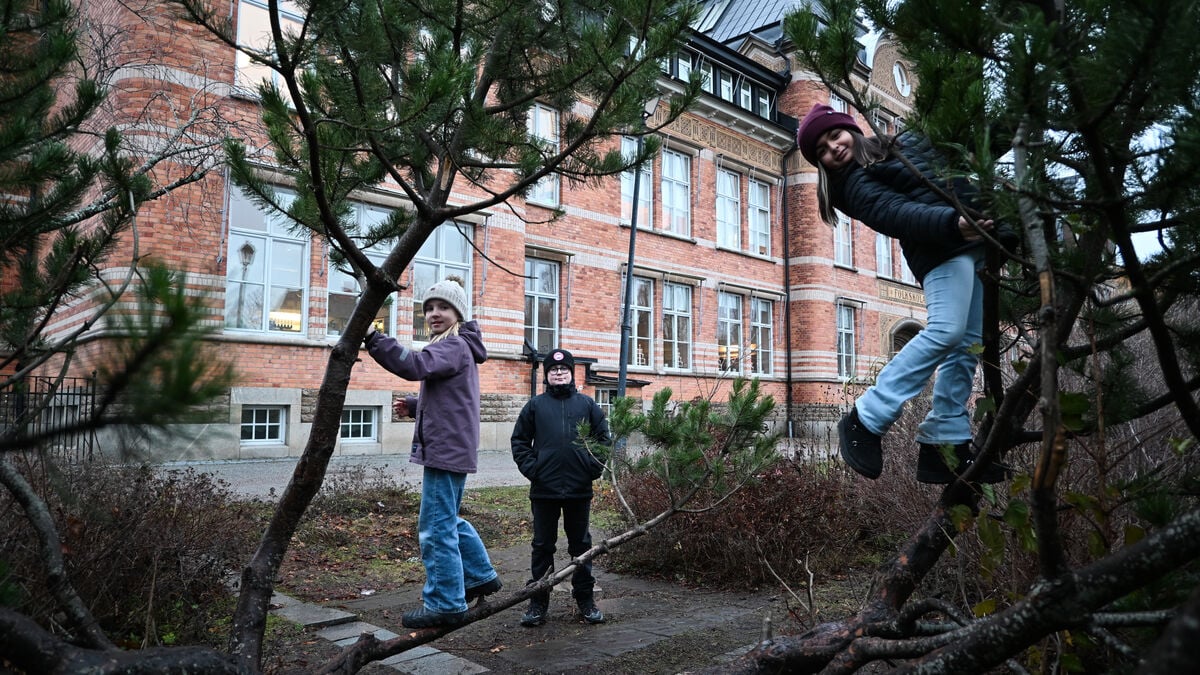
The Advent candles are lit in the windows at Herrgärdsskolan. But in the schoolyard the snow is conspicuous by its absence. In Sweden, there have been 20 fewer days of snow on the ground in the last five winters, compared to the second half of the 1990s.
"It feels more like autumn. I would describe it as cold, but also kind of boring," says Frank Wiman, who is in fifth grade.
His dad usually says that there was more snow in Västerås in the past.
"I can understand it with climate change and stuff. But it feels a bit unfair," he says.
Classmates Elise Kahlin and Greta Wiberg in second grade think that breaks would have been more fun with snow.
Now that the sand is completely frozen, we can't do anything, says Greta Wiberg.
"If you look out the window, there's no snow, it's just slush. You can't make lanterns out of slush," says Elise Kahlin.
Saving last year's snow
In a parking lot outside Vedbobacken just outside Västerås, Ingrid Tillander, 50, is picking out her cross-country skis. The temperature is seven degrees Celsius.
I've lived in Västerås since I was little. If I compare it to then, I remember there being a lot more snow when I was little.
She and other Västerås residents remember correctly. Between 1950 and 1999, SMHI's weather station reported an average of 88 days with snow cover during the winters. In the last five years, it has been 37. The decline is among the highest for SMHI's stations.
In addition to the cross-country trails, Vedbobacken also has a ski slope. Facility manager Martin Landås says he doesn't notice that the winters have changed. However, the facility is taking into account warmer winters. A new dam makes it possible to spray out 400 cubic meters of snow per hour on chilly days. The facility would not be able to do without it, and the snow that is saved over the summer allows them to be able to open on a certain date regardless of what the mercury is.
You could say that we have future-proofed the facility.
“Affected a lot”
Some who also depend on the winters are the outdoor center Aktivt Uteliv, which sells and rents out ski equipment and skates and organizes courses. Co-owner Mathias Bernövall says that the season has become shorter. It is important to be prepared when winter comes, because then customers flock quickly.
"We are being affected a lot. Winter has to almost get under way for our business to pick up. We're just standing around and waiting," he says.
TT has reviewed data for the number of days with snow cover per winter for SMHI's 37 weather stations 1950–2025.
Based on this, an average value for five-year periods has been developed, where the last five winters have been compared with the period 1950–1999.
The stations that have had the largest decrease in the comparison are Kristianstad, followed by Västerås, Lund, Ulricehamn and Kalmar. Some stations in the north, including Piteå, have had more days with snow.
On average, just over every fourth snow day has disappeared, a total of 20 days in the country during the time period.