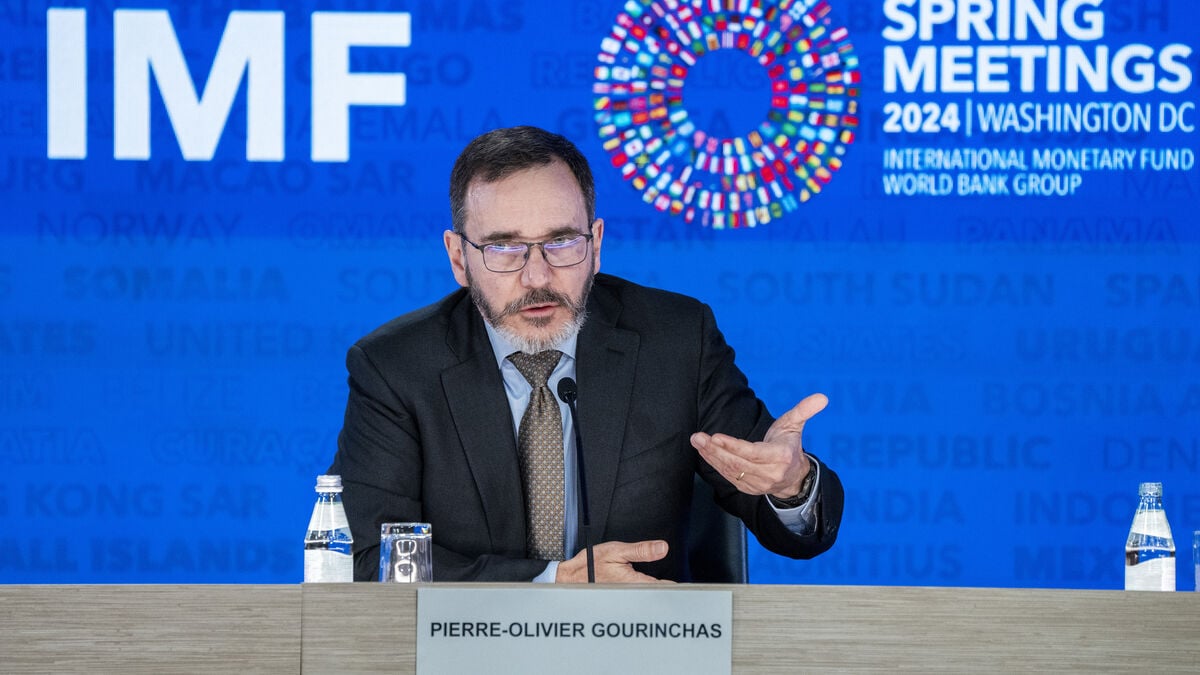
"The risks are clearly dominated by downside risks," write the IMF economists.
"Some downside risks have become more prominent since the forecast update in January 2026, particularly those related to a more protracted conflict in the Middle East," they add in the World Economic Outlook, which is presented in connection with the IMF's spring meeting in Washington.
Could be the worst crisis since the pandemic
A severe scenario outlined by the IMF in the report paints a picture of a major energy crisis with significant effects on global output. It could drag global growth this year to 1.3 percent – which IMF economists say can be defined as a "global recession".
The upward pressure on inflation would also be significantly more noticeable in this scenario, with global price increases of 5.8 percent at an annual rate in 2026 and 6.2 percent in 2027.
Similar global economic crises have only occurred four times in the last 45 years - including during the pandemic and in connection with the global financial crisis of 2008 - according to the IMF.
In the main scenario - which assumes that the Iran war ends fairly soon and does not lead to any sustained major economic disruptions - growth slows to 3.1 percent this year and 3.2 percent in 2027. This compares with last year's 3.4 percent.
The inflation forecast is raised by 0.2 percentage points to 4.4 percent in 2026 and 3.7 percent in 2027.
The Middle East conflict is wiping out what could have been a global recovery, according to the IMF. It involves higher commodity prices, higher inflation expectations and financial unrest - but also disruptions in supply chains, shortages and currency turbulence.
Lowered forecast for trade
The IMF's forecast for global trade growth is lowered to 2.8 percent this year in the main scenario - down from last year's 5.1 percent. A slight recovery to trade growth of 3.8 percent is expected in 2027.
The IMF's forecast for Swedish growth is 2.0 percent this year and 1.9 percent in 2027, up from 1.5 percent last year. This compares with the Swedish Central Bank's 2.5 and 2.6 percent, respectively, and the government's 2.8 and 2.5 percent, respectively.
"I share the IMF's view of global developments, which broadly aligns with the government's forecasts. I also share the IMF's risk picture, and that uncertainty about future developments is high, especially given the war in the Middle East," says Finance Minister Elisabeth Svantesson in a comment to TT.
According to the IMF, Swedish inflation is expected to fall to 1.5 percent this year and rebound to 1.8 percent in 2027, down from 2.6 percent last year. The Swedish Central Bank expects 0.8 and 2.0 percent, respectively, while the government in its spring budget assumed 0.5 and 1.7 percent, respectively.
In the IMF's main scenario in the new edition of the World Economic Outlook, the forecast for global growth is 3.1 percent this year and 3.2 percent in 2027. This can be compared with a forecast update in January - before the Iran war - when the forecast for this year's growth was 3.3 percent.
For the eurozone, the IMF lowers the growth forecast in the main scenario by 0.2 percentage points in both 2026 and 2027, to 1.1 and 1.2 percent, respectively. The forecast for the United Kingdom takes an even bigger hit, down by 0.5 percentage points this year to 0.8 percent.
For the United States, this year's growth forecast is lowered by 0.1 percentage points to 2.3 percent, while the forecast for 2027 is raised by 0.1 percentage points to 2.1 percent.
China's growth forecast is lowered by 0.1 percentage points this year to 4.4 percent, while the forecast for next year is left unchanged at 4.0 percent.
Source: IMF, World Economic Outlook (April 2026)