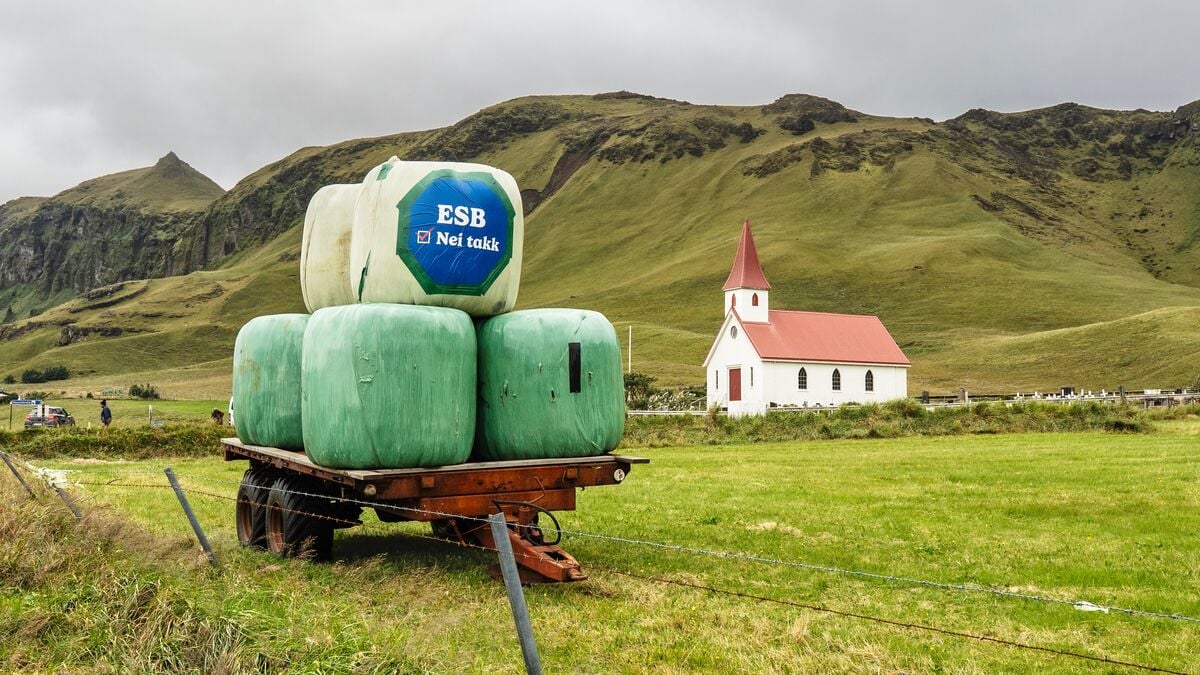
It has been over a decade since a Eurosceptic Icelandic government withdrew the country's application for membership in the Union in 2013. Since then, a more EU-friendly government has come into office and the world has changed radically.
And with it, the debate in Iceland.
"It is primarily about the US aggression against Greenland, which is our closest neighbour. All the arguments from the US president about why it is necessary to acquire Greenland can also be applied to Iceland," says Eiríkur Bergmann, professor of politics at Bifröst University in Iceland, at a digital seminar.
Iceland does not have its own military, relying instead on NATO membership and a bilateral defence agreement with the United States - an agreement that many Icelanders are now beginning to question, according to Bergmann. Prime Minister Kristrún Frostadóttir has also raised the US tariff war as an argument for joining the EU.
“Larger family”
But it is not a simple question. For Iceland, which only became independent in 1944, it is an existential one. Some see EU membership as a loss of the freedom they fought so hard for, and polls ahead of the vote show that Icelanders are deeply divided.
"Why would we want to join the EU? What would we get out of it, when things are already good?" 33-year-old office worker Vilborg Inga Magnúsdóttir told AFP.
Among the yes camp, the country's rising inflation and the security situation are leading arguments. Horse breeder Hrafnkell Gudnason will vote yes.
"It is becoming more and more dangerous for a small country to be outside the EU. I think it is safer to be part of a larger family," the 59-year-old told AFP.
Fishing decides
If the vote is yes, difficult discussions with Brussels await, especially on the fisheries issue - and at a later stage, a second referendum on the agreement itself. According to Eiríkur Bergmann, such a vote will likely be decided by fisheries.
"Iceland's economy is totally dependent on fishing. It is a fundamental part of our economic survival. If we don't find a solution where Iceland retains both formal and practical control over its fishing waters, the voters will never accept it," he says.
Icelandic polling stations are open between 9 a.m. (11 a.m. Swedish time) and 10 p.m. (midnight). Preliminary results are expected shortly after closing; final results likely early Sunday.
Iceland is by far the smallest country in the Nordic region in terms of population. Just under 400,000 people live in the island nation, fewer than in Gothenburg, for example.
The country is not a member of the EU, but has access to the EU's internal market through the European Economic Area (EEA). The EEA also includes Norway and Liechtenstein.
The boundary between the North American and Eurasian tectonic plates runs right through Iceland. This location means that the country has an extremely high level of geological activity, and the many volcanic eruptions are a constant scourge. For example, an eruption in the 18th century led to the death of a quarter of the population.
Nowadays, the energy-rich underground has the most positive consequences. Iceland gets much of its heat and electricity from there, and the dramatic nature contributes to tourism being one of the country's most important industries.
However, fishing is traditionally the most important. Fish and seafood products account for a significant part of Iceland's exports.