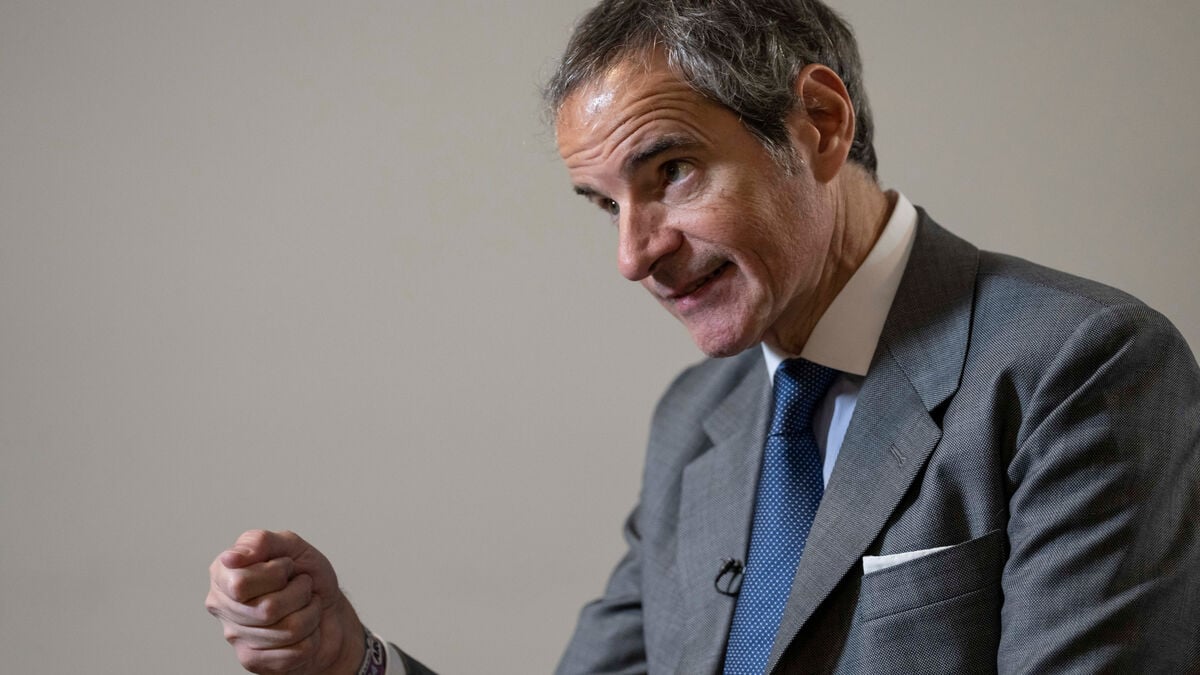
"I can understand political statements, they are part of reality, but the fundamental thing I want to remind you and draw your attention to is that there is a declaration of intent that has been signed by both presidents," said Argentine IAEA Director General Rafael Grossi, according to AP.
According to him, the letter of intent makes it clear what applies. As Grossi described it, it explicitly states that the IAEA will oversee "the activity that will be carried out regarding facilities with nuclear material."
Kazem Gharibabadi, Iran's deputy foreign minister, said this is not currently the case. He wrote on social media that Grossi requested a meeting in connection with this weekend's negotiations in Switzerland, but that no such meeting took place.
"These issues will be addressed and resolved only within the framework of a final agreement and as a result of practical steps by the other side to end all sanctions and other commitments," wrote Gharibabadi.
Pulling in different directions
The statement of intent sets out a direction for continued negotiations on a peace settlement between the US and Iran. But the text leaves a lot of room for negotiation on the major issues, and it is already clear that the parties have widely different interpretations of what is written.
The issue of Iran's nuclear programme is directly linked to the US promises to lift the burdensome sanctions against Iran. The countries are to agree on a timetable in which the two issues are resolved in parallel.
US Vice President JD Vance has said that Iran has promised to allow IAEA inspectors to visit the country's nuclear facilities - but this was flatly denied by the State Department in Tehran.
Shortly afterwards, US President Donald Trump took to social media and proclaimed that Iran had indeed agreed to nuclear inspections "at the very highest level" and for a long time to come - "forever!!!".
Handled on site?
The US president has previously said that Iran should not be allowed to have any uranium at all, but the declaration of intent and the negotiations no longer make such categorical demands.
In paragraph 8 of 14 of the document, it is stated that Iran's highly enriched uranium will at the very least be handled by diluting the material and giving it a lower content "on site under IAEA review."
To be able to do that, we need, of course, to inspect. Whether it happens the day after tomorrow or in a week or in ten days is important, but not decisive. This will happen," said Rafael Grossi.
In 2015, the nuclear deal JCPOA was signed between Iran and the "P5+1" - the five permanent members of the UN Security Council (France, China, the UK, Russia and the US) plus Germany and the EU.
Iran would be allowed to enrich a limited amount of uranium to a relatively low level (3.67 percent), far below that required for nuclear weapons, but sufficient for civilian purposes. About 98 percent of Iran's then uranium stockpile was sent abroad. The outside world would be given greater transparency. In exchange, sanctions would be lifted.
In 2018, US President Donald Trump decided to withdraw from the agreement and impose stricter sanctions. Iran responded by stepping up its enrichment and stockpiles of uranium.
In recent years of escalation and war, the US has previously demanded that Iran stop enriching uranium altogether. Iran has objected that all countries that have signed the Nuclear Non-Proliferation Treaty have the right to enrich uranium for civilian purposes.
According to the UN's International Atomic Energy Agency (IAEA), Iran had enriched around 440 kilograms of uranium to 60 percent before the 12-day war in 2025. Nuclear weapons usually require an enrichment level of at least 90 percent.