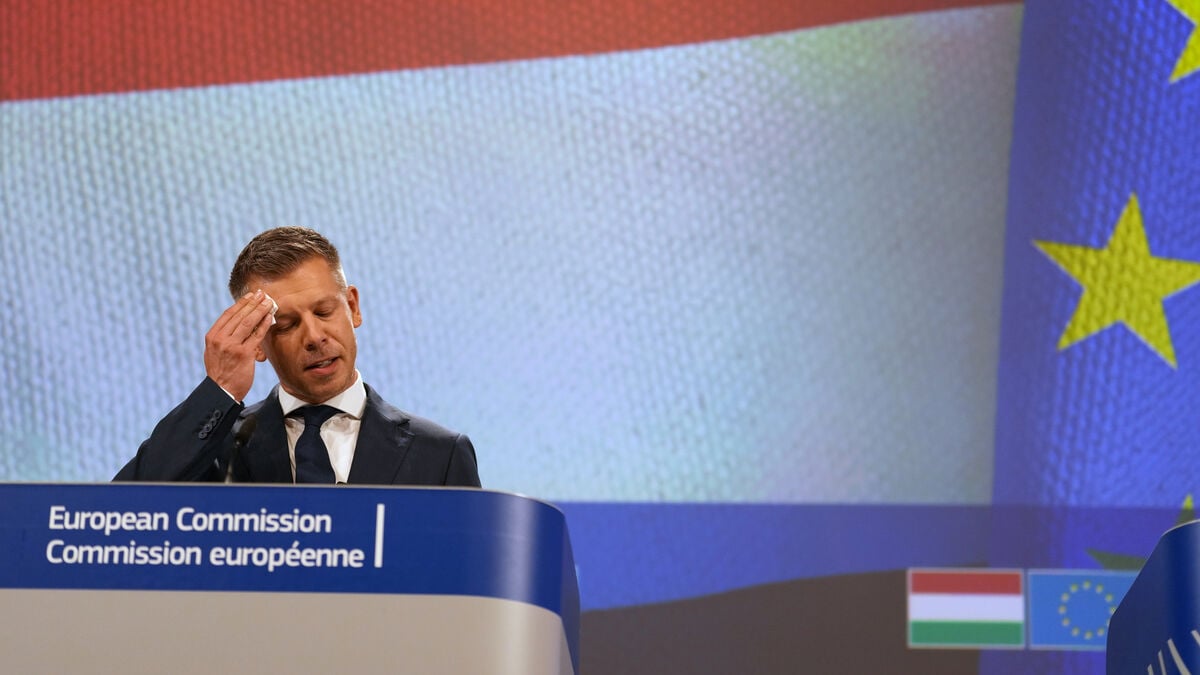
In the April elections, Hungarians put an end to Viktor Orbán's time in power.
Together we have liberated Hungary, proclaimed Péter Magyar as his Tisza party won a landslide victory with promises to set out on a democratic path again.
As prime minister, Magyar has unusually great power: an overwhelming majority in parliament and the ability to rewrite the constitution on his own initiative.
Partly, he is in a hurry: by August at the latest, several foundations for a free Hungarian society should have been reestablished so that the country can receive enormous EU support that has been frozen due to the previous regime.
“Not quite there yet”
After the election, people sometimes ask, "What are you going to do now, when everything is resolved?" says Márta Pardavi, chairwoman of the human rights organization Hungarian Helsinki Committee, at a meeting with Sweden's Foreign Minister in Budapest, which TT also attended.
But we're not quite there yet, says Pardavi.
I hope that the improvements are implemented at all levels and not just in selected areas.
The payment of around a hundred billion euros from the EU is dangling like a carrot in front of Hungary's struggling government.
It has raised criticism and questions: How much can be accomplished in such a short time? Is it a political “reward” paid out far too early? And is Péter Magyar - who was previously in Orbán’s Fidesz party - as reform-minded as he claims?
Márta Pardavi sees the payments as crucial for Péter Magyar to be able to get the work started. Many Hungarians are struggling financially and want to see rapid steps forward.
If he offers freedoms but not greater prosperity, then it will be difficult. My gut feeling is that he needs the EU funding as soon as possible.
Out with the old
Péter Magyar wants to clean up the authorities, courts and state-owned companies that have been filled with Orbán loyalists.
Hungary is ranked as the most corrupt country in the EU. Large parts of the country's assets have over time been accumulated in a circle around the former prime minister.
But purges cannot be done lightly, or necessarily legally. It was in a similar way that Viktor Orbán justified his purges when he said he was dealing with remnants of the old communist regime.
Orbán also enjoyed a large majority, enacted a new constitution and then updated it 15 times. The new government has already put forward proposals for amendments.
That flexibility is necessary to be able to make changes here and now, but somewhere that appetite for change needs to end, says Márta Pardavi.
Charm offensive
While the ranks of civil servants are being filled with new people, dignitaries are being invited from the countries that have long been the most critical. First the Dutch foreign minister came to Budapest, and shortly afterwards Sweden's.
When Maria Malmer Stenergard (M) was received in the Foreign Ministry building on the west bank of the Danube in early June, the corridors were eerily quiet. Dozens or hundreds of civil servants had left their jobs.
"I really feel great expectations, but also great hope. This government wants to be part of the EU and wants to implement necessary reforms, not least regarding the principles of the rule of law," Malmer Stenergard told TT after meeting with Hungary's new Foreign Minister Anita Orbán (no relation to Viktor).
The strong majority gives the Magyar government the opportunity to implement “substantial changes,” Sweden’s Foreign Minister noted:
But it is a very powerful tool to have such a majority and it comes with great responsibility.
Anita Orbán did not give any comments or press conferences in connection with the meeting with Malmer Stenergard, citing a busy schedule.
Stop propaganda
The new government has otherwise promised a freer media landscape. State media have long been transformed into pure propaganda outlets and other major media outlets have been taken over by Orbán's chosen ones.
Péter Magyar has launched a frontal attack in interviews with state media, proclaiming that the “lie factories” will be stopped.
Now it is up to the media to find a new role in this. You cannot undo 16 years in just a few months, says Viktória Serdült, a journalist who works for the large and independent magazine HVG and other international media.
Serdült's main hope is that the country's journalists will be able to work in peace. When she reported from the Pride parade in Budapest last summer, she worried for the first time about her own safety at work, she says.
Growing interest
The authorities had banned the parade, but it was given local permission to be held anyway. Hundreds of thousands of people took part in what became a major protest against the government - but they were met with counter-protesters and a tense atmosphere.
This year, the parade was allowed, in a Budapest where rainbow flags can be seen here and there in the cityscape. The celebration took place this past week, despite extreme summer heat and without major trouble.
"State media contacted us recently because they wanted to report. That hasn't happened before," Kristóf Bartucz from the organizer of Budapest Pride told TT before the parade.
We thought about how we should treat them. Can we trust them? We try to be friendly and constructive, but trust is low.
As in previous years, they had sent invitations to the government offices, but no representatives showed up. Although the government is relatively liberal, it has so far not set foot on the core issues: legalizing same-sex marriage and adoption.
Follow-up questions await
Due to Hungarian resistance on these issues - and the country's refusal to accept refugees - further large amounts of EU money are being frozen.
But these are also issues that divide Hungarians. Péter Magyar, who is supposed to appease a broad electorate, has so far opted out. In the background, supporters of the former government demonstrate in long trains in Budapest.
One risk, as Márta Pardavi sees it, is that political anxiety creeps in and that the government begins to postpone promised reforms:
Then sooner or later we will have to stand there and speak out.
Facts: Race against time
The change of power in Hungary means that the country can receive large sums of money that have been frozen for several years. This will happen as Prime Minister Péter Magyar's government meets a list of demands from the European Commission.
In total, this amounts to around SEK 170 billion that has been withheld due to abuse of power and dismantling of the rule of law that occurred during Viktor Orbán's long rule.
The majority, just over 100 billion, is Hungary's share of the EU's recovery fund after the corona pandemic. That money has a strict deadline of August 31. In addition, there are billions from regional aid to the Union's poorer countries, and money that has been stopped when academic freedom in Hungary has been restricted.
The Magyar government is expected to, among other things, stop political control of the country's courts, take measures against corruption, advocate for more transparency, and dismantle complicated structures to which large parts of Hungary's public assets have been moved.