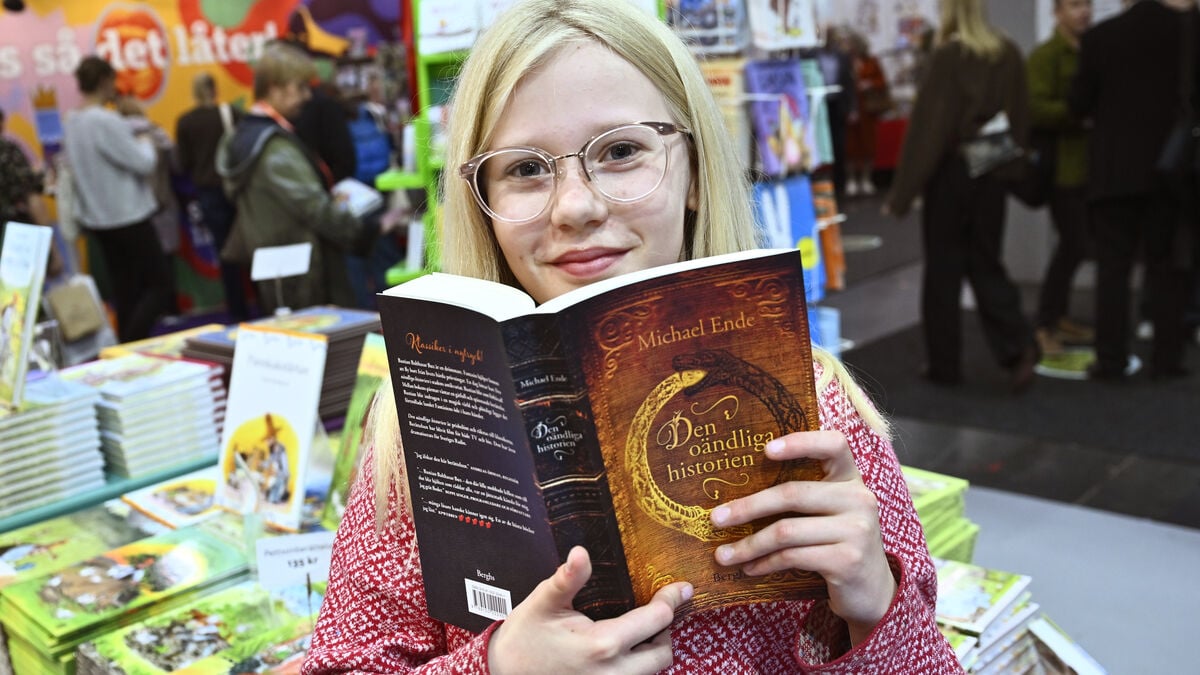
Cuddly children's book characters, crafts and soft sofas in every corner - the book fair's children's area has grown, and this year occupies a full 2,000 square metres. Here, 11-year-old Esther Alexandersson finds Michael Ende's "The Neverending Story" - which her father Olof Alexandersson read as a child.
You should find good books and decide for yourself, is her recipe for finding the love of reading.
She usually asks for tips from friends and at the library. Her father Olof nods; the family borrows about 70 books every two weeks for the three children at home.
Then they can try out what they like. It doesn't work if it's not fun.
The place of literature
At the fair, the reading crisis seems distant. But children are reading less and the differences in reading ability are increasing. After this year's disastrous PISA results, the OECD's education director said that a fundamental problem was "more reading on screens and less in-depth reading, less reading for pleasure (...)".
Reading is not just about decoding, emphasises Julia Pennlert, associate professor of literary studies at the Swedish School of Library and Information Science and director of a new centre for reading research at the University of Borås.
It's also about the place literature has in people's lives in general. Simply saying it's the screen's fault doesn't tell the whole story.
She sees that children are often left alone in their reading once they have cracked the reading code. But they need to see the adult world engaging in fiction. Reading aloud and reading together is important, she emphasises.
And going to the local public library, making sure there are books at home and introducing children to different types of reading material. You can read books, comic books - it can be an activity you can do together.
Books available
Julia Pennlert takes her children to the Book Fair herself; she thinks it is important to have places where you can experience literature together.
Being a reader today is not just about reading lots of books, she says.
At the fair, more people are talking about the importance of reading together. Letting children choose their own books is also fundamental, believes Sara Fagani, who is bringing her 8-year-old son Benjamin with her.
We try to find new books and series that interest him, and make sure that books that he likes are always available, she says.
Benjamin reads whenever he wants, before school or “when he eats”.
And your favourite genre?
"I like history and adventure the most. Like Tintin," he says.
Read together. Read aloud for a little while every day and also read silently next to each other, as a shared activity.
Make sure there is a variety of texts at home. Fiction, non-fiction, newspapers and comics - several reading researchers point out that it is good to read different types of texts.
Bribe the kids. In Singapore, citizens who read at least 15 minutes a day are paid by the authorities in a five-year initiative. Julia Pennlert says parents can try different ways to find motivation - bribes can work. But remember that it's not just the number of pages that matters, also talk about what you've read.
Try LitRPG - literary role-playing. The texts are structured like in the world of video games. At the fair, for example, author Ted Forsström will talk about his mission to reach guys who love fantasy, games and role-playing games but rarely open a book.
Go to libraries, writers' meetings and places where literature is discussed.
Source: The Guardian, Julia Pennlart, Ted Forsström