
There is a flurry of activity in the Norwegian high mountains. Skanska is building kilometres of tunnels here. The idea is to pump water up to the high-altitude mountain lake Illvatn in summer, when electricity prices are low, and then release it to generate electricity when prices are high.
Aluminium manufacturer Hydro, which has a factory nearby, is behind the billion-kroner investment, which will provide 107 gigawatt-hours annually. Critics have spoken out against the interventions in the sensitive mountain environment, while Hydro says it is trying to do as little damage as possible.
This contributes to stability in the energy system, and we use the regulating capacity of hydropower in relation to wind and solar power. We make that combination work better, says Jan Helge Mårdalen, Operations and Development Manager at Hydro Energi.
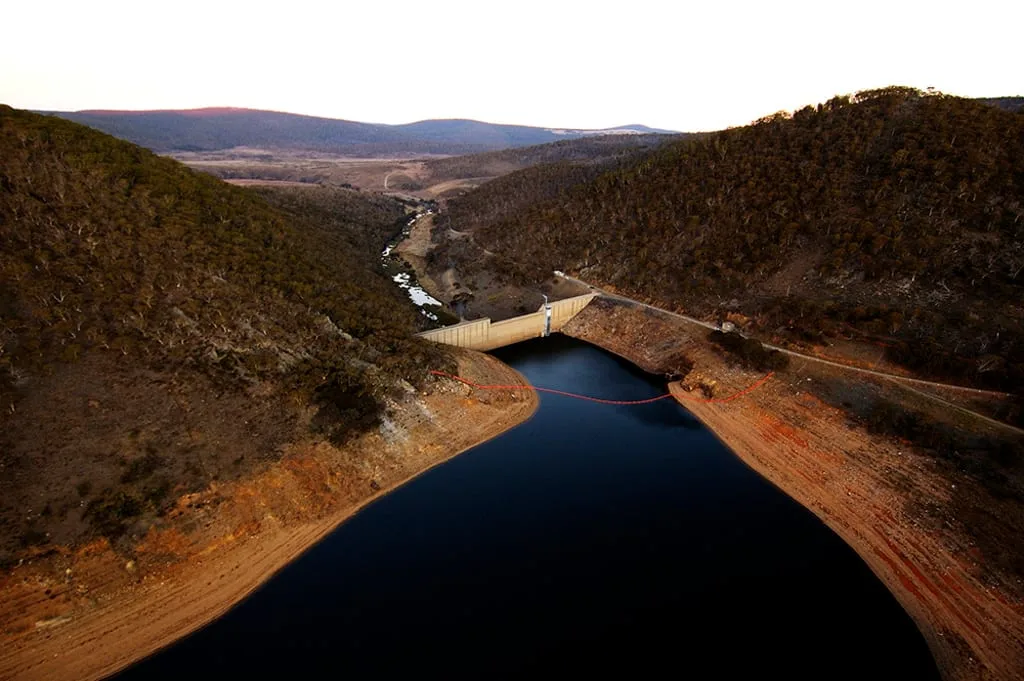
The advantage of pumped storage compared to battery storage is that storage can be done for longer, sometimes several months. Pictured is Lake Tantangara in the Snowy Mountains in Australia, part of a criticized multi-billion dollar project. Press photo.
800,000 sites
Using water as a battery is a technology attracting increasing interest as weather-dependent energy production expands. Sweden's ABB is involved in several projects in Europe.
"There is great interest globally, while Sweden so far has only a handful of projects in this area," says Karin Nilsson Malmén at ABB, one of the suppliers to the Hydro project.
Andrew Blakers, a professor of engineering at the Australian National University, sees enormous potential:
It is the same technology as conventional hydropower. The only difference is that instead of the water passing through once, it goes up and down a hill for a hundred years or so, he says.
In one project, he and his colleagues mapped potential sites and found 800,000.
That is equivalent to 2 trillion vehicle batteries. That is about 200 times more than the world would ever need, he says.
Expensive and delayed
The technology can be used in old mine shafts or mountain gorges. A drop of a few hundred metres is required, with a tunnel or pipe in between.
In principle, you need a pumping system to pump the water to the top, and then you let it flow down through the tunnel, where you have the generator, he says.
The energy loss is about 20 percent. According to Blakers, five giant plants with a capacity of 5,000 gigawatt-hours each would be enough to cope with power peaks and weather-related dips during Europe's winters.
In his home country, however, the giant project in the Snowy Mountains has seen its costs increase sixfold and has been delayed by several years. Blakers believes that cost increases "affect all large projects" and that the technology will be cheap in the long run.






What do you think?