For a long time, English wines were looked down on by connoisseurs. But as the climate in the country’s southern regions increasingly resembles that of Champagne in the 20th century, production has multiplied.
"Ten years ago, there were interesting sparkling wines in Sussex. Now there are also very exciting whites and reds," says Hervé Quénol, who works at the French research institute CNRS’s laboratory in New Zealand.
He researches how climate change affects local areas, and winegrowers are among those who are clearly noticing its effects.
In general, the impact is negative for the main wine-growing regions, with more extreme weather such as heat waves leading to wines with excessively high alcohol content, he says.
Growers in traditional wine regions have been forced to adapt in various ways. Winemaker Ulf Sjödin is product range manager at Systembolaget (Sweden’s state alcohol monopoly).
20 years ago, people cut grapevines to expose the grapes to the sun, so that they would get more sunlight and ripen. Now they do the opposite: they cover them and make sure there is always shade, because otherwise they will fry in the heat.
At the same time, the number of places where grapes can be grown is increasing. The key is that they must reach full maturity before winter arrives.
The extension of the grape-growing season, from March to September in New York, for example, means the grapes become ripe enough to produce quality wine, says Quénol, continuing:
In the last 20 years, new growing regions have emerged in northern Europe, such as Belgium, the Netherlands and Sweden.
Forced to adapt
Poland, Thailand and Morocco are on the rise, and countries like Denmark and Norway also have commercial cultivation. In Argentina, farms have started to appear in Patagonia in the south.
Ulf Sjödin has witnessed rapid changes since the turn of the millennium.
It's not just new countries, but also new areas in existing wine-producing countries that have become suitable for cultivation, he says.
In many places, it is not primarily a changing climate but more disease-resistant grapes that have made this development possible. In Sweden, the green Solaris grape is popular. It was developed to withstand disease and fungal attacks and thrives in the north.
Even though it has gotten warmer in Sweden, there is still a risk of really cold winters. So you still have to have vines that can withstand a really cold winter, says Sjödin.
A third category of new wine-producing countries comprises those that previously lacked the resources.
"There are countries in the former Eastern Bloc that still have great potential. Moldova has very good conditions, but perhaps hasn't had the money to invest," says Sjödin.
Looked like a wine region
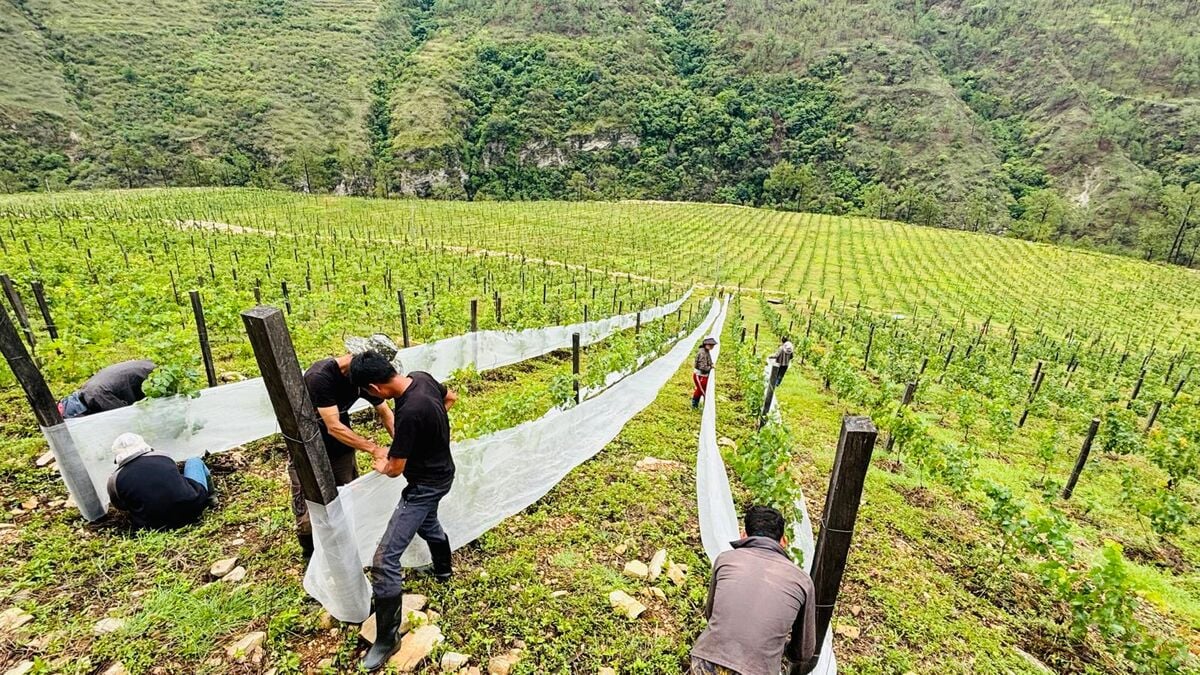
The Bhutan Wine Company hopes the tiny kingdom, which got its first winery in 2019, will have significant production in a few years. Americans Mike Juergens and Ann Cross went there to run a race, and wine consultant Mike liked what he saw.
I looked around and thought it looked like a wine region. They said, "We don't have anything."
Tigers and wasps
He put together a prospectus and business plans and sent them to the country. He was then asked if he wanted to run the project.
I said, “If I want to lead – hell yes.” If they want a punk rocker from California to lead an entire country’s wine production, I’ll say yes without batting an eye. So that’s how it started.
The country now boasts ten vineyards - but it hasn't been easy. One year, the monsoon destroyed 80 percent of the harvest; another time, giant wasps punctured the grapes.
There is a tiger around one of our farms. We find dead cows and horses. They don't eat grapes per se, but they can eat vineyard workers. So the tiger problem is something we have to deal with going forward.
Another challenge is getting all the equipment to a country in the middle of the mountains with no established wine industry.
It has been a nightmare. Imagine transporting tanks in containers from France to Calcutta (Kolkata), which alone takes 50 days. Then you have to load them onto small trucks and transport them through the Himalayas. Once there, you have to think about how to get three-phase electricity, which is not a given here, says Juergens.
But the potential is great. The country's varied altitudes and good water supply provide great opportunities for experimentation. There are no wine regulations, and the state is positive, according to the founders.
"Part of it is about putting Bhutan on the map. Doing that through wine is a way to show how special the country is," Cross says.
Like a canary
Kimberly Nicholas, a sustainability professor at Lund University, describes vineyards as a canary in a coal mine - a clear warning sign of climate change. Frost, forest fires and water shortages are some examples.
"It has become more and more clear. For example, if it is too hot in the last six weeks of the ripening period, we lose quality. The sugar rises quickly, but the flavor doesn't have time to keep up," she says.
She says it would generally be better to redevelop existing wine regions than to move large operations to new locations.
The most sustainable long-term thing is not to take up more agricultural land, because we need it for nature and other things.
Instead, it would be better for winegrowers to try to adapt.
"This thing about the champagne growers buying land in Kent. Actually, maybe they should change grapes instead," she says.
In recent years, wine consumption has also declined. The question is whether we even need new wine-producing countries. Mike Juergens argues that there is something interesting about capturing some of Bhutan's mystique in a bottle. He reasons that low global demand for wine mainly affects the major producers.
Bhutan is simply not big enough; it will never be a country that produces millions of bottles of wine, he says.
India
Grape production is increasing rapidly here. However, wine production is concentrated mainly in Nashik, whose name is protected in a similar way to Champagne.
Ethiopia
A wine-producing country with a long history. The Castel company produces 1.4 million bottles a year. The vines originate from Bordeaux.
Namibia
This is said to be the world's driest vineyard outside the Atacama Desert in Chile, and its wine has won multiple awards.
Algeria and Morocco
Algeria was once a major exporter. Now Morocco is on the rise. The cool climate of the Atlas Mountains supports relatively extensive wine production.
Norway
Like Sweden, Norway has growing wine production. Slinde in the Sognefjord is said to be the world's northernmost commercial vineyard.
Poland
Polish vineyards have expanded rapidly, from less than 50 hectares to 1,100 in about 15 years.
Bhutan
The first barrel of wine was produced in 2023, and this year’s harvest is estimated to be enough for around 4,000 bottles.
Polynesia
In 2000, the world's first Polynesian wine was produced outside Tahiti. The estate, which covers around 3 hectares, is said to be the only one based on a coral atoll.
Sources: OIV, CNN, France 24, Tahiti Tourism Authority, Bhutan Wine Company, money.pl