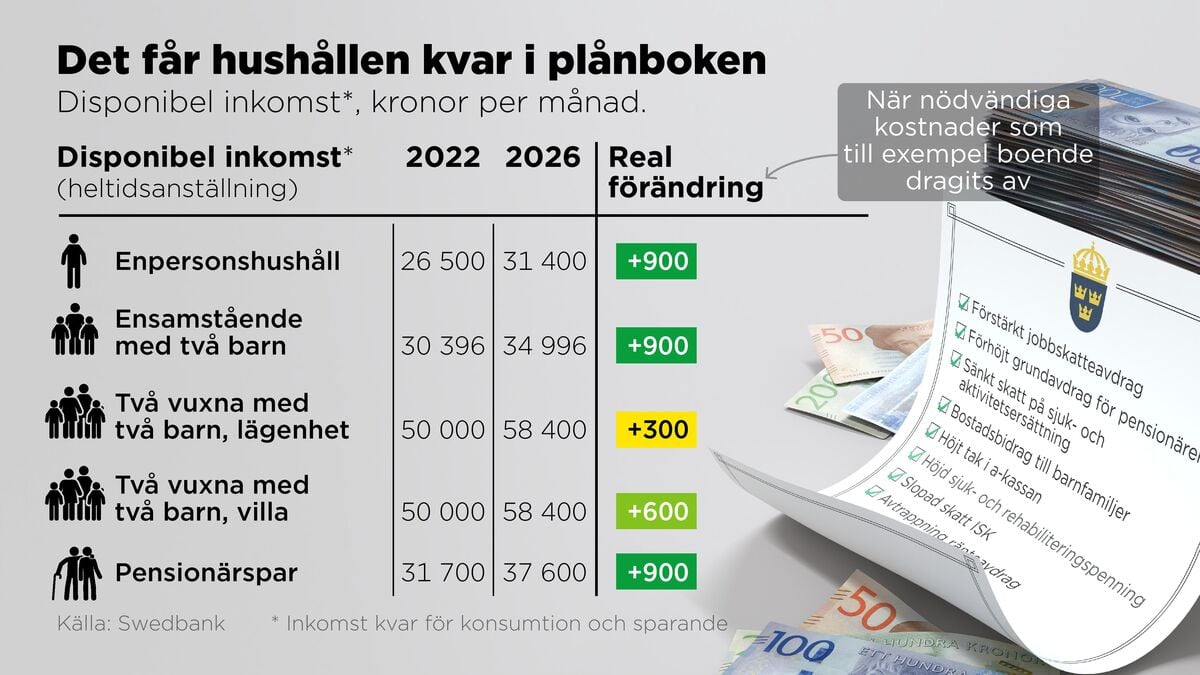
When the budgets during the mandate period are summed up, it is the three earned-income tax deductions that have contributed the most to households' finances, according to Madelén Falkenhäll, economist for financial health at Swedbank.
That's the big change for ordinary wage-earning households, she says.
According to her calculations, a nurse has received 2,700 kronor more in her wallet since 2022 (including salary increases), while a private civil servant has received approximately 8,000 kronor more per month.
Catching up
According to Falkenhäll, the fact that the earned-income tax credit has given the most in kronor to those with the highest incomes is due, among other things, to the fact that the cut-off point for state income tax has been raised, and that the reduction in the earned-income tax credit for higher incomes has been removed.
But while income taxes have been reduced, increased costs have eaten up much of the effect. Especially in 2022 and 2023, with high food and energy prices and housing costs.
It is only now that households, according to Swedbank, are starting to catch up. Those who own their home and have mortgages have begun to feel relief, even though there is now again uncertainty about interest rates going forward.
The reduced VAT on food prices is also expected to have an effect on wallets.
But many are still having a tough time financially, says Falkenhäll, noting that, for example, rent increases remain high.
According to Stefan Westerberg, private economist at Länsförsäkringar, a typical Swedish citizen now has the same purchasing power as in 2021, before inflation and interest rates started to rise.
We have returned to square one, but you can also turn it around and say that we have lost four years of purchasing power, he says.
Got it tougher
Westerberg says that “everyone” has benefited from the government’s budgets, but to different degrees.
But there are also those who have had it tougher. Above all, the incentives are not aimed at the unemployed.
The unemployed are losers, and unemployment is high.
In the unemployment insurance fund, there has been a deterioration for those with lower incomes and for the long-term unemployed, says Westerberg.
According to Madelén Falkenhäll, those who are dependent on subsidies can also be seen as losers.
The housing allowance for families with children has certainly been increased.
But neither child support nor maintenance support is listed, she says.
A protracted war in the Middle East, with continued high oil prices, has also increased risks in the economy. Westerberg believes we are heading towards a new crisis for household finances.