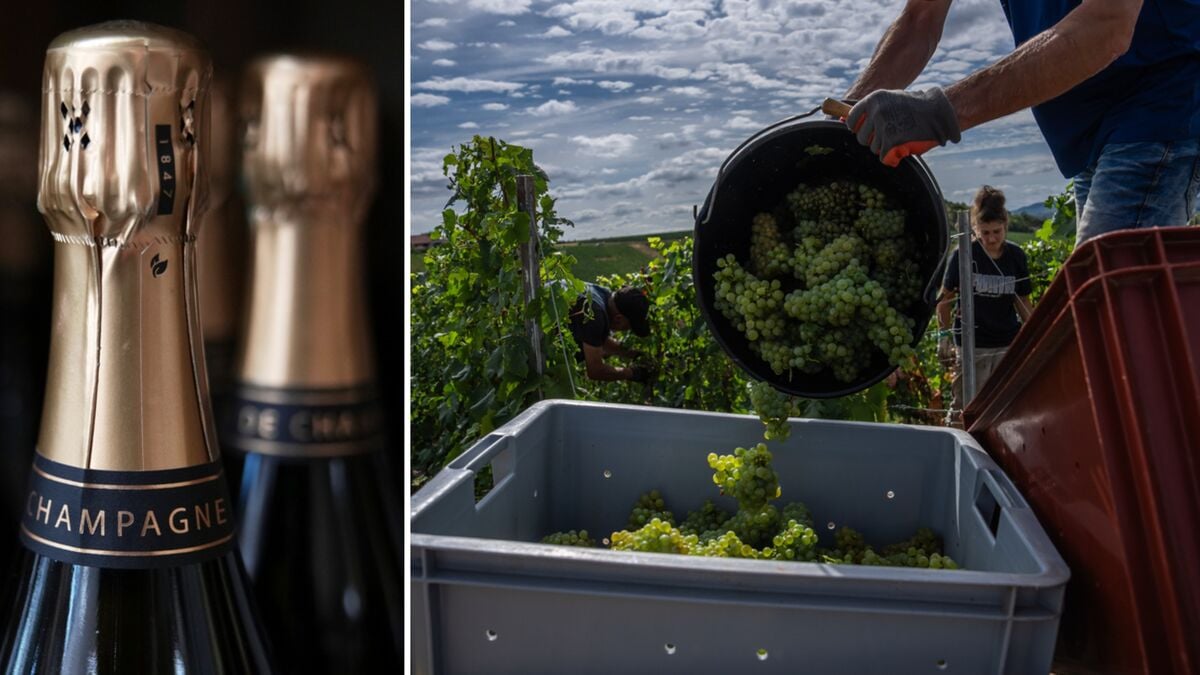
French winegrowers look set to suffer their worst harvest in 70 years, 6 percent lower than last year's poor harvest. This is partly due to the shrinking area and partly to the weather.
"Some have had a tough harvest. Some have not reached the quota of 8.8 tons per hectare, some have had as little as 1.5 tons," says Chantal Brégeon Gonet, champagne maker at Philippe Gonet.
Expert Fredrik Schelin, who owns a house in the area, says that a mild winter meant the vines did not get enough rest. The buds also came early, and 40 percent died in frosty nights later in the spring.
This was followed by summer, with heat waves and drought.
They say that from flowering to harvest it should be about 100 days. This year it was 78, which shows how fast it goes, he says.
Difficult to find workers
Heat and drought stress the vines, making the grapes smaller. Historically, Champagne grapes are harvested in September. But the heat and the small grapes caused the sugar content to skyrocket towards the end.
This year, the harvest began record early, already on August 12. This made it difficult to find labour in a region where everything is harvested by hand.
We could have started even earlier, because the grapes were already ripe, says Chantal Brégeon Gonet.
At the same time, she is pleased that the dry conditions meant there were no fungal attacks to speak of this year.
There were nice grapes of good quality and good sanitary conditions. But the weight of the grapes was very low because they are so small. For some that were affected by early frost, the quantity was very small this year, which is sad, and it is also the third year in a row with a low harvest.
Thumbs up on alcohol content
The rapid spurt caused high sugar levels in some places, which led Champagne to relax the rules on alcohol content for the first time. This year, 15 percent is temporarily allowed, compared with the normal 13 percent, although few producers are expected to take advantage of the exemption.
It will be much bigger, wider and fuller. I'm sure many people will find it very nice. I just think that people won't recognise it as classic champagne, says Fredrik Schelin.
Many winemakers will also be able to make balanced bubbles by blending with previous vintages. However, Chantal Brégeon Gonet notes that the stocks risk drying up if the poor harvests continue. She has a wish list for next year:
"A little more rain, a little less heat, but the same amount of sun. We need balanced conditions," she says.
Champagne is a region in northeastern France, which gives its name to the sparkling wine produced there.
To be called champagne, a large number of rules must be followed, which are set by the state.
This includes grape varieties, harvest time, harvesting by hand, processing and storage.
The grapes must have a minimum sugar content when harvested. Champagne is normally allowed a maximum alcohol content of 13 percent.