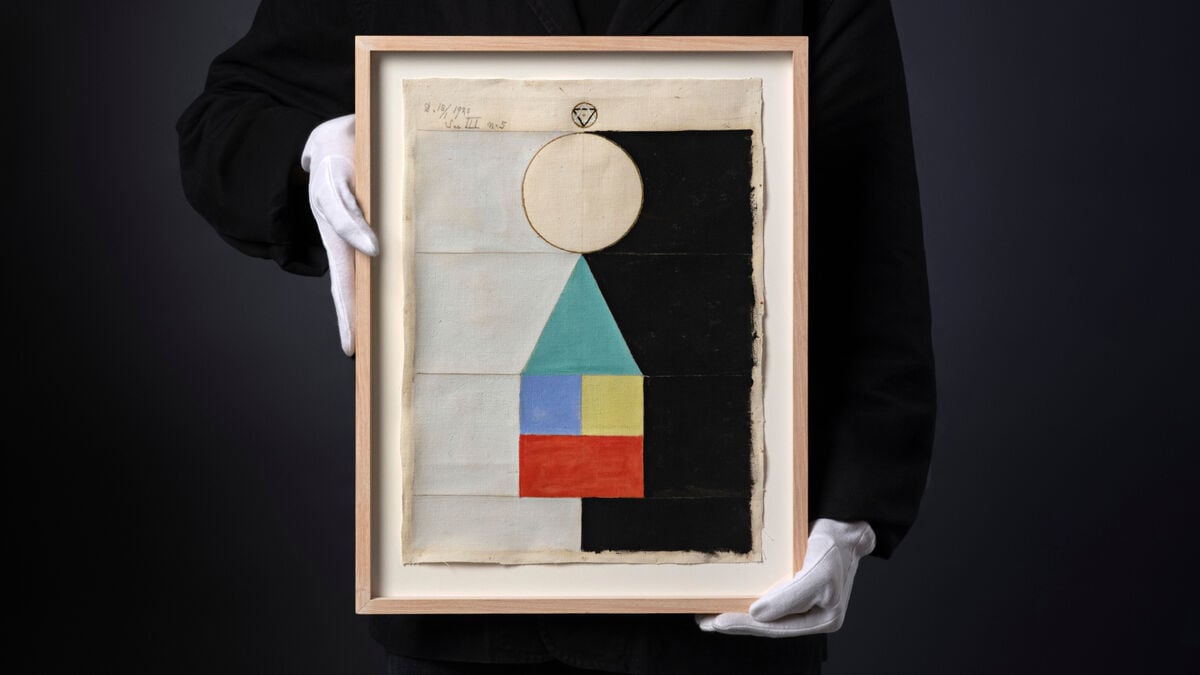
The painting “Ser III No. 5” is a work of great significance, according to Louise Wrede, head of the art department at Bukowskis. It was included in the first major exhibition to recognize Hilma af Klint’s art: “The Spiritual in Art: Abstract Painting 1890–1985” at the Los Angeles County Museum of Art.
It was the major breakthrough exhibition, the rediscovery of Hilma af Klint’s work.
Intensive months
The work is dated January 18, 1920, during a period when Hilma af Klint created 85 abstract works in eight series over a few intense months.
These were the last abstract works she made before she moved on to more figurative painting and greater references to Rudolf Steiner’s teachings, as she painted almost exclusively in watercolor.
In recent years, the Hilma af Klint Foundation has been rocked by internal disputes, including over whether the works should be sold. But the foundation does not oppose the sale of “Ser III No. 5,” Louise Wrede confirms.
We have spoken to the foundation, and they are well aware that it is going up for sale. Since the painting was sold, the foundation has no claim to it.
When the foundation sold the painting, along with some other works, through a gallery in Stockholm in the 1990s, interest was rather lukewarm.
It took a while before it was sold, but in 1995 a collector came into the gallery and bought it. Since then, it has been passed down to its current owner.
International interest
After several notable international exhibitions, the world has opened its eyes to Hilma af Klint, and Bukowskis expects great international interest in the auction.
The price the painting was bought for will likely remain a secret, but it has definitely increased in value. The estimate is six to eight million. Putting a price on something so unusual has not been easy, says Louise Wrede.
We have taken into account the work’s art historical significance, provenance, exhibition history and the quality of the dating. It is precisely the fact that it is an abstract masterpiece that makes it so unusual.
Ultimately, it is the market that decides.
Hilma af Klint was born in 1862.
From 1882 to 1887, she studied at the Academy of Fine Arts as one of the first generations of women to be educated there.
At the age of 17, she turned to spiritualism and later joined the Theosophical Society and the Anthroposophical Society, among others.
In 1906, she began painting in a more abstract and symbolic style. The series “Paintings for the Temple” consists of 193 paintings created between 1906 and 1915 and is said to be one of the first abstract works of art in the world.
In 1907, she began “The Ten Greatest,” a series of gigantic paintings (approximately 2.40 x 3.20 meters).
The series “The Swan” was begun in 1914 and depicts the fight between a black and a white swan.
Hilma af Klint died in 1944. She bequeathed her paintings to her nephew, who founded the Hilma af Klint Foundation in 1972. At that time, only a few people had seen her abstract works. They were shown publicly for the first time in the 1986 exhibition “The Spiritual in Art: Abstract Painting 1890–1985” in Los Angeles. This was her international breakthrough.
Source: The Hilma af Klint Foundation.