Naim Qassem emphasizes in a statement that the ceasefire cannot be unilateral - and on Saturday evening issued a sharp warning to Israel that Hezbollah forces continue to be in the field on high alert.
"A ceasefire means a total stop to all attacks," he said in a statement, adding that it must be followed by all parties.
Hezbollah is not formally part of the ceasefire. The Shia movement has criticized the agreement that Lebanon's weak government has made with Israel - but has so far signaled that it will abide by it.
Demolition continues
On Saturday, an Israeli soldier was killed and nine others were injured in an explosion in southern Lebanon, according to Israeli media. The soldiers were said to have hit a previously deployed bomb or mine.
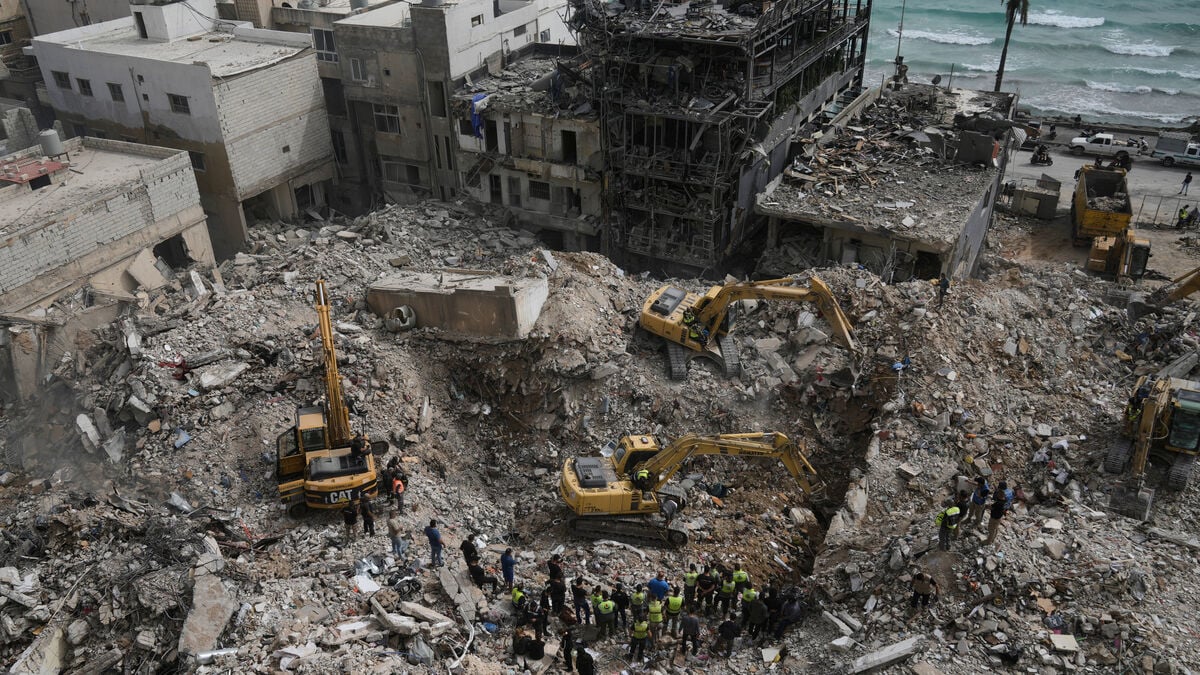
Israel carried out new airstrikes in southern Lebanon on Saturday, and is also continuing systematic demolitions of buildings there.
According to sources cited by the Israeli newspaper Haaretz, the Israeli demolitions follow a pattern similar to those carried out by Israel in the Gaza Strip. The work has been outsourced, including to companies that previously demolished in Gaza, and many bulldozers have been working in a long line along border towns.
The sources say the explicit goal is to prevent the Lebanese population from returning.
Draw your own boundaries
Israel says it has drawn a “yellow line” in southern Lebanon, a fortified border on Lebanese soil that borrows its name from the border that Israeli forces drew around a buffer zone in Gaza. The military has also published a map showing the boundary of the country’s “defense line” in Lebanon.
Israeli forces have displaced the Lebanese population behind the unilaterally declared border demarcation. There have been warnings of a long-term Israeli occupation of a “security zone.”
"Prime Minister Benjamin Netanyahu and I have ordered the military to act with full force, both on the ground and in the air, even during the ceasefire, to protect our soldiers in Lebanon from all threats," Defense Minister Israel Katz said on Sunday.
Displaced civilians were reported to have returned to their homes over the weekend after the ceasefire was announced, but on Sunday, traffic jams were once again long in the opposite direction, reports L'Orient-Le Jour .
Facts: Seven invasions in 50 years
Over the past 50 years, Israel has entered Lebanon with ground forces on seven occasions.
Israel's opponent in Lebanon, the Shiite Muslim movement Hezbollah, is a militia and political party. It was founded partly with Iranian help after Israel's occupation of southern Lebanon in the 1980s. It acts as a proxy for Iran in conflicts in the Middle East and has been partly labeled a terrorist organization by the EU and the US.
The long-running conflict flared up again in connection with the Gaza War. A ceasefire was reached in 2024 that required both Hezbollah and Israel to withdraw from a buffer zone in southern Lebanon. The parties have accused each other of violating it.
In the spring of 2026, fighting broke out again when Hezbollah fired rockets at Israel in response to Israel's war with Iran. Israeli ground forces have advanced further into Lebanon, hundreds of thousands have been displaced, and there are warnings of a lasting occupation.