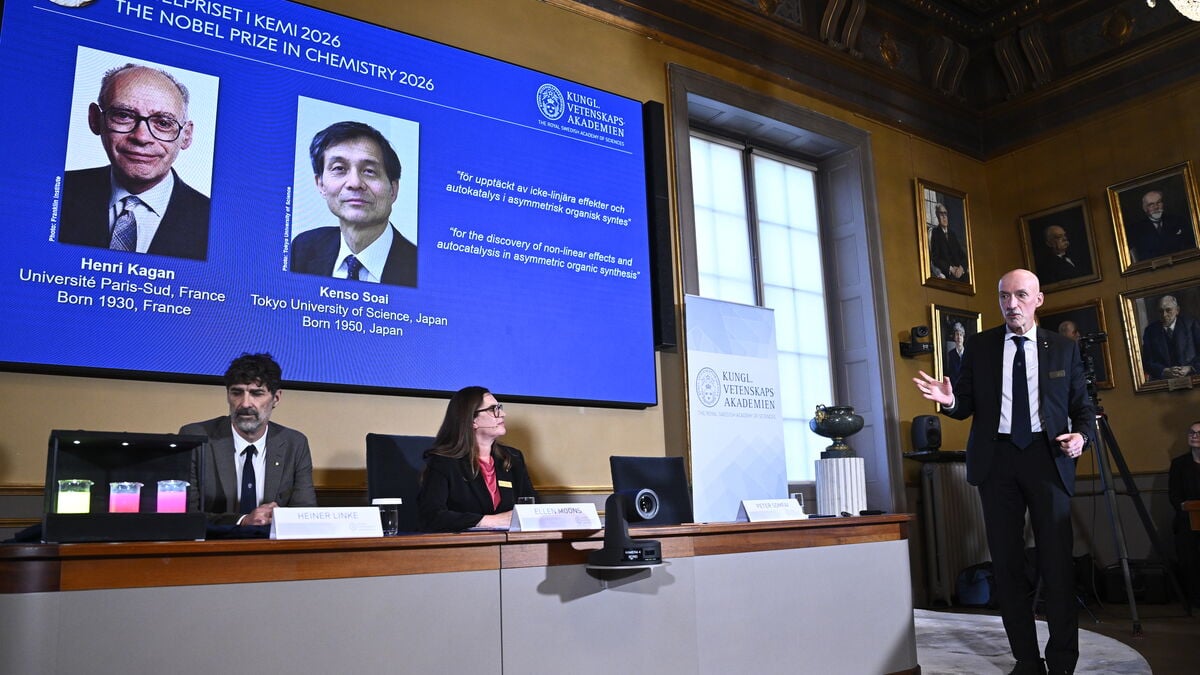
"I am very excited to receive this good news. It is one of the most exciting days of my life," says Kenso Soai over the phone from Hiroshima during the press conference in Stockholm.
I am very happy to share the award with Professor Kagan.
The prize is about so-called homochirality, which chemists call "the chemistry of life".
Some molecules, such as amino acids, exist in two variants that are mirror images of each other. In living organisms, only one of the mirror images exists, and how such chemical asymmetry (homochirality) can arise spontaneously was long unknown.
When chemists began experimenting with reactions that could form two mirror-image molecules, they got an even mixture of both mirror images in their test tubes, but were unable to produce just one of the images.
Harmful effects
However, when developing molecules that are to interact with living organisms, such as drugs, only one mirror image has the desired effect. One of them has the intended effect; the other can have unnecessary and sometimes harmful side effects.
An example of how serious the effects of the wrong mirror-image molecule in a drug can be is the so-called Neurosedyn scandal in the 1960s, when thousands of children around the world were born with malformations, and an unknown number of fetuses died.
Through their respective research, Kagan and Soai found the answer to the more than 100-year-old mystery surrounding mirror images.
Manipulated reactions
Kagan took the first crucial step when, in 1986, he discovered a way to manipulate chemical reactions to create larger excesses of one mirror image than was thought possible.
In 1995, Soai took the next step when he designed the first chemical reaction with the potential to become homochiral.
In 2003, he went all the way and presented a reaction in which he managed to create molecules in which only one of the mirror images was formed. In this way, he was able to explain homochirality for the first time.
We have discovered many interesting things about homochirality. I am delighted to receive the prize. It is recognition from the Nobel Committee of this area of research, says Kenso Soai, who emphasizes that “more research is needed to understand life.”
Sara Linse, a member of the Royal Swedish Academy of Sciences (Sweden’s national academy of sciences), says that the research is used, among other things, in the pharmaceutical industry and in the manufacture of optical materials.
This is already being used today in the manufacture of asthma medications and antiviral substances.
Henri B. Kagan, born in 1930 in Boulogne-Billancourt, France.
Professor emeritus at the then Université Paris-Sud, France.
Kenso Soai, born in 1950 in Hiroshima, Japan.
Professor emeritus at Tokyo University of Science, Japan.
They will receive the 2026 Nobel Prize in Chemistry "for the discovery of nonlinear effects and autocatalysis in asymmetric organic synthesis."
The prize money, 12 million kronor (about $1.1 million), will be divided equally between the laureates.