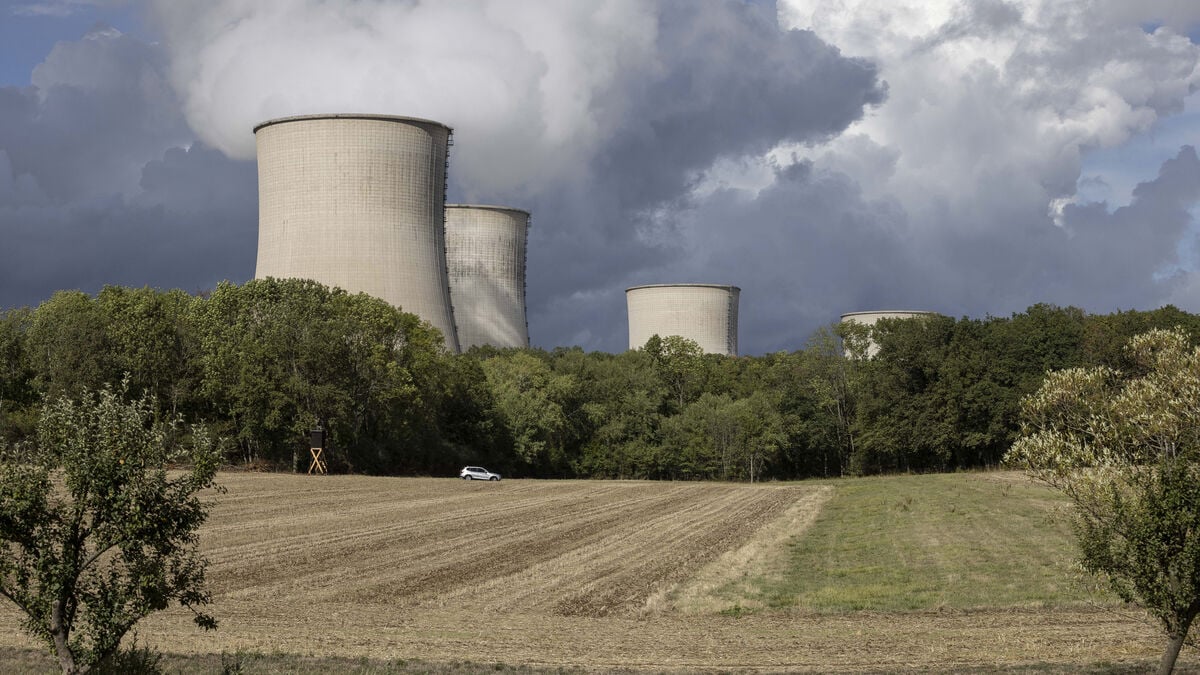
In Hungary, the government last week asked industries in the country to reduce electricity consumption because the country's only nuclear power plant, Paks, south of Budapest, is at risk of closure due to record low water levels in the Danube River.
Neighboring Romania has taken drastic measures. On Monday, part of a canal was blown up to divert water to avoid the closure of the Cernavoda nuclear power plant.
More outages
In France, too, summer heat waves have put pressure on the country's nuclear power. This weekend, state-owned EDF shut down several reactors due to drought in two rivers. And the Golfech nuclear power plant in the southwest of the country has been forced to shut down several times because the temperature in the Garonne River has been too high. Since 2006, it has been prohibited – in order to protect aquatic environments – to release cooling water into rivers when the temperature exceeds 28 degrees. In July, a reactor in Golfech was shut down for over two weeks, which is the longest shutdown on record.
According to the Cour des Comptes (the French equivalent of the National Audit Office), outages could triple to quadruple by 2050 as a result of recurring heat waves.
Christophe Demazière, an expert on reactor safety, notes that nuclear power plants are not adapted to this type of extreme heat.
When these reactors were built in the 1970s and 1980s, they didn't think the temperatures would be this high during the summer months, says Demazière, who is a professor of nuclear reactor physics at Chalmers.
Technical solutions
France produces nearly 70 percent of its electricity from nuclear power and is one of Europe's largest electricity exporters. The power plants are located along rivers or by the sea because they rely on large amounts of cooling water. But as temperatures rise and water levels drop, the power plants must find other solutions.
Demazière believes that there are technical solutions that do not require water, but that would require investment. And when new power plants are built, they can be adapted to the heat. In the United States, the world's largest producer of nuclear power, authorities last spring approved the construction of a nuclear reactor that is cooled with sodium instead of water.
However, the summer reactor shutdown has not led to any electricity shortages in France. On the contrary, the country has been able to continue exporting electricity to Germany, among other countries.
The need for electricity is lower during the summer, so reducing electricity production has still meant producing more than is needed, says Demazière.
Corrected: In an earlier version of the text, there was incorrect information about Poland, which has no nuclear power plants in operation.