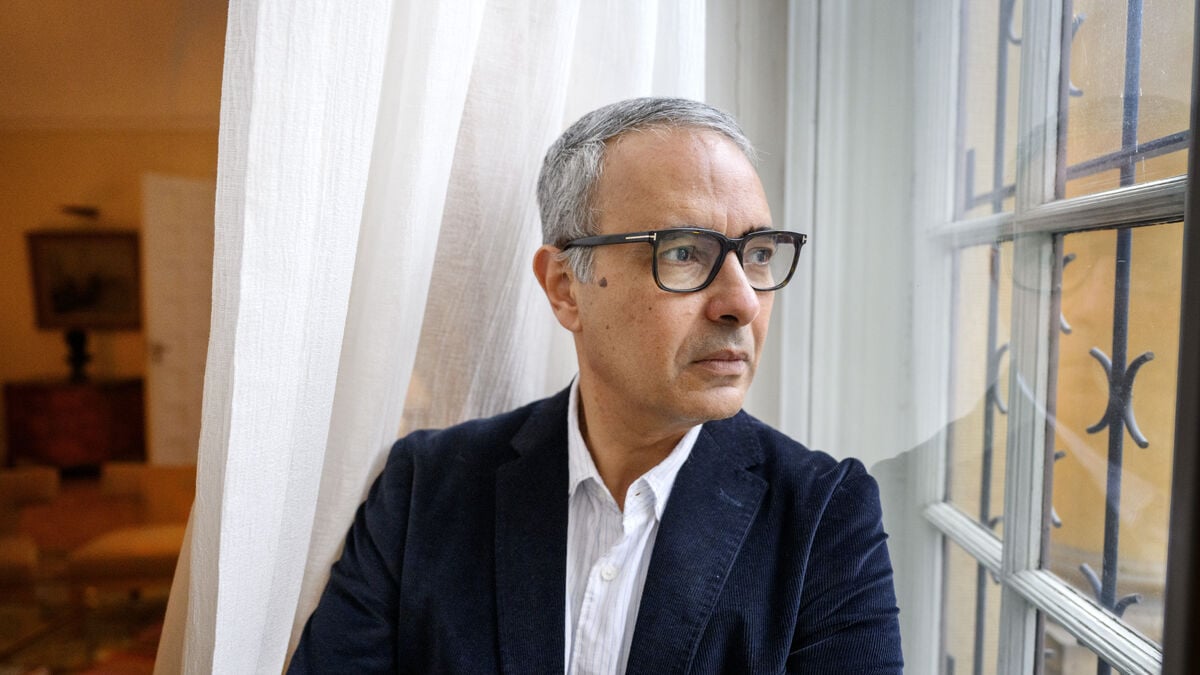
Lawsuits, a theft charge and a ban. All of his novels have caused Kamel Daoud problems in his homeland, but none like the latest. In "The Scar," he gives voice to a young woman, Aube, whose vocal cords were cut by Islamists during the Algerian civil war.
At the same time, Daoud writes about a dirty war whose horrors no one is allowed to talk about. To do so, he moved to France in 2023.
I started writing this novel when I arrived.
If he returns, he will be arrested.
It's painful. Is it worth it to be able to write a book? No, he answers himself.
I am not bitter, I am sad for my country. An Algerian writer wrote to me: "To be a good Algerian writer, you must be dead or in exile."
A team
At least 200,000 people died during the “black decade” of the 1990s. Under a 2005 law, anyone who speaks publicly about the civil war risks imprisonment. During the conflict, Kamel Daoud worked as a journalist and reported on violence far more extensive than the cut throats he included in his novel. There, he chose a female narrator:
I wanted the war to be told by those who suffered most, and the women suffered enormously. Afterwards, the men were paid to lay down their weapons, but the women who had been raped and left pregnant were made to seem guilty in the eyes of society.
After the 2024 Goncourt Prize, the Algerian regime issued two arrest warrants for him, while a woman, Saâda Arbane, sued him for stealing her story. As a child, the woman had her vocal cords cut when Islamists executed her family, just like the novel's Aube. The Algerian woman had also been a patient of Kamel Daoud's wife.
That was before I had even met my wife. I don't need to steal medical secrets from my wife to be able to write books,
Well-known
Saâda Arbane's fate is well known – her adoptive mother became Minister of Health and she herself a famous equestrian – but not unique, emphasizes Kamel Daoud, who shows pictures from the civil war of other children with bandages around their necks.
I can understand people's pain; it hasn't been acknowledged. Before this book, she couldn't talk about it.
Isn't she risking trouble now?
I don't know. Only time will tell whether she came forward of her own accord or whether she was pressured to do so, which I believe.
Facts: Kamel Daoud
Born: 1970 in Mesra, Algeria. Grew up in simple circumstances. Mother was illiterate.
Background: Worked for a long time as a journalist in Algeria, reporting on the civil war between Islamist groups and the military that began in 1992 and lasted for just over ten years. The 2005 reconciliation law prohibits Algerians from researching what happened.
Lives: Since 2023 in France. "To be able to write, you have to be able to feel free, and in Algeria I was no longer free. Many people were in prison, there was police surveillance, there was terror, there was phone tapping. All of this made me know that it was soon my turn. I left the country before then," he says.
Books: Made an international splash with "The Meursault Case," which has been translated into about 40 languages. The novel is written in dialogue with Albert Camus’ "The Stranger" - and is about the "Arab" who is shot dead in Camus’ novel.
Current: With his latest novel "Ärret", now in Swedish translation. For it, Kamel Daoud received the Goncourt Prize in 2024, which is synonymous with enormous distribution and sales success.
On May 23, he will receive this year's Dagerman Prize for his ability to give "power to the nameless" and for "showing us what many want to keep secret."