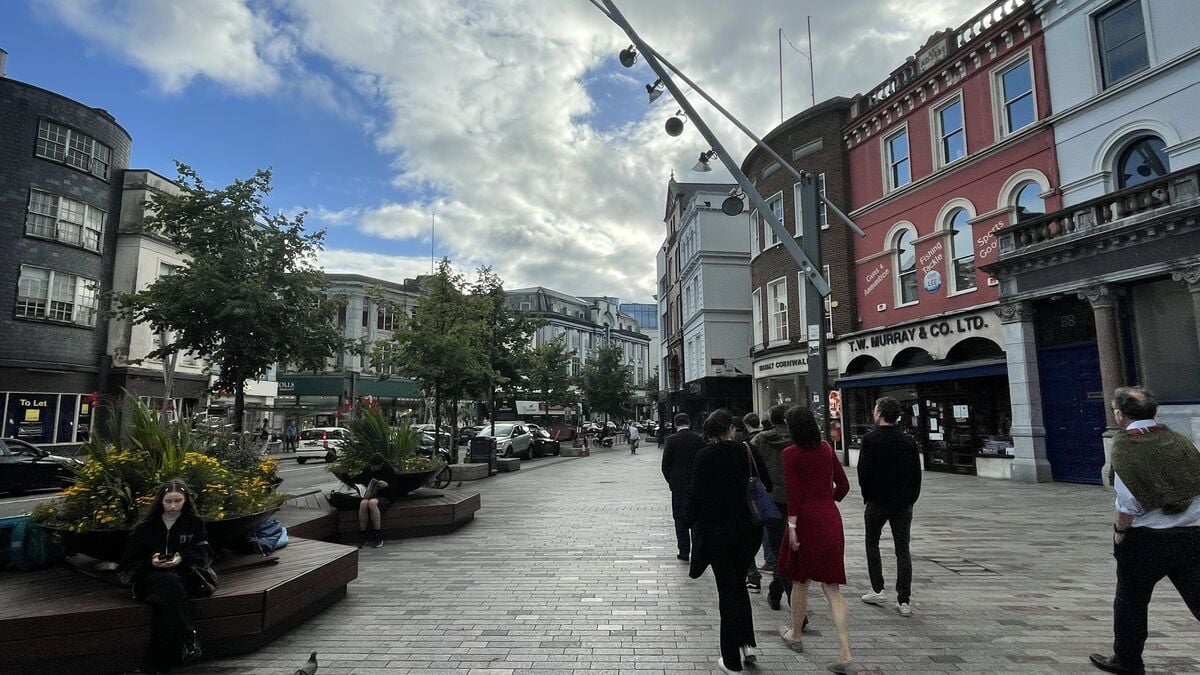
Where the River Lee winds around an old porter brewery in Cork, plans are being made for a new development worth billions.
That's where the new building, worth 100 million euros, will be located, says the guide at the Tyndall Institute, the local university's high-tech department, pointing out over the water.
Extensive research is conducted here in several areas that are seen as technologies of the future.
Cleitus Antony and Rory Fox showcase hair-thin cables that, using light, impulses and vibrations, are used in two ways: not only to send data and communicate via the seabed to the other side of the Atlantic, but also to reveal who and what comes close.
"This is like a fingerprint on a dolphin or a boat or whatever it is. We can tell what kind of fishing vessel or military boat it is," Rory explains.
Showcased to the EU
It is no coincidence that Ireland wants to showcase the Tyndall Institute when the entire EU Commission and a group of incoming Brussels correspondents are in Cork.
This is what is frequently repeated as absolutely necessary for Europe's future. Research and development of new technologies cannot only take place in Asia and the US. Europe must create the conditions to keep up - both in terms of knowledge and to then be able to benefit economically from the results.
Tyndall proudly boasts a number of new companies nurtured by researchers and professors. The new department across the river will be specifically geared towards those who are willing and able to develop their ideas into businesses.
The new investment, equivalent to 1.1 billion Swedish kronor, was completed as late as the beginning of July.
Creating new knowledge is crucial for Europe's future competitiveness, security and prosperity, says Ireland's Minister for Research and Education James Lawless.
Needs to “scale up”
Prime Minister Micheál Martin and European Commission President Ursula von der Leyen are full of admiration.
It was absolutely fantastic to see. The EU is bridging a gap that we have long struggled with, says von der Leyen, urging EU countries to agree on measures to create a “capital markets union”, where private money can be more easily invested in new companies.
"We have all the ingredients: talent, innovation, research, infrastructure and capital - if only we could get the Capital Markets Union in place. What we need now is to scale up," says von der Leyen.
Ireland has a strategy to develop into a “Silicon Island” with the same cutting-edge research and companies as in California.
At the same time, it is emphasized that it is about joint European cooperation - not something that should only benefit one's own country.
Europe's competitiveness lies in cooperation, not fragmentation, says Georgios Fagas, who is head of strategic development at Tyndall.
From India and China
But it is also important to attract those who will be responsible for the actual implementation.
Of the 600 researchers and students at Tyndall, just under two-thirds come from Ireland and the rest of Europe. Of the rest, 200 are from India and around 40 from China. Retaining them is crucial to Europe's success.
I've been here for 15 years already, started my studies here and did my master's and my doctorate here. I really love the research here and have just continued - and will probably never leave here, says Han Shao from China, with small computer chips in the soil of a basil plant.
"I want to dig deep into what we can do in electrochemistry. I really want to build something that can help both people and animals," says Ridwan Abid, who tracks diseases using cow livers.
Education Minister Lawless emphasizes the importance of finding the right students.
It's all about talent. We can and we are investing in software and hardware. But without human capital, nothing will work. People are our greatest national asset, says the minister in Cork.
The Tyndall National Institute in Cork, southern Ireland, was founded in 2004 as a collaboration between the Irish government and the local university, UCC.
Tyndall is Ireland's largest research institute with around 600 researchers and students from over 50 countries.
The institute is named after the Irish physicist John Tyndall (1820-93), who, among other things, solved the question of why the sky is light blue.