Sudan's civil war forced Omer al-Hassan to abandon his land. Now that he has returned, a new conflict threatens to destroy everything once again.
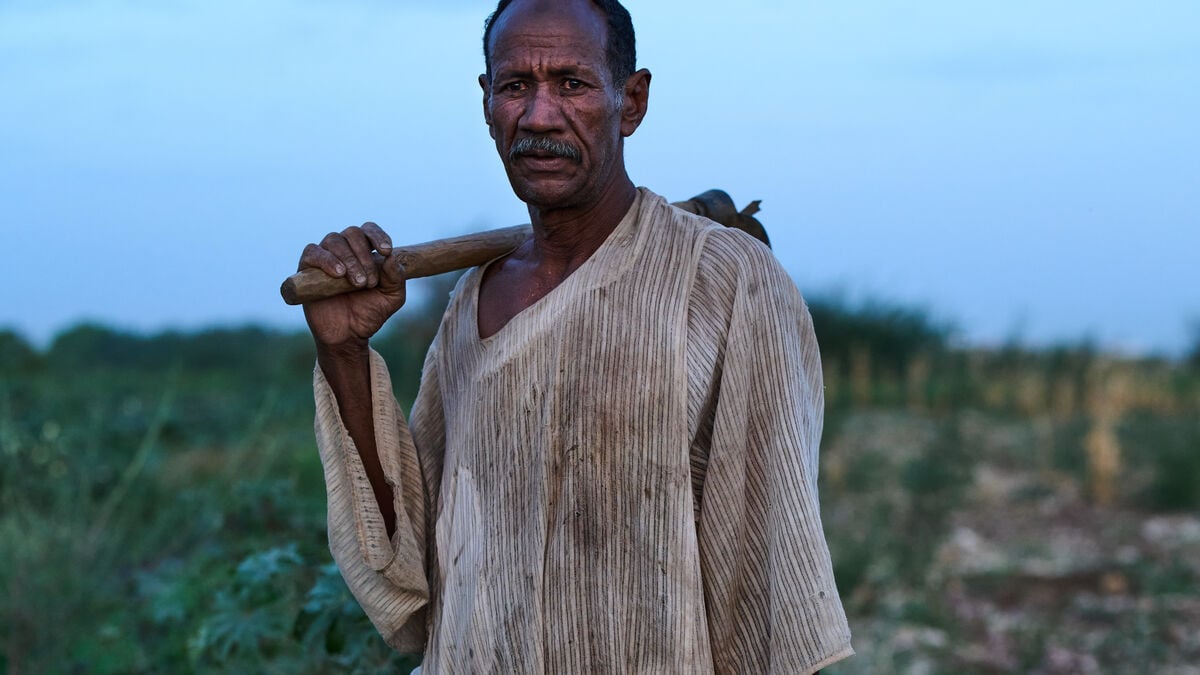
With pickaxes and calloused hands, he and other farmers dig onions out of the ground in Omdurman, near the Sudanese capital, Khartoum. These are difficult times - the war is hitting hard, the men tell AP.
It has affected just about everything related to agriculture, says al-Hassan, who in addition to onions also grows potatoes and tomatoes.
Mohammed al-Badri could only afford to cultivate half of his land due to rising prices for things like fertilizer.
"Nothing will be left," he tells AP.
Millions at risk of famine
Increasingly expensive fertilizer and fuel for agricultural equipment mean increased prices for several staples that grow in Sudanese soil: sorghum, millet, sesame.
In March, the UN World Food Programme (WFP) warned that 45 million people - in addition to the 320 million already suffering from food shortages - risk famine and starvation unless fertilizer is able to pass through the Strait of Hormuz before the summer.
"It would raise global hunger levels to record levels - and that is a terrible, terrible thought," said Swedish WFP chief Carl Skau in Geneva.
For already distressed, war-torn countries like Sudan, the situation is particularly alarming. Countries around the Persian Gulf, where hundreds of ships have been stranded for weeks as a result of the war, account for more than half of Sudan's fertilizer imports by sea. Sub-Saharan Africa imports around 80 percent of all its fertilizer.
Dangerous chain reaction
The Norwegian fertilizer giant Yara International is sounding the alarm about a global fertilizer crisis that risks hitting the most vulnerable.
"The most important thing we can do now is to sound the alarm about what we see: that there is a risk of a global price war on fertilizer that would make it unaffordable for the most vulnerable," CEO Svein Tore Holsether told The Guardian earlier in May.
The war has triggered a dangerous chain reaction at exactly the wrong time, Melaku Yirga, deputy director of the aid organization Mercy Corps, told the AP.
People are buying less food, cutting back or skipping meals, selling assets and taking greater risks to survive. Mothers are forced to make painful decisions about who gets to eat what little food is available.
Fertilization can be done at seeding or during the growing season. It is necessary, among other things, to replace nutrients that harvesting, leaching and evaporation remove from the soil.
Fertilizer can be of organic or inorganic origin.
Inorganic fertilizers are dominated by commercial fertilizers, also called artificial or mineral fertilizers, which contain nitrogen, potassium and/or phosphorus.
A very common nitrogen fertilizer is urea (also called carbamide), which is used, among other things, to grow staple foods such as rice, wheat and corn. Iran and Qatar are two of the world's largest exporters of urea, and the blockade of the Strait of Hormuz has hit supplies hard.
The war in Sudan is between two rival militaries and has been raging since April 2023.
On one side is the regular army, led by General Abd al-Fattah al-Burhan, with a power base around the capital Khartoum and along the Nile in the east.
On the other side are the so-called RSF forces, led by Mohammed Hamdan Dagalo (known as Hemedti). They have their origins in the so-called Janjawid militias that former dictator Omar al-Bashir hired to brutally crush an uprising in the devastating and ethnically charged Darfur conflict in the early 2000s.
Al-Bashir was overthrown in a wave of popular protests in 2019. But just over two years later, the two armies he had left behind - the regular military and the RSF - seized power in a joint military coup. Rivalry grew within their joint junta rule, and eventually full-scale war broke out between them.
Tens of thousands of people have been killed and tens of millions have been displaced, many of them to poor neighboring countries. In the Darfur region, there are renewed alarms about ethnic cleansing.
The military is believed to be receiving support from Egypt, Saudi Arabia and Qatar. The RSF is believed to be receiving support from the United Arab Emirates.