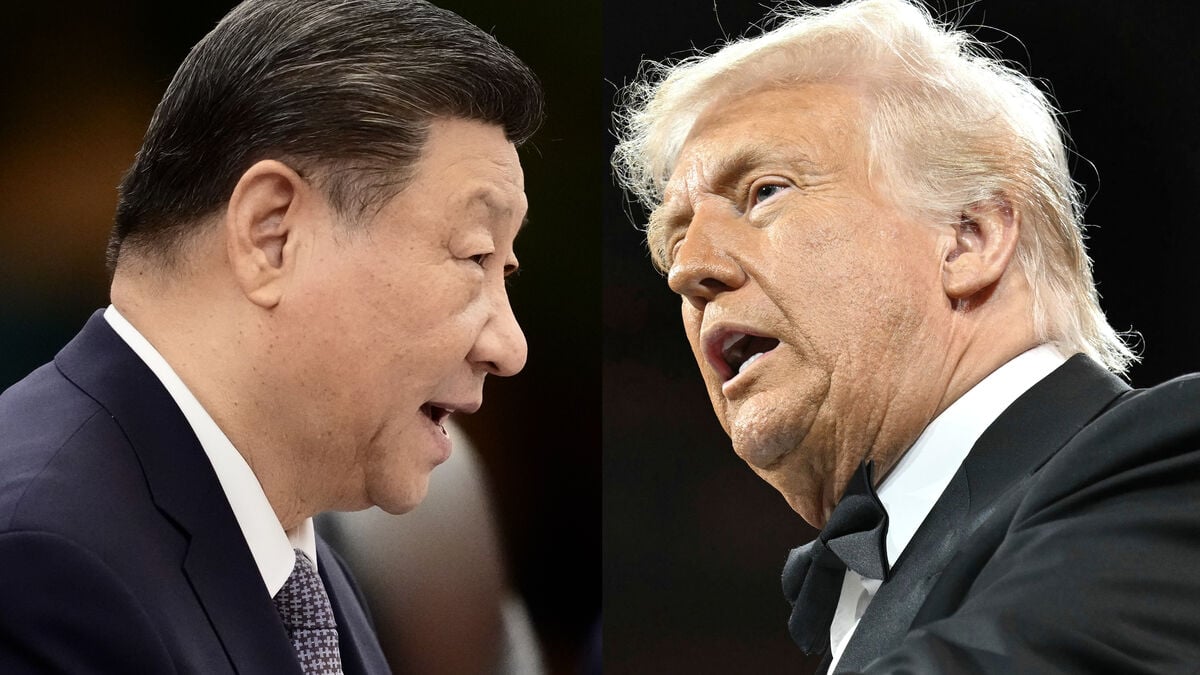
Donald Trump is in a rock-paper-scissors situation in the Middle East - and is believed to need Xi Jinping's help to get out of it. Both Secretary of State Marco Rubio and Treasury Secretary Scott Bessent have asked China to use its influence to get Iran to stop blocking shipping through the Strait of Hormuz.
It is in China's interest for Iran to stop keeping the strait closed, Rubio said last week, in connection with Iranian Foreign Minister Abbas Araghchi's visit to Beijing.
It is clear that China has the means to exert influence over Iran. During the war Beijing is said to have continued to buy Iranian oil, helped Tehran circumvent sanctions, and supplied products linked to Iran's missile program.
Desperate enough?
The question is what China would get in return for stopping acting as a lifeline for Iran. Some fear that Trump will scale back US support for Taiwan, which Xi has long sought to incorporate into China.
China's dream scenario is to persuade the US to give up Taiwan, and by extension also to give up the US military presence in that part of the world, says Björn Jerdén, head of the National Knowledge Center on China at the Swedish Institute for International Affairs.
However, he sees it as unlikely that this would happen right now.
Would China sell out Iran to gain Taiwan and control of East Asia? Anytime. The question is whether the Americans are desperate enough to do it. I don't think so, although we can't rule anything out with Trump.
Want to stabilize
Björn Jerdén does not believe that the meeting between Trump and Xi will end with any major agreements. The relationship is characterized by a “serious structural conflict” that has gradually worsened since Trump's last round in the White House, he says.
It is a conflict about military and security interests, trade and technology, and overall about power over the world order.
Trump probably wants to make a deal with China. He wants that with all countries. But I think there are very few possibilities to reach an agreement with China that will make this structural conflict disappear, Jerdén notes.
Instead, he believes both sides will focus on stabilizing the relationship. A likely outcome is an extension of the fragile trade truce between the countries.
As long as this relationship is stable, it matters to us because it contributes to a calmer world economy and reduces turbulence.
US President Donald Trump and Chinese President Xi Jinping will meet in Beijing on May 14-15.
The meeting was originally scheduled for March, but was postponed due to the Iran war. It is the first US presidential visit to China since Trump's trip in November 2017.
Trade tariffs, the Iran war and the energy crisis, AI safety, and the US-China agreement on rare earth metals are expected to be on the agenda.
Trump has also announced that he will raise the issue of US arms sales to Taiwan. In December, the president approved an $11 billion arms package to Taiwan, but the US has not yet moved forward with the delivery.
Several business leaders are on the trip, according to media reports, including Tesla CEO Elon Musk and Apple CEO Tim Cook. Boeing CEO Kelly Ortberg, who is reported to be close to securing a gigantic order for around 600 aircraft to China, is also part of the delegation.