The proposal to send the matter to court was narrowly approved in the European Parliament on Wednesday: 334 votes to 324, with 11 abstentions.
This means that the entire agreement could now be delayed by at least several months and perhaps even years.
There is great disappointment among those who support the agreement.
"It is extremely bad for Europe. There is no need for further scrutiny. What is needed is that we start making money from the agreement," tells Foreign Trade Minister Benjamin Dousa (M) to TT.
Will it still take effect?
Both he and several Swedish members of the European Parliament hope the European Commission will now use its opportunity to allow the agreement to enter into force provisionally, without waiting for the court proceedings.
However, this will likely receive harsh criticism from the majority in the European Parliament and the countries - France, Ireland, Austria, Hungary and Poland - that strongly opposed the agreement.
There is great dissatisfaction, not least among European farmers, who are concerned about increasing competition from South American giants such as Brazil and Argentina.
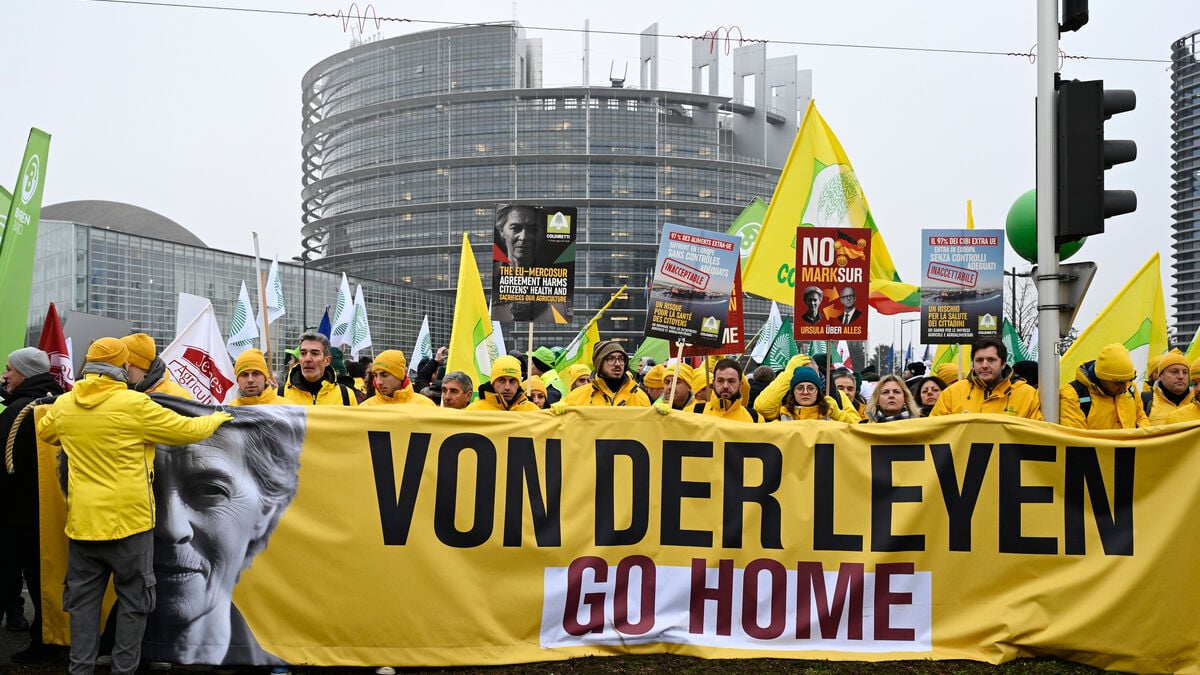
On Tuesday, up to 5,000 demonstrators gathered with their tractors outside the European Parliament to protest the agreement.
“Hole in the head”
The vote was extremely divided. In all party groups in parliament, there were members who voted both for and against.
Among the Swedes, members from M, KD, L, C, S and SD voted against taking the issue to court.
Members from MP and V, on the other hand, were in favor.
"It is also about ensuring that the Commission has acted within its mandate and the balance of power between the EU's decision-making bodies," writes Pär Holmgren (MP).
Benjamin Dousa doesn't like it at all.
"They are putting Swedish jobs and the Swedish economy at risk. This is a foolish action," says Dousa.
The agreement between the EU and the Mercosur countries - Brazil, Argentina, Uruguay and Paraguay - has been negotiated on and off since 1999.
Facts: The battle over Mercosur
Critics of the EU's trade agreement with the Mercosur countries in South America are primarily concerned about increasing competition in agriculture, not least from Brazil.
On the environmental side, there are also warnings about increased imports of goods produced using various pesticides and that more rainforest will be cut down to create farmland.
The European Commission has tried to calm things down with promises of increased financial support for farmers and not allowing anything that is banned within the EU into the country.
In addition, the advantage of forging stronger ties with other parts of the world is pointed out, at a time when the relationship with the United States is shakier than ever.