Thirteen years have passed since the EU last expanded, when Croatia joined in 2013. The Commission wants to change that with a combination of carrots and sticks.
The aim is to speed up the process for countries that are interested in joining the EU and have been negotiating for several years, while also giving current members guarantees that enlargement will not complicate the EU’s work.
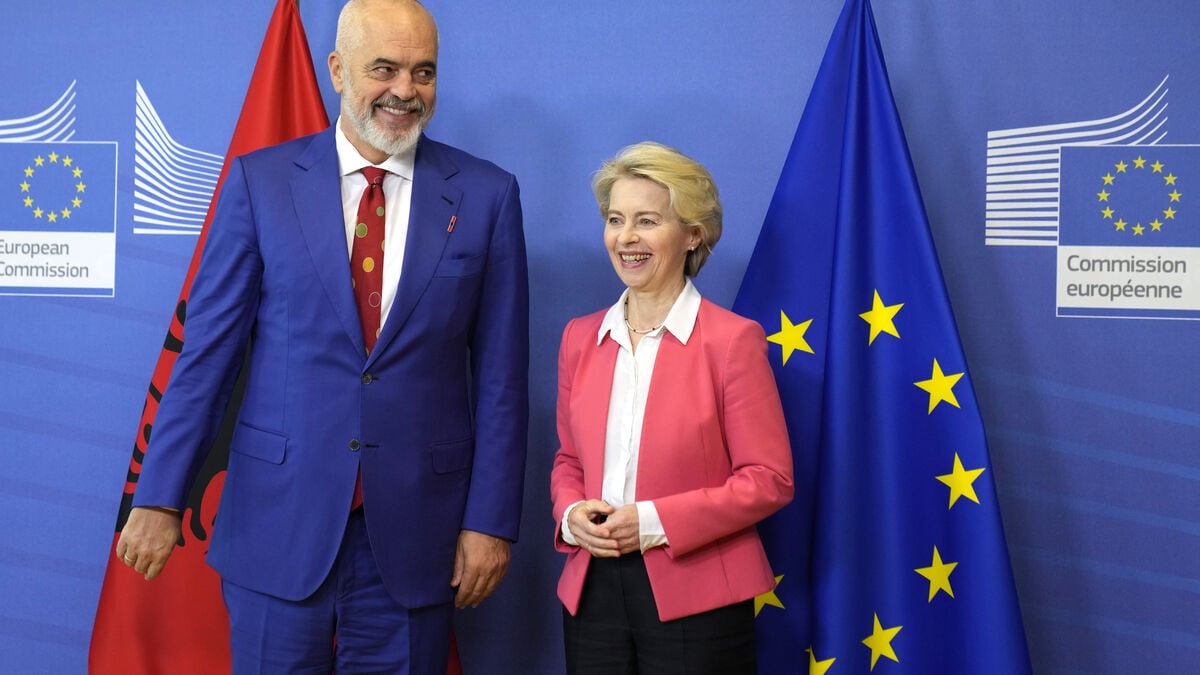
Accession must always be merit-based. But merit-based does not have to mean slow, said Commission President Ursula von der Leyen at a meeting with Prime Minister Edi Rama in EU candidate Albania last week.
Gradual admission
Much of the review now being presented was leaked in advance to news sites such as Politico Europe and Rapporteur (formerly Euractiv).
The proposal is for the countries closest to EU accession - in addition to Albania, Montenegro, Moldova and Ukraine - to receive clear “roadmaps” setting out what measures need to be taken and when.
The idea is also to gradually bring the countries into the EU system. Parts of the single market would be opened up over time, as long as the candidate countries meet the requirements - for example, by aligning with the EU’s sanctions system and foreign policy.
Should not be blocked
Much depends on winning over current member states. Several older EU countries in the West are hesitant about enlargement, fearing that cooperation will be paralyzed by more authoritarian leaders and governments, as in the constant disputes with former Hungarian Prime Minister Viktor Orbán.
The European Commission hopes to address such concerns by imposing binding requirements on new members not to block decisions by the rest of the EU during a certain probationary period. In addition, countries must join the EPPO (the EU’s anti-fraud prosecution office) as soon as they join the bloc. The EPPO has the right to investigate corruption across the EU.
The number of EU decisions that require unanimity will also be reduced, for example on sanctions and other foreign policy issues.
More power to Brussels?
The latter is particularly sensitive. Although many EU countries are quick to complain when others block them, they hold fast to their right to say no on matters they consider their own business.
Furthermore, limiting the right of veto is seen as giving more power to the European Commission - something particularly unpopular among governments and members of the European Parliament from smaller countries and on the right.
The EU has expanded seven times since West Germany, Belgium, the Netherlands, Luxembourg, France and Italy signed the Treaty of Paris in 1951, creating the so-called "Coal and Steel Union":
January 1, 1973: Denmark, Ireland and the United Kingdom
January 1, 1981: Greece
January 1, 1986: Portugal and Spain
January 1, 1995: Finland, Sweden and Austria
May 1, 2004: Cyprus, Estonia, Latvia, Lithuania, Malta, Poland, Slovakia, Slovenia, the Czech Republic and Hungary
January 1, 2007: Bulgaria and Romania
July 1, 2013: Croatia
Footnote: All of Germany has been an EU member since October 3, 1990, when the former East Germany was incorporated. The United Kingdom left the EU on January 31, 2020.