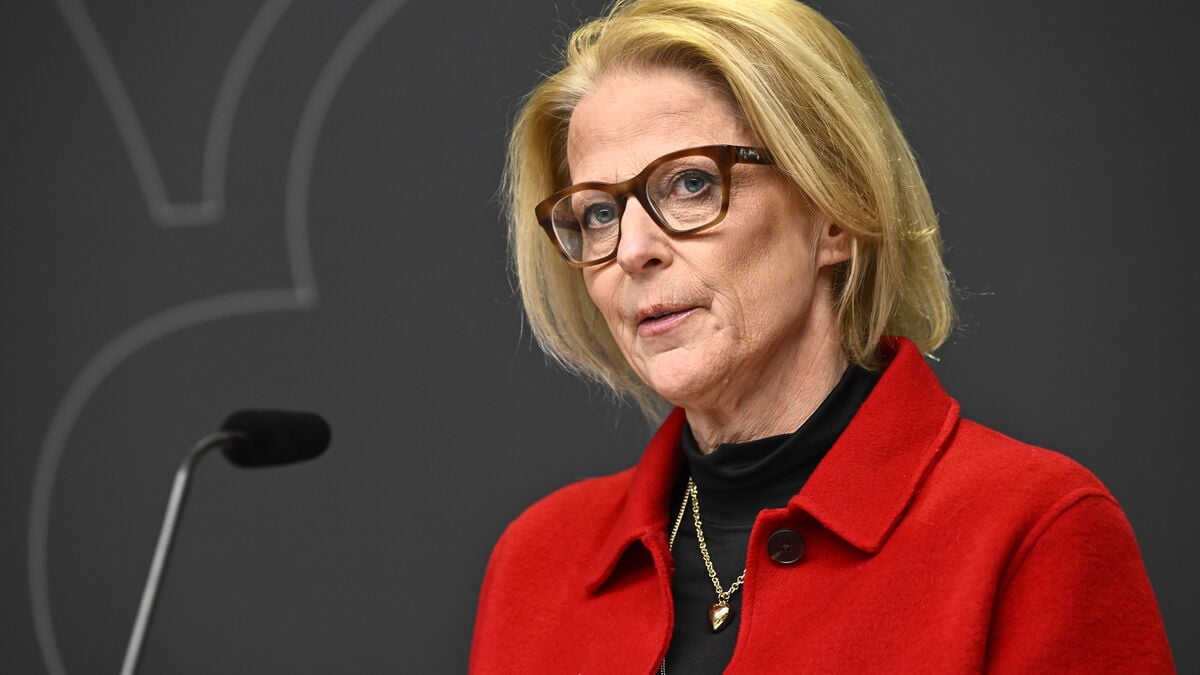
She does not yet want to say how the EU will fight back against Trump's tariff threats, or what position Sweden will take in the EU discussions.
"It is extremely important that we stand united now," she tells TT.
This afternoon she will travel to Brussels to meet with her fellow finance ministers.
Tough and harsh
The EU's response should be "tough and harsh", according to Svantesson.
"I understand there is concern about tariffs. But I don't think the biggest problem here is the tariffs. Of course, that's what Donald Trump is doing with Greenland."
France thinks the EU should deploy the "trade bazooka", according to sources.
"You shouldn't respond in an emotional way, but in a way that affects European companies as little as possible while also putting pressure on the US," says Svantesson.
At the same time, the Swedish and global economies appear to have weathered last year's tariffs better than expected:
"Tariffs are bad, they are harmful. But we should be calm; we have good conditions to cope economically," she says.
Mikael Damberg, economic policy spokesman for S, however, believes that the consequences could be major for the Swedish economy if the conflict develops into a full-blown trade war. He gets nervous when he hears Svantesson say that the Swedish economy is “Trump-proof”.
"It's a somewhat naive statement," he says.
Don't show weakness
Damberg does not think the EU should exclude any options in its response to Trump, with the aim of bringing him to the negotiating table.
"There is no room for weakness now. Trump must understand that Europe is united and that we are prepared to fight back if he chooses to impose these tariffs," he says.
Jan-Olof Jacke, CEO of the Confederation of Swedish Enterprise, calls the situation "very serious and worrying" for Swedish companies.
"It will be important to act with calm, strength and unity," he says about the role of business and politicians.
Do you share the Minister of Finance's view that the Swedish economy is "Trump-proof?"
"I completely agree that the Swedish economy is very strong. We are better equipped to handle a difficult situation than most others."
Using the so-called "trade bazooka" is not an obvious choice, according to Jacke.
"This requires careful thought and great caution. We should not put European companies in an even worse situation."
Background: Trump's threat
US President Donald Trump has threatened eight European countries, including Sweden, with 10 percent tariffs starting February 1.
Trump's tariff threat comes after Sweden and other countries - all NATO members - protested against Trump's increasingly aggressive demands that the US take over Greenland, and also initiated a joint military exercise in Greenland.
The governments of the EU countries - who have called for an extraordinary summit later this week - are now discussing possible countermeasures.
Among other things, there is a proposal for EU tariffs on US goods worth around SEK 1,000 billion. It may also be possible to introduce more extensive trade restrictions, such as blocking US companies from public procurement in the EU.
Trump has said that the 10 percent tariffs will be raised to 25 percent in June if there is no deal on Greenland by then.