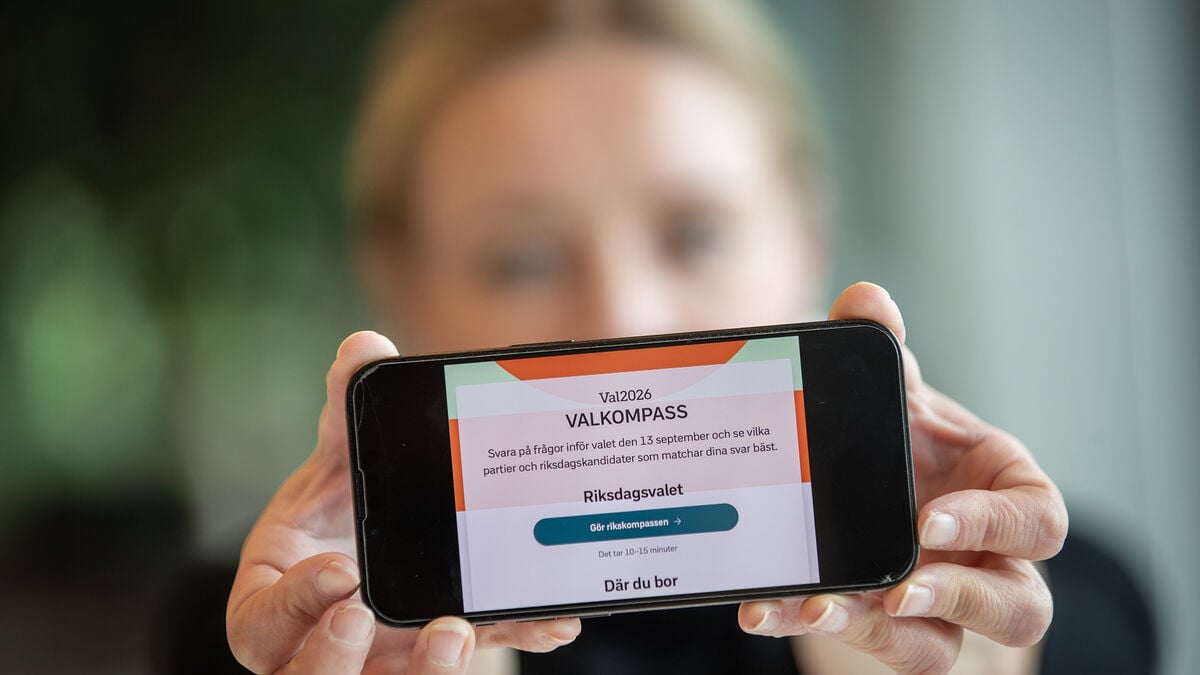
Most people have seen them - the media's digital election compasses that, in ten minutes, pinpoint which parties best match their own positions on current issues.
The fact is that the election compass has taken off since its broad impact in 2006. Before the 2022 election, 63 percent of voters had taken at least one party test, according to the Election Research Program's book "Voters and the 2022 Election".
The value of the compasses is also rated highly. In the Internet Foundation's survey Election Special 2026, half (50 percent) said the election compass would be an important source of information for them ahead of the autumn elections. Only televised party leader debates rank higher (55 percent).
Difficult to pin down
But if the election compasses are seen as sensible guidance, how common is it that the result also determines how people vote?
Researchers in the Electoral Research Program at the University of Gothenburg have delved into the question of how widespread it is for people to take away impressions from test results. They conclude that it is very difficult to pin down. Party tests cannot be isolated from all the other information that flows in an election campaign. Nor did compass users vote significantly differently from those who did not take any tests ahead of the 2022 election.
When voters themselves were surveyed after the 2022 election, the group of first-time voters stood out. Among them, 72 percent said that the test played some or a large role in how they voted.
It is not surprising, as we know that young people are more uncertain about how to vote and have less political knowledge, says Maria Solevid, associate professor of political science and a researcher within the Election Research Program.
In the voter group as a whole, a majority (56 percent) said that the party test did not play any role. However, 38 percent said that it played some role and for six percent it played a major role.
May be important
The six percent is still quite a bit on the margin, says political science professor Tommy Möller at Stockholm University.
It can be quite decisive. It can have a great impact on the electoral campaign when the elections are very close.
But Tommy Möller, who participated in the design of TT's election compass, believes that the party tests primarily play a large indirect role, as a political interest-arouser.
It is important to highlight the democratic value of the compasses. They increase interest, they increase knowledge among voters and that is what the election should be about, namely the substantive issues.
Facts: Election compasses
Digital election compasses, or party tests, became widely popular in the 2006 election campaign.
Since then, use has increased sharply. In 2006, 27 percent of voters said they had taken one or more tests. By 2022, the proportion had risen to 63 percent.
The election compasses ask a series of questions on current issues that the voter must take a position on. The results show the extent to which their own positions match those of the various parties.
The compasses include brief backgrounds and explanations.
In this year's election campaign, voters can, for example, create their own election compasses (at national and local levels) for SVT. These are also used by Sveriges Radio.
Aftonbladet and TT News Agency also have their own election compasses. TT's election compass is used by a number of other media.
Sources: Voters and the election, University of Gothenburg, and TT.