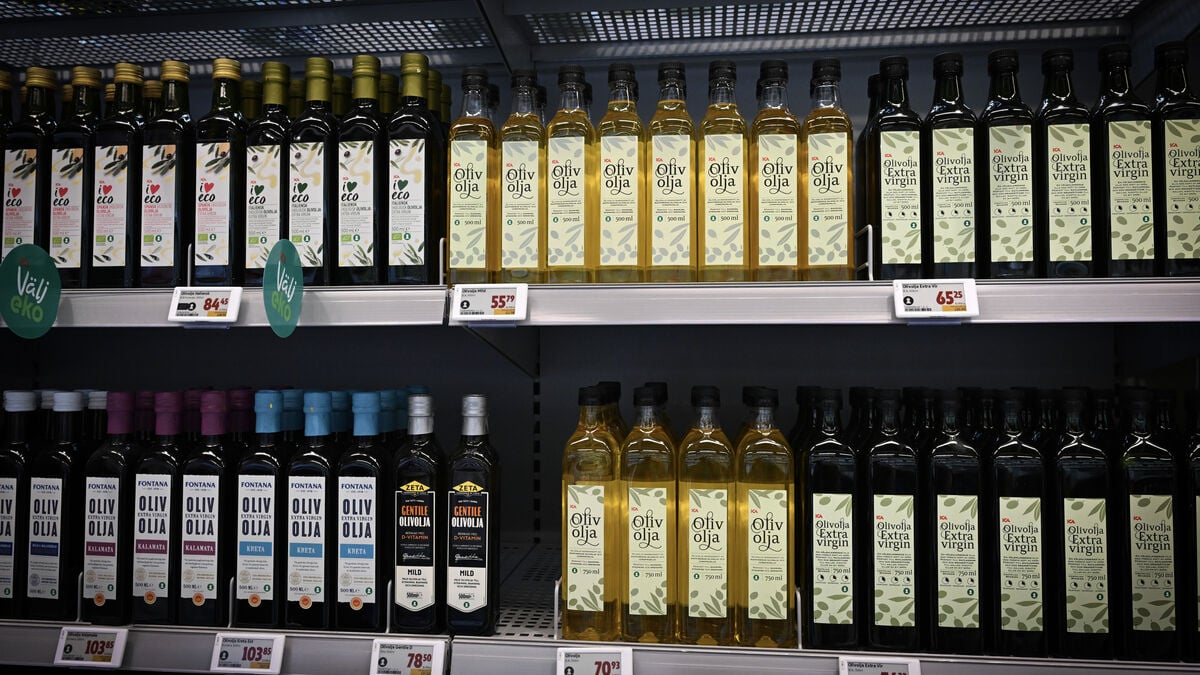
Between 2022 and 2024, the price of olive oil on store shelves in the EU soared by 78 percent. The rise was mainly due to drought and heat waves in Spain - first the olive harvest was halved, and the following season was also weak.
"For the last six seasons we have had below-average production. This is the first time, so prices have been very high," says Juan Vilar at the consulting firm Vilcon.
This summer has also brought extreme weather, and already in May, the analysis company Tridge warned that the price shock was not a one-time event.
Spring rain important
Many olive groves lack irrigation and are therefore vulnerable to prolonged drought. Some industry representatives have warned that prices could rise if the weather does not improve. But Vilar sees a new, better harvest era.
The most important thing was that it rained this spring. The current situation with the difficult summer means that we will not have the best season, but still a good season, says Vilar.
The Spanish producer price for extra virgin olive oil has been just under 4 euros per kilo this summer, compared with 9 euros at the peak in January 2024.
The only thing that affects the price is the expectations of the harvest. So people believe that the upcoming harvest will be higher than the last one, which affects the price, says Vilar.
“Stable scenario”
Spanish olive oil giant Deoleo also sees stabilization after several shaky years, with a “robust and balanced supply worldwide.”
"We expect a stable scenario in terms of overall supply. Despite the recent high temperatures, we have seen favorable rainfall trends over the year across the major producing countries in Europe, such as Spain," the company writes in an email to TT.
Early conclusions
In Sweden, the company Di Luca & Di Luca, with the Zeta brand, has not seen any signs of turbulence.
We have not received any information or alerts that this heat wave has affected supply, says Helene Rehnberg, Head of Purchasing and Quality.
At the same time, she emphasizes that it is still too early to draw firm conclusions.
Because the harvest doesn't start until the end of September and the beginning of October, and most people would like to see rainfall in September.
Vilar also points out the uncertainty.
Forecast and reality are different things. But my opinion is that prices will drop until the end of the year.
Olives have been cultivated in the Mediterranean region for more than 6,000 years, and the area dominates world production, although there are cultivations in South America and Australia.
Olives are heat and drought tolerant, and are therefore often grown in places where few other crops thrive. However, an increasing number of olive plantations now use drip irrigation.
The vast majority of the world's cultivated olives are made into olive oil, of which there are about eight categories. The Greeks are the largest consumers in the EU, with twelve kilos per person per year.
Within 24 hours of harvest, the olives are crushed in mills, then the mixture is stirred before the oil is separated. It is then often stored for a couple of months before being bottled.
Source: American Society for Horticulture Science, Landscape and Urban Planning, European Commission.