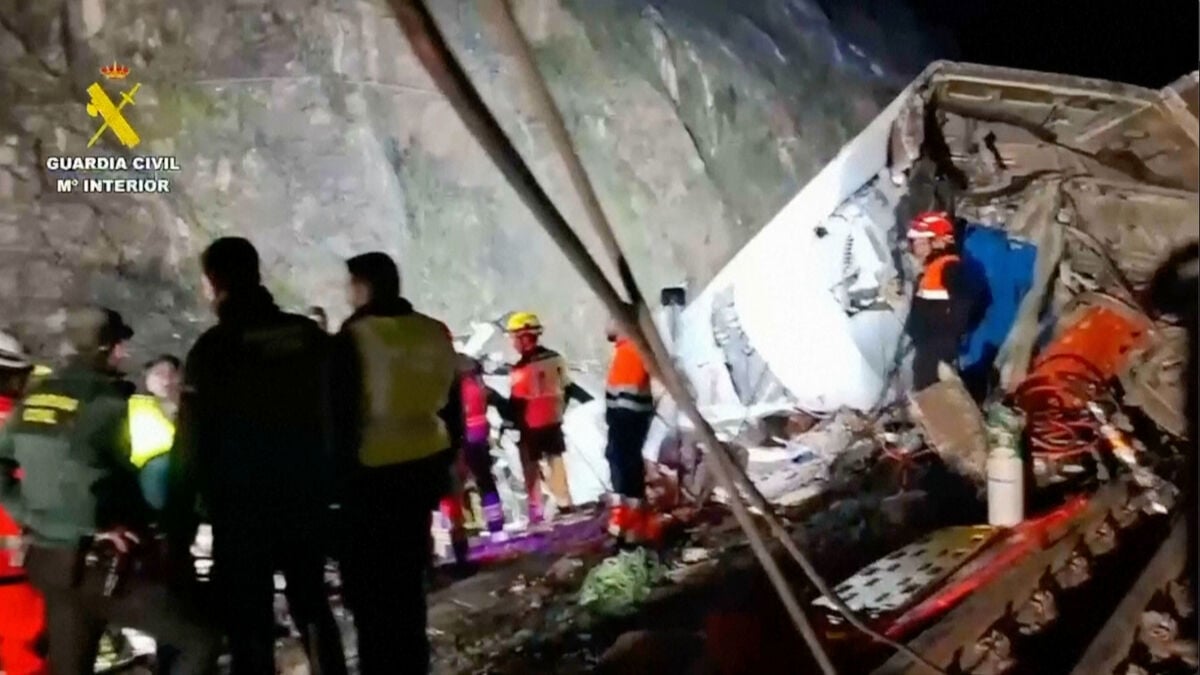
Television journalist Salvador Jiménez, who was on board one of the trains that crashed, told RTVE that survivors climbed out of badly damaged carriages through broken windows and that the derailment itself felt like an earthquake, AP writes.
Other witnesses, including those who spoke to the newspaper El País, described screams, falling luggage and trolleys that were transformed into "distorted chaos".
Transport Minister Óscar Puente says the death toll is "not definitive," AFP reports, warning it could rise.
Difficult rescue work
The accident occurred when a high-speed train en route to Atocha station in Madrid derailed on Sunday.
"At 19:45, Iryo train 6189 on the Málaga-Atocha route derailed at Adamuz, ended up on the oncoming tracks and caused Alvia train 2384 from Madrid to Huelva to also derail," train operator Renfe wrote on X.
The Iryo train is believed to have been carrying around 300 people on board, while the Alvia train from Renfe had around 180 passengers.
Iryo is a challenger to Renfe on the Spanish high-speed network. The company is backed, among others, by the Italian Trenitalia.
"My deepest condolences to the families and relatives of the victims of the accident," Renfe boss Álvaro Heredia wrote.
Vibrations in the rails
According to Spanish media, Transport Minister Puente described the derailment as "extremely strange", as it happened on a straight stretch that was renovated as recently as last spring. The train that derailed was inspected on Thursday, Iryo reports.
The cause of the accident is currently unclear. However, Spanish media say there have been previous reports of vibrations in the rails on the route. Since it was the rear carriages of the Iryo train that derailed, such vibrations may have contributed. The forces are immense, as Spanish high-speed trains can run at 300 kilometers per hour.
"It is difficult to grasp the extent of what has happened. Renfe rescue teams continue to collaborate with authorities," Heredia added in a post where he also published photos from the scene of the accident.
Prime Minister Pedro Sánchez will visit the scene of the accident on Monday, AFP reports. He has canceled other commitments and a trip to the World Economic Forum in Davos this week.
Facts: Serious train accidents in Europe
February 2023, Greece: A passenger train carrying 350 people en route from Athens to Thessaloniki collided head-on with an oncoming freight train. 57 people died.
January 2019, Denmark: Eight people were killed in an accident on the Great Belt Bridge when a train collided with a truck trailer that fell from a freight train in a storm. At least 16 people were injured.
July 2016, Italy: 27 people were killed and 50 were injured when two trains collided head-on in the city of Andria.
February 2016, Germany: Eleven people died when two passenger trains collided head-on at Bad Aibling in Bavaria. 85 were injured.
November 2015, France: Eleven people died when a train derailed north of Strasbourg.
July 2013, Spain: At least 77 died and around 140 were injured when a train derailed near Santiago de Compostela.
March 2012, Poland: 16 died and 58 were injured in a head-on collision near Szczekociny.
February 2010, Belgium: 18 died when two trains collided at high speed at Buizingen near Halle.