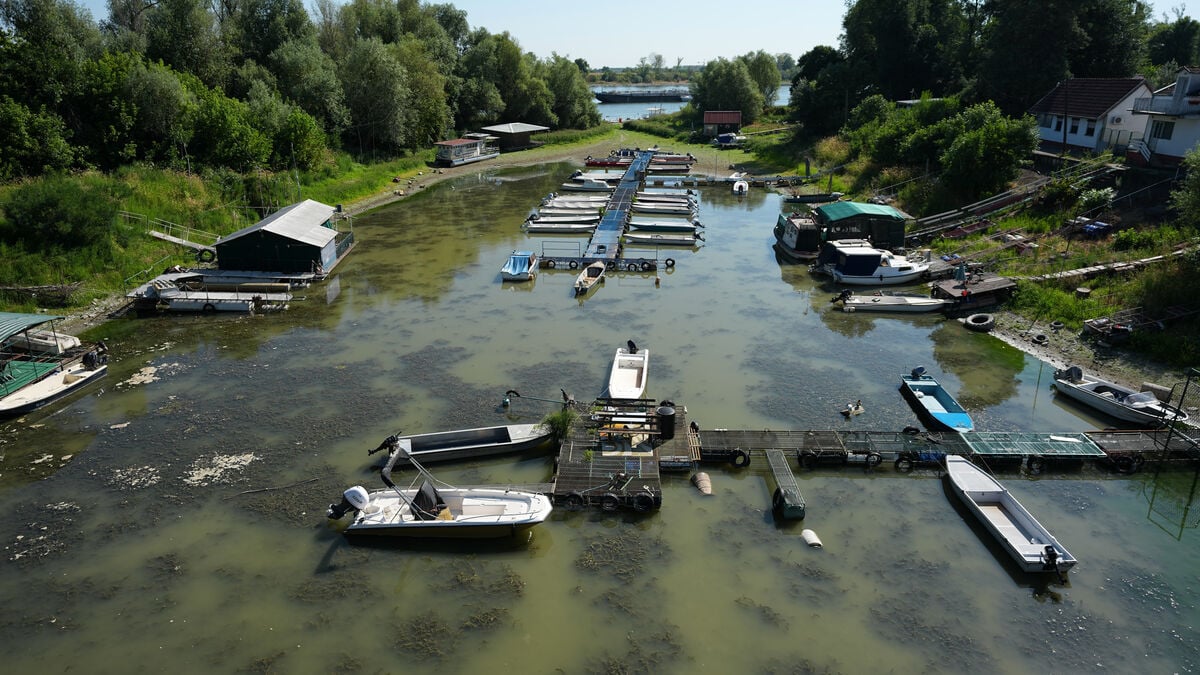
The AP news agency has spoken to Segrt and other residents of Budapest, where the Danube's level is now one decimetre below 2018, the previous record low.
The river has receded 15 to 20 metres from the shoreline, says Segrt, who usually arranges boat trips for tourists.
Prolonged drought has had the same effects on the Danube and the Rhine. And alongside tourism, these giant rivers are economic lifelines for shipping.
The big ones in terms of volume are raw materials, oil, iron ore, coal and grain, says Johan Woxenius, professor of maritime transport economics and logistics at the School of Business, Economics and Law at the University of Gothenburg.
Great harvest time
But now things are running on a shoestring. According to the German news site DW, some barges are only daring to take 15 to 20 percent of their usual cargo, for fear of running aground. Capacity is plummeting, and prices are skyrocketing, at the same time as it is peak season for many goods.
The grain will probably need a lot of shipping capacity. It's a big harvest time now, says Woxenius.
The problem comes during dry summers, which is only a small part of the year. This makes it difficult to achieve profitability in building alternatives, says Woxenius.
But if I were a logistician or ran a shipping company, it would have been difficult to turn a blind eye to the fact that this would happen again, probably more often.
We've seen it in 2018, 2022, and 2026. Those are pretty close intervals.
Media estimates that the problem could even lower this quarter's GDP in Germany, Europe's largest economy.
"They have a lot of infrastructure in Germany along the rivers. It's natural that both highways and railways run there," says Woxenius.
Triggered by climate change
In Budapest, AP photographer Gábor Kertész meets, who documents that the foundations of the famous Margaret Bridge in the Danube are now dry.
It's shocking to see the difference between then and now, he says.
This must have been triggered by climate change.
Further south, the same river forms the border between Romania and Bulgaria. Fishermen there tell AFP that there is so little water that it is possible to wade between the countries.
Children who try to swim barely get their legs wet.
It's like quicksand! A boy shouts as he walks along the jagged shoreline.
In both Romania and Hungary, nuclear reactors depend on cooling water from the Danube. Several of them have reduced production or have been shut down completely.
In terms of water flow, Europe's largest river is the Volga, but it only flows through Russia.
For the rest of Europe, the Danube and the Rhine are numbers one and two. The Danube flows from southern Germany to the Black Sea - through or along the borders of Austria, Slovakia, Hungary, Croatia, Serbia, Bulgaria, Romania, Moldova and Ukraine in turn.
The Rhine flows from the Alps to the North Sea. It forms part of the border between Germany and Switzerland, and between Germany and France. It also flows in or near the Netherlands and Liechtenstein.
The water flow in the large rivers normally amounts to several thousand cubic metres every second.