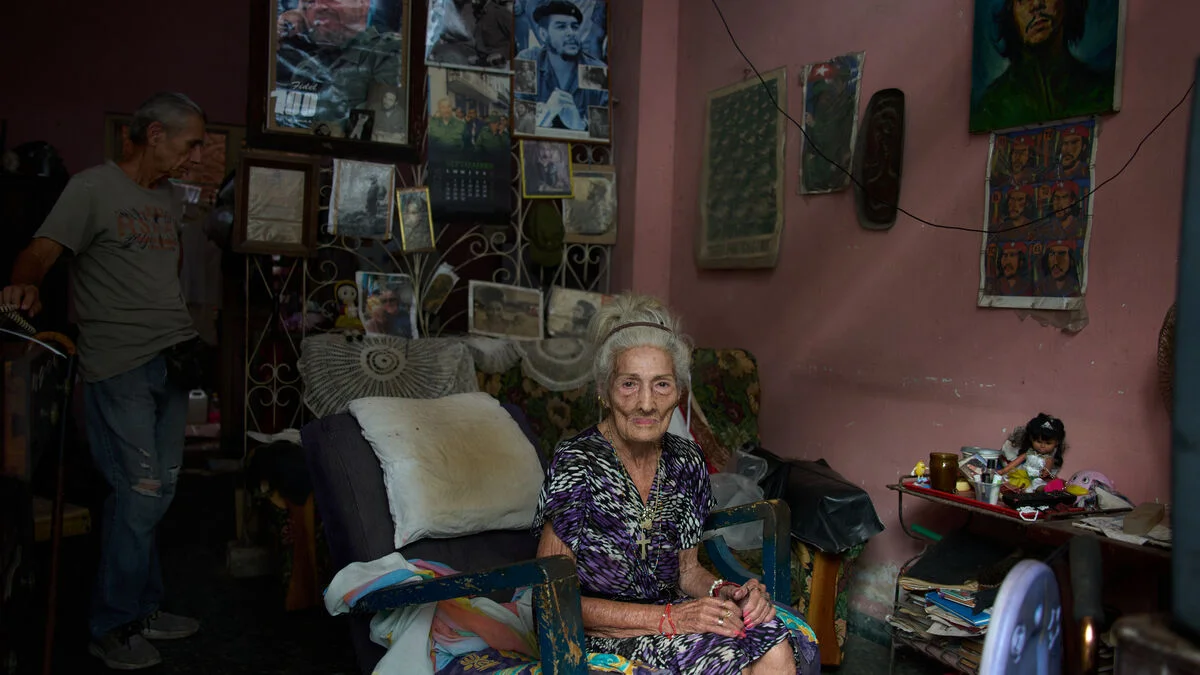
81-year-old Oscar Joaquín López collects water from a pipe on the street. 62-year-old José Laó Faviel searches through garbage to feed his pig and her ten piglets.
"What should I do? These are difficult times," the Havana resident told the AP news agency.
Cuba has been in crisis for decades - a result of the Communist Party’s autocracy and planned economy combined with the US trade embargo that was imposed as early as the 1960s. Now the situation is described as worse than ever. The fuel blockade that the US imposed in January - shortly after Cuba’s oil supplies from Venezuela were cut off with the arrest of Nicolás Maduro - has meant that Cuba has been completely cut off from oil supplies and money flows.
President Donald Trump did not cause the Cuban Missile Crisis, but he definitely made it much worse, Harvard professor Alejandro de la Fuente tells El País .
Escape or be imprisoned
Perhaps the most visible consequence is the constant power outages. With the blockade, there is no oil to run Cuba's power plants, nor any foreign currency to buy spare parts for the outdated facilities. Since January, Cuba has been blacked out a total of at least six times.
The US embassy in Havana recently warned of an increase in gastrointestinal illnesses due to deteriorating water and energy infrastructure. The blockade has made food, water and medicine scarce. Hospitals are struggling to function and schools and government offices are closed.
"They are exterminating us," Dianne Tamayo, a mother of young children in Havana, told the AP .
The streets of the capital are strangely deserted. Tourism is down and Cubans are fleeing. According to analysts, up to a quarter of the population has left the island since 2020 - figures that can only be compared to active war zones. Those who dare to protest are thrown into prison: hundreds of political prisoners are crowded into Cuba's prisons, according to Human Rights Watch .
Strengthens the regime
For the AP, general practitioner Yomeidis Felicó Riverón describes a people who have lost all hope. Nowadays, she is increasingly being asked to act as a psychologist.
People come here and cry about their problems. They have no one else to vent to.
US President Donald Trump has repeatedly threatened to “take over” Cuba. But the US threats and sanctions are only strengthening the Cuban regime, many analysts say. The consequences will be borne by the civilian population.
The embargo and US sanctions have only served to justify the continued existence of a single political party, Mexican researcher and former Cuban ambassador Roberta Lajous told El País.
This suffering just can't continue.
Cuba in the Caribbean is one of the last communist countries in the world. The country is a communist one-party state that is still strongly influenced by the 1959 revolution, when Fidel Castro took power in Havana and forced dictator Fulgencio Batista to flee.
Cuba's new constitution, which came into effect in 2019, like its predecessor, states that the Communist Party (Partido Comunista de Cuba, PCC) shall play the leading role in society and the state. No other parties are permitted.
The Communist Party controls all governing bodies from the government down to the municipal councils. Since 1992, general elections have been held for parliament, the national assembly, provincial assemblies and municipal councils. However, all candidates must be approved in advance by the party.
Until 2006, Fidel Castro was President of the Council of State, but then, due to health reasons, he handed over power to his brother Raúl Castro. In 2018, Vice President Miguel Díaz-Canel was appointed as Raúl Castro's successor and President of the Republic. In April 2021, he also became leader of the Communist Party, which is considered the most powerful position in the country.
Cuba has a population of around 10 million. Some market economic reforms have been implemented in the last decade, but the economy is still largely state-run and is now in its worst crisis since the early 1990s.
The US has had a trade embargo on Cuba for over 60 years, but in 2026 the pressure has increased significantly. Oil imports have been cut, leading to repeated power outages and an increasingly acute energy crisis.
Source: Landguiden/UI and others