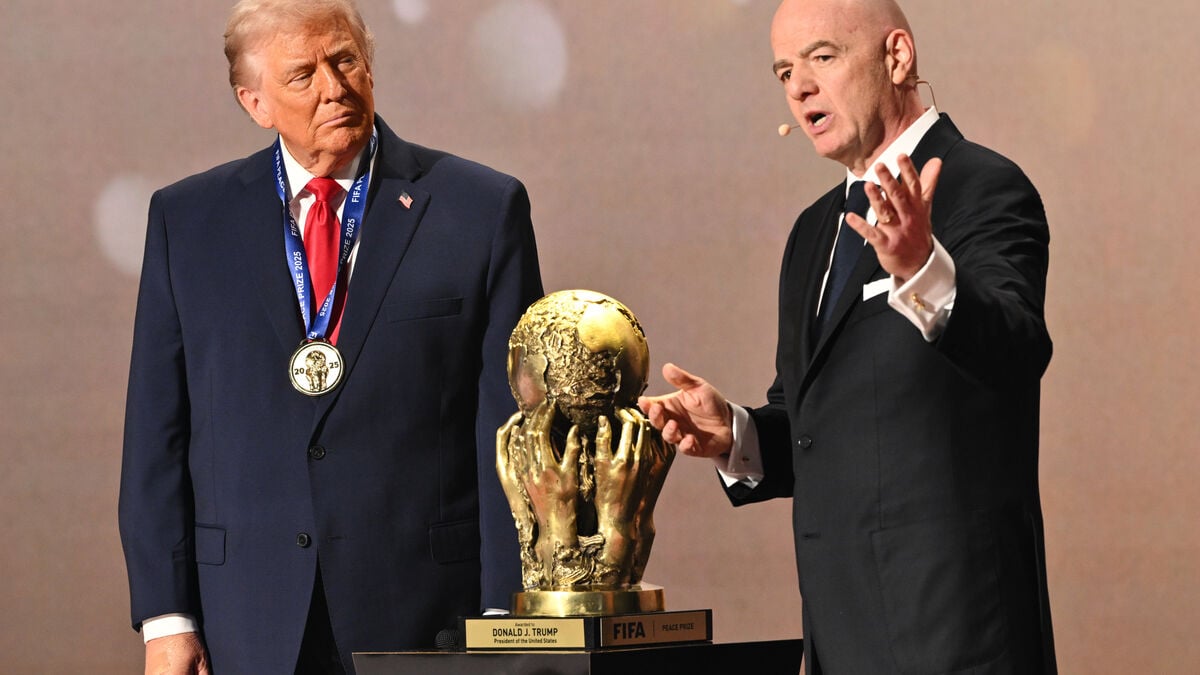
This summer's World Cup will be played in the United States, Canada and Mexico. Two-thirds of all matches will be played in the United States, a country that, according to the human rights organization Amnesty, is in a human rights crisis.
Many human rights are in free fall. Based on our latest report, we see that access to the World Cup will not be equal. There are various travel restrictions, discriminatory migration policies and increased controls that mean that some fans will not be able to participate, says Maja Åberg.
Under the new US travel restrictions, people from World Cup-qualified countries Iran, Haiti, Senegal and Ivory Coast are at risk of being denied entry. For other travelers, there are proposals to have their social media accounts reviewed for anti-American content as part of the entry process.
“Cannot downplay the risks”
Victor Montagliani, one of FIFA's vice-presidents, tells AFP that concerns about security and geopolitical tensions are exaggerated. Maja Åberg does not think so.
You can't downplay the risks when you actually see major human rights violations in these countries.
Montagliani says that security is the most important thing for the World Cup event.
"Of course, you want everyone to be safe during the matches. But the security work must be done correctly. What you can see is the risk that groups and people will end up in trouble if the security work is militarized or that certain groups will be discriminated against because of the countries they come from, or because of their appearance," says Åberg.
Amnesty also says that space for protests and freedom of expression in the host countries is being restricted in various ways and sees a great risk that any protests in connection with the World Cup could be suppressed.
Hoping for attention
This year, the World Cup has been expanded to 48 nations, which will generate a record-breaking financial profit.
Then the least you can ask for is that it happens with respect for human rights and that there are no risks for fans, journalists, players and those who work on it, says Åberg.
She hopes that FIFA and the host nations pay attention to Amnesty's report and its message.
Given how much attention the deteriorating human rights situation in the US has received, I hope this is taken to heart.
Facts: Amnesty's demands ahead of the World Cup
In a report ahead of this summer's World Cup, the human rights organization Amnesty has compiled demands it has of the International Football Federation (FIFA), the host countries United States, Canada and Mexico, and the host cities.
+ Guarantee the right to freedom of expression and peaceful assembly in and outside World Cup stadiums in all host countries, avoid the use of military forces for civilian policing, and protect the media and human rights defenders.
+ Stop arbitrary raids, racial profiling, arbitrary arrests, mass detentions, and unlawful deportations in the United States. Provide public assurances that World Cup matches, stadiums, and gatherings around matches will not be subject to immigration controls.
+ Lift the discriminatory travel bans to the United States, including for teams that have qualified for the tournament, and scrap proposals to review the social media accounts of entrants.
+ Take effective measures to protect LGBTQI supporters from discrimination, harassment and abuse, including through anti-discrimination campaigns and the proper use of FIFA's anti-discrimination protocol during matches, throughout the tournament and also after the tournament.
+ Ensure the publication of updated and strengthened human rights action plans for host cities (in line with FIFA's own framework) that provide comprehensive protection for fans, players, journalists, those working with the World Cup and local communities.
+ The tournament will be held June 11–July 19 in the United States, Canada and Mexico.
+ The World Cup is being expanded this year to 48 teams, 16 more than in Qatar 2022. The teams are divided into twelve groups of four. A total of 104 matches will be played in 16 stadiums. United States: Dallas, New Jersey, Atlanta, Kansas City, Houston, San Francisco Bay, Los Angeles, Philadelphia, Seattle, Boston and Miami. Canada: Vancouver and Toronto. Mexico: Mexico City, Monterrey and Guadalajara.
+ The World Cup playoffs begin with round of 32 matches (32 teams) on June 29–July 3. The round of 16 will be played on July 4–7, the quarterfinals on July 9–11, the semifinals on July 14–15, the bronze medal match on July 18 and the final on July 19.
+ The prize pool is the largest in history. All 48 participating teams are guaranteed 98.5 million kronor ($10.5 million). The world champion team collects 469 million kronor ($50 million).
+ A total of around 7 million tickets will be released. FIFA has received requests to purchase 508 million tickets. In the first sales period that ended on February 27, over 1 million tickets were sold, according to FIFA. The next sales period starts on April 1.