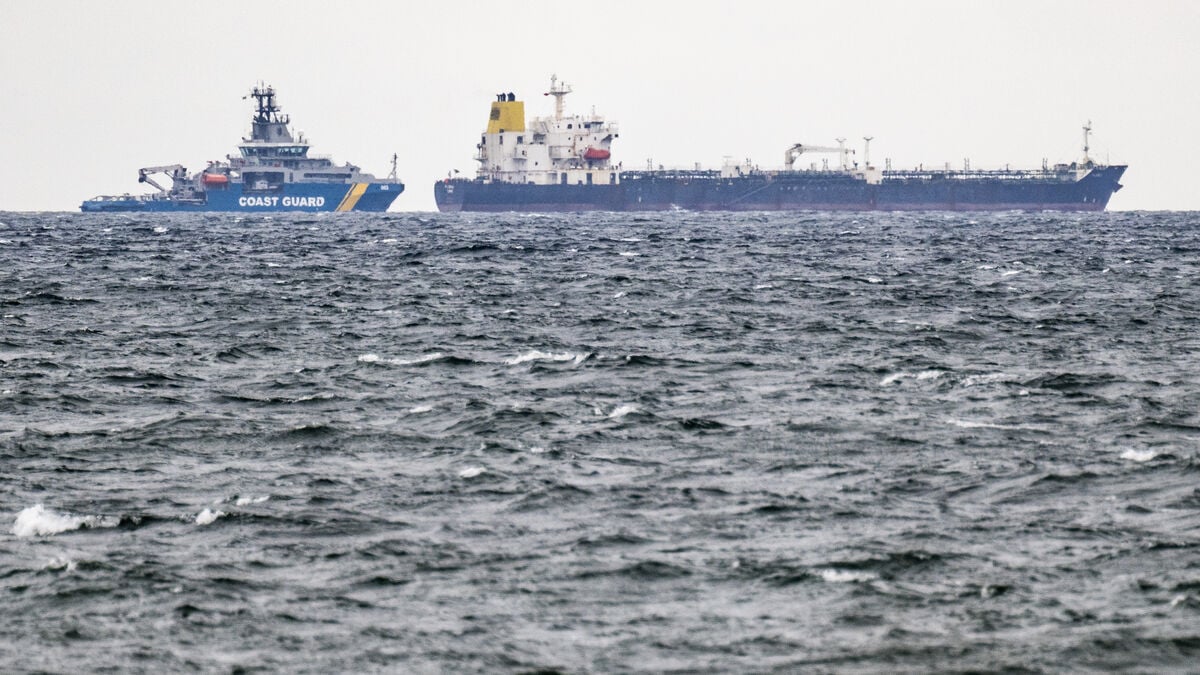
The oil spill in the Baltic Sea east of Gotland was discovered on Thursday morning and traced to the tanker Flora 1. The Coast Guard began boarding on Friday morning.
"In connection with our identification of the ship, we note that it is on the EU sanctions list. So there is a lot of important information that we need to follow up on," says Mattias Lindholm, press officer at the Coast Guard.
Later on Good Friday, the Swedish Public Prosecutor's Office announced that two members of the crew had been questioned and subsequently charged with a violation of the Act on Measures to Combat Pollution from Ships. The men are foreign citizens and have not been arrested.
According to Mattias Lindholm, at least 2,000 liters of oil have been released, but it has not been possible to clean it up and it has now dispersed at sea. The oil tanker is anchored just south of Ystad.
"Unclear flag status"
Flora 1 is registered in Sierra Leone, but where the ship actually belongs is unclear.
There are many uncertainties regarding the flag status and which flag state this ship belongs to, and that is, of course, interesting, says Lindholm.
The Minister of Civil Defense, Carl-Oskar Bohlin (M), writes in a post on X that the government is taking the incident seriously:
"The Russian shadow fleet, consisting of older, inadequately insured tankers that evade sanctions, poses a significant security and environmental threat."
Rules around shadow fleet
There is no clear definition of what constitutes the Russian shadow fleet, which is why the Coast Guard does not want to use the term. However, the term "shadow fleet" is used for a number of tankers that Russia uses to circumvent sanctions.
The ships are usually outdated, falsely flagged, and do not always transmit an identification signal. In addition, insurance conditions are often unclear.
"In that respect, you could say that it (Flora 1) belongs to the shadow fleet. It clearly shows such characteristics," says Mattias Lindholm.
This is the third time in a month that the Coast Guard has boarded a ship suspected of sailing under a false flag. Both the tanker Sea Owl and the bulk carrier Caffa were boarded in early March outside Trelleborg. The ships' respective Russian captains are in custody on suspicion of using a false document, a felony.
A large proportion of ships in global maritime traffic sail under so-called flags of convenience. This means that the ship is registered in a country other than the one where its owner is based - usually to circumvent regulations, high tax requirements and wage costs. This has happened in various forms for many centuries.
A so-called country of convenience allows any number of foreign ships to be registered there.
During the years that Russia's notorious shadow fleet has grown, an increasing number of tankers sailing to and from Russian ports have been registered in, for example, the Cook Islands, Gabon, Cameroon, Palau, Vietnam, and Saint Kitts and Nevis.
The trade union organization International Transport Workers' Federation (ITF) labels 42 countries or territories as flags of convenience.