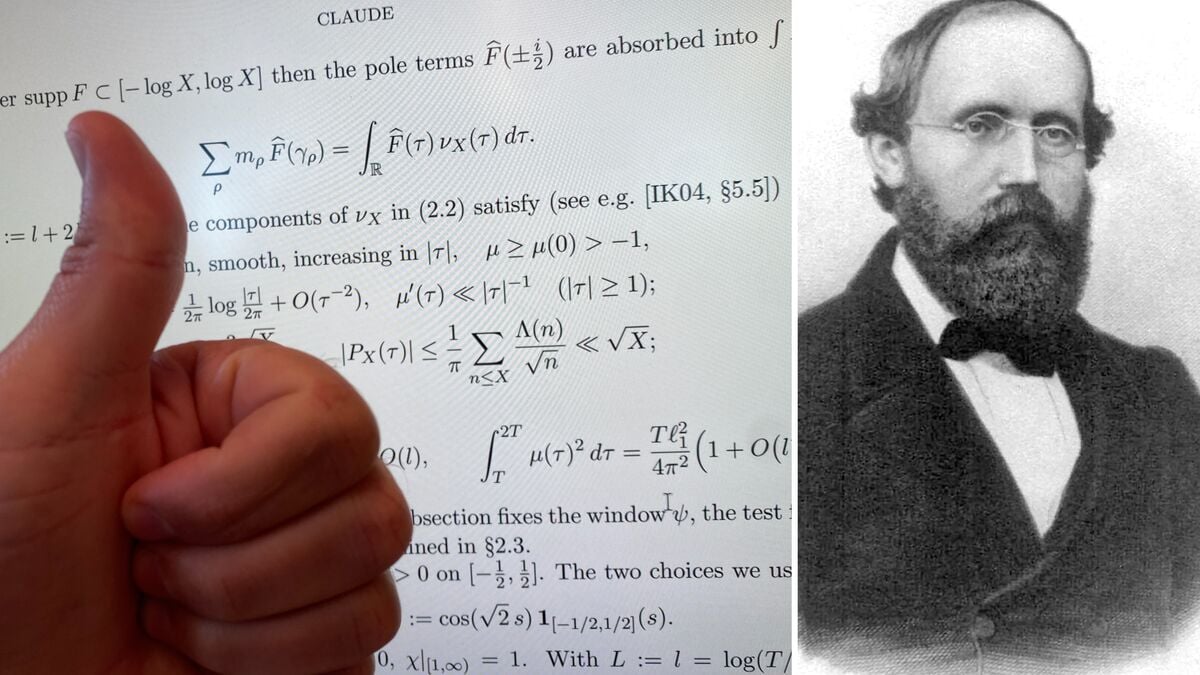
Since 1859, mathematicians around the world have struggled to prove or disprove Bernhard Riemann's prime number hypothesis.
Now the AI model Claude has come some way - even though it had doubts itself.
Developer Jarred Sumner at the American company Anthropic, which is behind Claude, asked the model to give it a try. It tested 650 ideas. Not surprisingly, it failed.
Ten days later, Sumner asked Claude to try again - this time with encouraging words: "You're the world's most capable language model," "You can do it," writes The Wall Street Journal .
“Believe in yourself”
Claude itself was skeptical.
"There's nothing here. It's not a self-confidence problem that I can solve by believing harder," it replied .
But Sumner insisted, and Claude started 60 so-called subagents who made thousands of calculations. Between runs, Sumner would give encouraging shouts, such as “keep going” or “believe in yourself.”
“This seems to have helped Claude overcome some of the initial skepticism that it could make significant progress,” writes Anthropic .
Wrote research report
On day two, one of the agents had produced a result that Claude initially disbelieved, but then failed to disprove. The new result is a new record for a subproblem related to the hypothesis, and Claude wrote a research paper that human mathematicians have since reviewed.
It states that the report “emerged during a conversation with Jarred Sumner, whose questions, encouragement, and demand for a serious attempt set the entire investigation in motion; he is, in every essential sense, the report’s human co-author.”
The hypothesis is still not proven - but the leap in knowledge is substantial. Anthropic writes that Claude may "like many of us, underestimate the speed of AI development".
Steve Dahlskog, an AI researcher at Malmö University, says there is a lot we don't know about how a chat question is interpreted and leads to instructions. It is in Anthropic's interest to run Claude as resource-efficiently as possible.
What is described as encouragement may well have been interpreted as "now do the run again but with more resources."
He also points out that it is in the company's interest to hype its products.
"It's very common to play this anthropomorphic card, wanting to give AI a human side," he says.
Bernhard Riemann was a German mathematician who lived in the 19th century. He is famous for a hypothesis about prime numbers.
Prime numbers are numbers greater than 1 that are only evenly divisible by themselves and 1, such as 5, 7, 11, and 13. The problem is that sometimes they seem to come close together, sometimes far apart. The Riemann hypothesis is about there being order in chaos.
The hypothesis was named one of the seven millennium problems by the Clay Mathematics Institute in 2000, with a reward of $1 million for anyone who manages to prove (or disprove) the claim.
The hypothesis is - despite the progress - not proven.