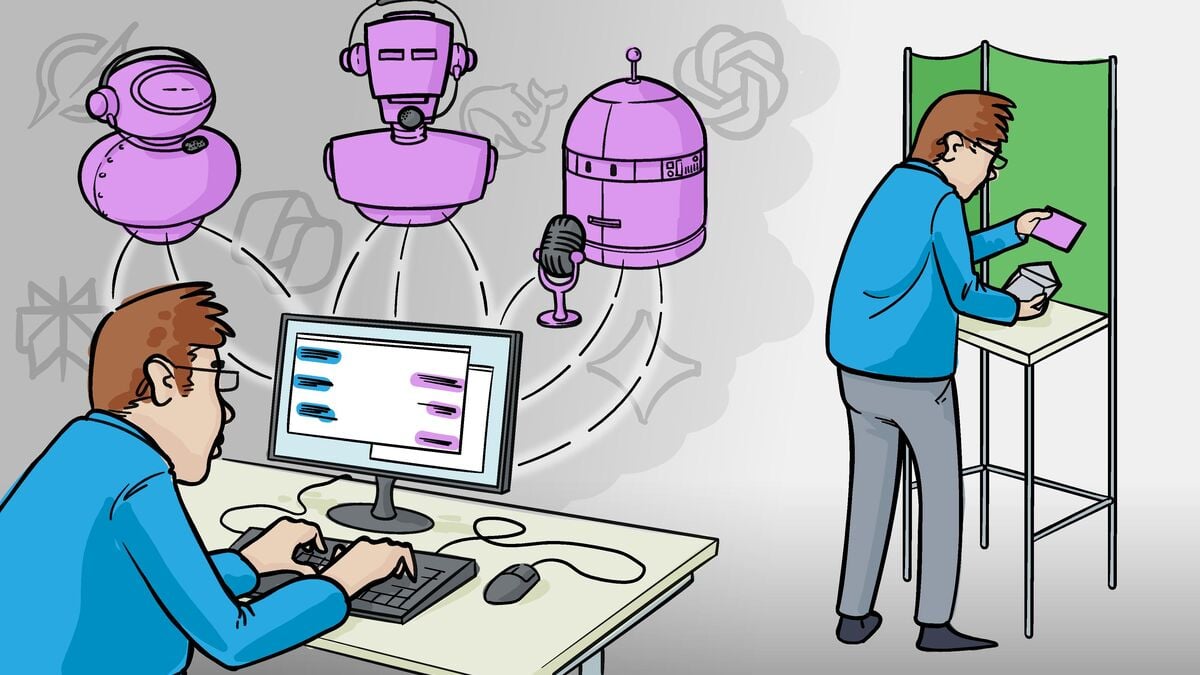
There is great concern about how generative AI, especially chatbots, could be used to influence voters on various issues. In a large experiment, researchers in the US, Canada and other countries had thousands of people chat with an AI before elections in the US, Canada and Poland. The chatbots were instructed to advocate for one side or the other in the election, and the result was clear: voters changed their minds to a significantly greater extent than with traditional advertising, according to the report published in Nature.
“Subjects were allowed to discuss politics with large chatbots, and the researchers instructed the chatbots to try to persuade the subjects about various things,” says Markus Furendal, a researcher at Stockholm University and the Institute for Futures Studies, who is not involved in the study.
Changed candidate
The effect also persisted when the researchers followed up on the experiment a month later.
In simple terms, voters became slightly more positive about the candidate the AI advocated, especially if it was a candidate who did not have the voter's support to begin with. A Trump voter thus became more positive about Kamala Harris after chatting with the bot, and vice versa. The effect was so clear that it also slightly increased the likelihood that the voter would vote for the other candidate.
Facts most important
According to the study, it was mainly fact-based arguments, rather than psychological persuasion methods, that mattered. However, the facts did not necessarily have to be true.
Furendal says the same results could probably be achieved with campaign workers. One difference is that chatbots can theoretically talk to many more people. At the same time, it can be difficult to get a voter to voluntarily chat with a party AI from the opposing side.
“It's not certain it would be the same if you applied the same strategies in reality,” he says.
Embargo: Facts: How the survey was conducted
A total of just over 6,000 volunteers were recruited for elections in the US, Canada and Poland this year and last year.
The subjects were first asked about their political preferences. The AI was told which candidate the voter preferred and which issues they thought were most important, and then tried to persuade the voter.
After participants chatted with the bot, preferences were tested again, and a follow-up was conducted a month later.
Various chatbots such as GPT-4o, Deepseek-V3, and Llama-4-Maverick were used.
The study was published in Nature.