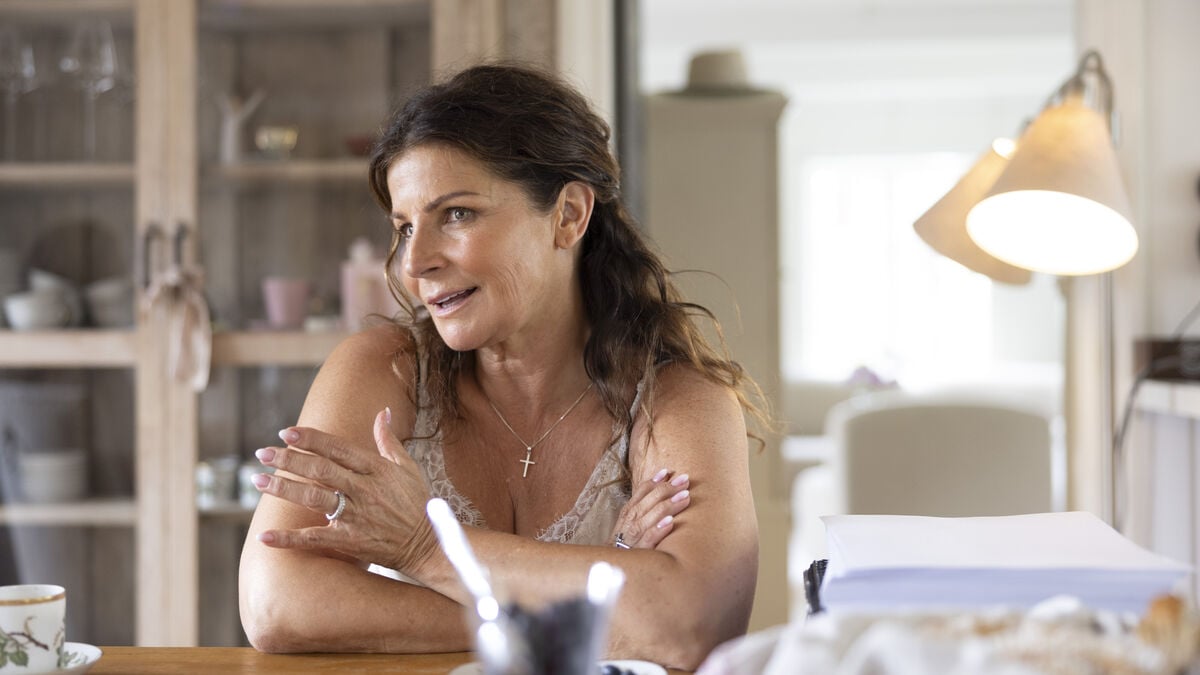
Strong winds blow at Carola's new country home in Skåne. Her hair flutters and it's impossible not to think of "Caught by a Storm Wind" - the song that took her all the way to Eurovision victory in 1991.
For Carola, the meaning of songs tends to change over time.
Today, she would rather talk about what makes her feel free than trapped by something, and she would rather not elaborate on the passage in the book where she writes that she felt psychologically abused.
"I have deliberately chosen not to delve into it," she says.
“No sacrifice”
Between the lines, the accusation appears to be directed at her ex-husband Runar Sögaard. She sensed the warning signs already during their honeymoon. However, what preceded the accusation remains unsaid.
Why so few details about something that you still choose to cover and which is a central part of the book?
I'm not a victim. I'm making sure I get free. I could sit and talk about this all day, but then I'd be caught.
She answers vaguely when asked how serious it was and whether it was something she had reported to the police today, considering that psychological violence has recently been criminalized in Sweden.
I want my book to be honest. I want it to please God. I'm sure some Christians think I'm giving away too much.
Carola herself believes that it is important to be "authentic and true", both before God and her own audience. Sögaard has previously accused her of infidelity - an infidelity that she confirms in the book.
"I would like those who have stepped on the piano to know that there is a way back," she says, adding that she wants to be "a better person" than her ex-husband.
I don't think I'm standing here today because I sing "amazing". I think I'm standing here because I have clean channels.
Third ingredient missing
The relationship with God is something that Carola returns to several times in the biography of over 400 pages and also how it made her stay in a marriage she had begun to question.
In the late 1980s, Carola felt so bad that her parents took her to a psychiatric hospital. There, a doctor urged her to leave the Word of Life congregation because, according to the doctor, it was “better than taking medication that you can become addicted to.”
Carola insisted that Words of Life was not the problem and saw it as a battle won when she left without a prescription. She cannot answer what made her feel bad.
"There are some who have read the book and think that I was under such enormous pressure," she says, looking out over the fields of Skåne.
Even though she may question some choices in the past, she is in a good place today.
"I'm a grandmother and I've been given a farm. It's just the third ingredient that's missing, but he's coming," says Carola.
Answer from Sögaard
TT has been in contact with Runar Sögaard, who explains that "it sounds completely sick and horrible" that Carola experienced being subjected to psychological abuse and believes that it "absolutely" has nothing to do with him.
Correction: In an earlier version of the text, Carola used a different verb than “leaves out” in her fourth quote. This has now been changed.
Facts: Carola Häggkvist
On September 8, in connection with her 60th birthday, Carola Häggkvist will release her autobiography "Jag är Carola".
She wrote the book herself together with Desirée Stattin Drakenberg.
From August 20, Carola will give moving-in concerts at her new farm in Vejbystrand, Skåne. Starting on October 9, she will embark on the Nordic tour “I am Carola – a musical life story” with over 30 concerts.
The documentary film "Carola!" will premiere in Swedish cinemas on August 21. It is directed by My Sandström.
Carola herself describes that the book is written by her while the documentary is about her.
Carola broke through at the age of 16 when she won Melodifestivalen in 1983 with the smash hit "Främling".
Eight years later, she won the Eurovision Song Contest with "Fångad af en stormvind".
Today Carola lives in Stockholm. She has a summer house in Skåne, two children and a grandchild.