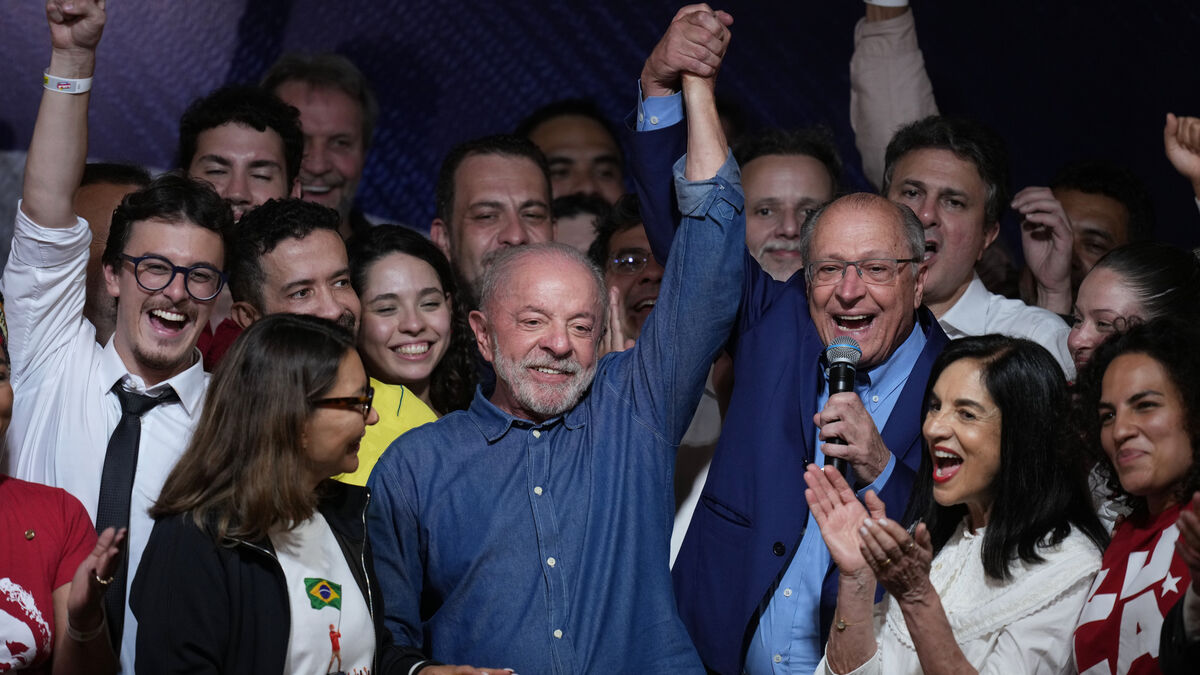
The left-wing president received 51.8 percent of the vote, compared with Bolsonaro's 48.2 percent, according to official figures, the AP news agency reports. That means around 4.4 million more votes for Lula, who turns 81 this week. Lula has thus secured a fourth term as president. He won his first presidential election in 2002.
"People went to vote because we managed to convince them that it was very important to vote to secure democracy in the country," Lula said after the election results were announced, the AFP news agency reports.
In the first round of the election on October 4, Lula received just over 45 percent of the vote, compared with Bolsonaro's 47 percent. Since neither candidate received more than 50 percent, the election was decided in a second round.
It has never happened that a candidate who has lost in the first round wins in the second. It is an incredible achievement by Lula, says Andrés Rivarola Puntigliano, a professor of Latin American studies at the Nordic Institute of Latin American Studies at Stockholm University.
He has never before experienced such a harsh tone in a Brazilian election campaign, but notes that the electoral system was flawed.
At a time when democracy is being questioned and regressing in so many places around the world, Brazil is demonstrating extraordinary democratic strength, says Andrés Rivarola Puntigliano.
Polling stations open longer
On election night, voting hours were extended following demands from both presidential candidates. Flávio Bolsonaro, son of imprisoned former president Jair Bolsonaro, called the extension, which was later ordered by the Supreme Court, “unacceptable” and said he would request that the election be annulled.
It is impossible to recognize the result, he says in Brasília.
However, Andrés Rivarola Puntigliano does not believe Bolsonaro has enough public support to succeed in having the election results reconsidered.
No "leftist victory"
With these election results, Brazil will not join the conservative wave in which other South American countries - such as Argentina, Chile, Colombia and Peru - have swung to the right.
At the same time, one should be careful not to describe the result as a straightforward left-wing victory, says Andrés Rivarola Puntigliano. Among Lula's supporters are many who could be described as right-leaning, including Lula's vice-president, Geraldo Alckmin.
There are also question marks over Lula's future rule, not least because of his age and the lack of an obvious successor.
He is a bit like the Rolling Stones of politics, who have incredible energy even though they are 80 years old. Lula is the same, but the path forward is still uncertain.
Facts: The election in Brazil
Lula da Silva and Flávio Bolsonaro have opposing views on most things, from climate change and social welfare to relations with the United States.
Lula is promising tighter regulation of big tech platforms, after previously trying to have Flávio Bolsonaro's candidacy invalidated, citing alleged election interference by tech giant Meta. Meta has denied giving any candidate an advantage or disadvantage ahead of the election.
During Lula's third term, Brazil has had lower inflation and unemployment, but voters have complained about the cost of living.
The economy, gang violence and relations with the United States were identified in advance as crucial issues.
Flávio Bolsonaro, the son of imprisoned former president Jair Bolsonaro, has very close ties to US President Donald Trump and has advocated for an even closer relationship between Brazil and Washington. The trade tariffs that the US imposed on Brazil last year were motivated, among other things, by what Trump called a “witch hunt” against Jair Bolsonaro. The former president was sentenced in September 2025 to 27 years and three months in prison, accused of attempting a coup after the 2022 elections.
The next term of office begins on January 5, 2027.


What do you think?