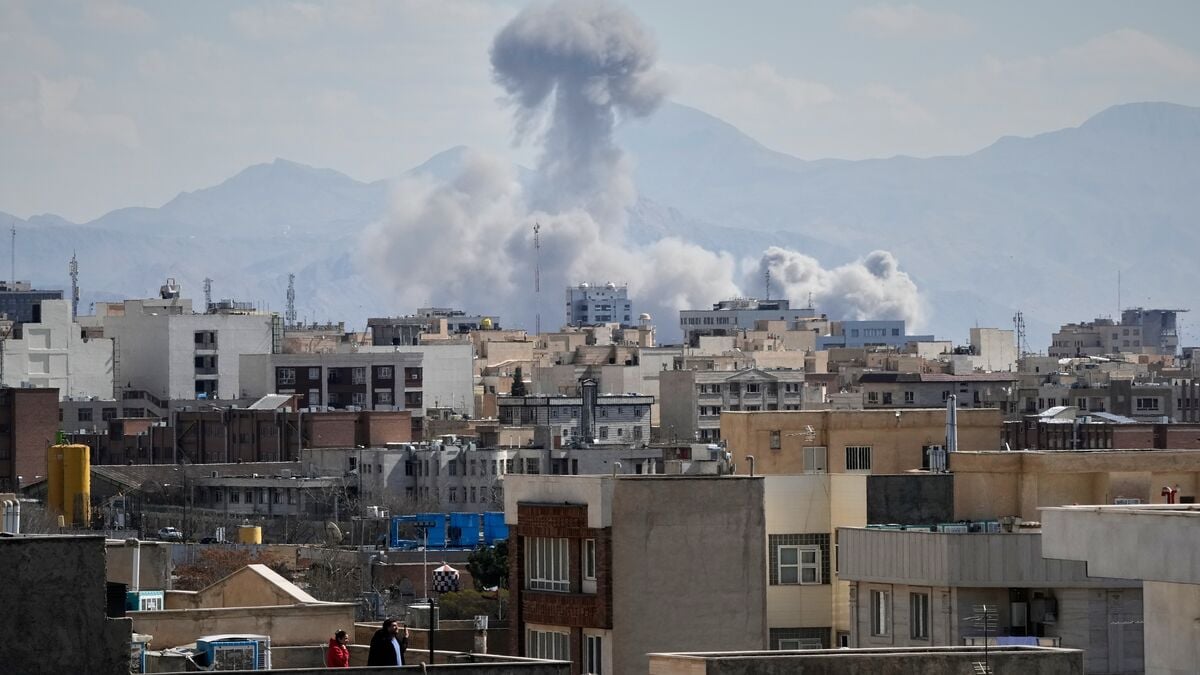
The first reports of explosions in the Iranian capital Tehran came shortly after 7 a.m. Saturday morning, local time in Sweden. Israel announced that the country had launched a “preemptive strike.”
Just over an hour later, Iranian media reported that the attacks were nationwide. Iran and Israel closed their respective airspaces, and in Iran the mobile network was reportedly down.
At 8:30 a.m., President Donald Trump confirmed that the United States was engaged in a “major combat operation” aimed at militarily crushing Iran. He called on the Iranian people to overthrow the regime.
Shortly afterwards, there were reports of explosions in northern Israel. Prime Minister Benjamin Netanyahu said in a statement that the purpose of the attack on Iran was to neutralize an “existential threat.”
The Iran-backed Houthi movement in Yemen announced that it would resume its attacks on shipping in the Red Sea.
Shortly before 10 a.m., Iran's Revolutionary Guards announced that they had fired "the first wave" of drones and rockets at Israel. Shortly afterward, Bahrain reported that a U.S. naval base in the country had been targeted by a missile attack.
Saudi Arabia, the United Arab Emirates, Qatar, Jordan and Kuwait - all of which host American bases - also reported that they had been attacked and that they had shot down missiles in their airspace.
The Israeli military said it had attacked hundreds of military targets. Iranians in or near military infrastructure were being urged to evacuate.
A number of international airlines were canceling flights and the EU announced that it was withdrawing all non-essential personnel from the Middle East, citing the “dangerous” situation.
The Iranian Red Crescent said over 100 people had been killed in an attack on an Iranian school. Neither the death toll nor the circumstances surrounding the alleged school bombing have been verified by independent media, and Israel has not commented on the reports.
According to the Iranian Red Crescent, around 200 people in Iran had been killed and nearly 750 injured around the country in the American and Israeli attacks.
Late Saturday night, U.S. President Donald Trump announced that Iran's supreme leader, Ayatollah Ali Khamenei, had been killed. During the night into Sunday, Iranian media confirmed that Khamenei was dead.
Mohammad Pakpour, leader of Iran's Revolutionary Guard, Defense Minister Aziz Nasirzadeh, and Army Chief Abdolrahim Mousavi were also killed in the American and Israeli attacks.
During the night into Sunday, Israel began a new wave of attacks on Iran. A powerful explosion shook the capital Tehran and, according to the Israeli military, strikes were targeting government buildings and the "heart of the city."
On Sunday, new explosions were reported from several cities around the Persian Gulf - Dubai and Abu Dhabi in the United Arab Emirates, as well as in Doha in Qatar and Manama in Bahrain.
Iran responded with attacks on Israel, and the Revolutionary Guard warned that “the most violent offensive operation” in the country’s military history would be launched. At least six people were killed and about 20 people were injured after an Iranian missile struck west of Jerusalem.