The vacuum that arose when Ayatollah Ruhollah Khomeini, founder of the Islamic Republic of Iran, died in 1989 was enormous.
Without a clear successor to the supreme leader, the Islamic state formed after the 1979 revolution was in fragile condition.
Khamenei was then president and did not actually have the religious title required to shoulder the spiritual and political leadership that the position entails. However, he was still considered the best candidate, and the constitution outlined by Khomeini was changed in Ali Khamenei's favor.
Attempted assassination gave weight
Shortly before Khamenei became president in 1981, he was the target of a bomb attack by the armed opposition movement, the People's Mujahedin. He survived, but his right arm was so badly damaged that he could never use it again. The assassination attempt gave him added standing among the top leadership.
Seven years later, one of the worst episodes in Iran's modern history took place. On the orders of Ayatollah Khomeini, and with Khamenei as president, thousands of members of the People's Mujahedin and other opposition groups were executed in Iranian prisons.
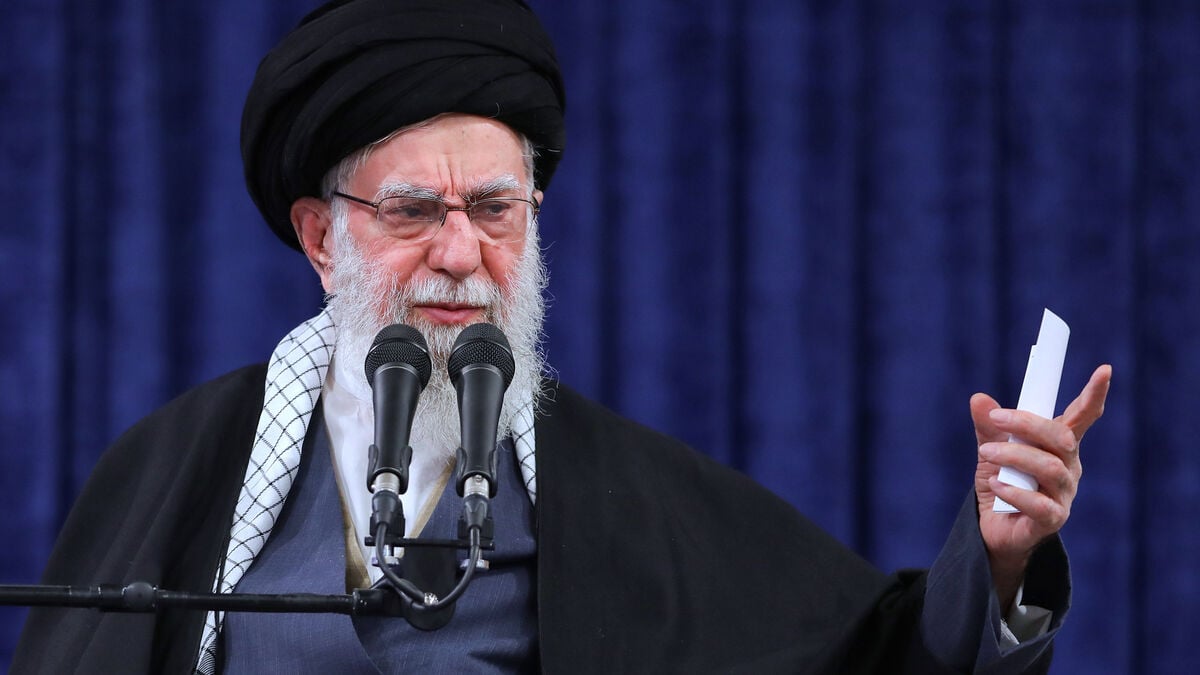
After taking over the position of Ayatollah and Supreme Leader - with almost omnipotent power over all instances and bodies in Iran - Khamenei has continued to uphold the strict Islamic line that his predecessor created.
For example, he never wavered on the heavily criticized veiling that Khomeini imposed on Iranian women after the revolution, which came to symbolize both the regime's power and oppression.
Brutal violence
Those who protested were crushed with brutal violence.
On the evening of January 8 this year, the regime blocked access to the internet and telephone service. After that, security forces began shooting. Thousands of protesters and other civilians were murdered across Iran over the course of a few days; some figures put the toll at tens of thousands.
With religious speeches addressed to his followers - and threats of violence against those in opposition - Khamenei managed to keep the ideologies of the Islamic revolution alive and also expand Iran's influence in the region, with the help of militia movements often classified as terrorist groups in Lebanon, Iraq and Yemen, among others.
Despite massive uprisings on several occasions, such as in 2022 when large parts of Iran's youth took to the streets and demanded regime change under the slogan "women, life, freedom", he did not budge an inch, despite his increasing age and rumors of failing health.
With the death of Ali Khamenei, aged 86, Iran, as in 1989, is once again in a power vacuum that will likely be difficult to fill.
Fact: All power emanates from the Ayatollah
(TT)
Power in Iran stems from the supreme leader, who is seen as a representative of the Twelfth Imam who, according to Shia Islam, disappeared in the 9th century and is expected to return one day.
The Supreme Leader is elected by the so-called Council of Experts, which can also formally remove him. The Council of Experts consists of just over 80 clerics who are elected in general elections every eight years - but all candidates must first be approved by the so-called Guardian Council, of which six out of twelve members are appointed by the Supreme Leader himself.
The rest of the Guardian Council is appointed by Iran's chief prosecutor (who is chosen by the Supreme Leader) and then approved by parliament. However, all candidates for parliament and the presidency must be approved by the Guardian Council.
The Supreme Leader is the commander-in-chief and appoints all senior positions in the judiciary, state media, and the so-called Mediation Council, which mediates disputes between parliament and the Guardian Council. He also has veto power over all important decisions made in the country.
Source: UI, Uppsala University
(TT)
Ayatollah Ali Khamenei is believed to have been born in 1939 in Mashhad, a conservative city in northeastern Iran. He received his religious education in the Shia Muslim holy city of Qom, where he studied under Ayatollah Ruhollah Khomeini, among others.
In 1963, he became involved in protests against Iran's then-monarchy, and was imprisoned several times for this. He maintained close contact with Khomeini, and when the latter returned to Iran after the Islamic Revolution in 1979, Khamenei was immediately given several high-ranking positions in the new regime.
He was president from 1981 to 1989, when he took over as Iran's supreme leader after Khomeini's death.
Source: Britannica