In 1981, six-month-old Gabriela came to Sweden after being picked up in Brazil by her adoptive family. The family has been open about her background, but she always carried a longing to know more about her origins.
"My adoptive family had been told that I was found in a basket in a priest's garden. Newborn, naked and wrapped in a torn blanket," Gabriela says on the phone from her sister's house in Brazil.
A pastor's family and nuns then reportedly took care of her until she was picked up by the Dutch lawyer who handled the adoption.
But behind everything she heard was a completely different story.
Took a DNA test
In her search for her identity, Gabriela took a DNA test through the genealogy platform MyHeritage six years ago. When the results didn't lead to anything, she started searching for her family in Facebook groups.
But when she mentioned the lawyer's name in a post, the search took an unexpected turn. Someone linked to a feature about illegal adoptions where the same lawyer talked about how she had helped parents register children they had "had at a clinic."
The discovery put an end to everything Gabriela thought she knew.
Then I started to give up hope, this won't work. So I went through an identity crisis and a little depression.
New cousin gave answers
After nearly five years without clarity, the crucial piece of the puzzle came last spring - a new hit on the DNA test.
It said I had been matched with a cousin in the Netherlands and that he had messaged me. I was shocked, it was surreal.
When Gabriela got in touch, it turned out that the cousin knew that someone in the family had lost a child through illegal adoption.
Then he called and said, "I think I've found your biological mother."
Shortly afterwards, the cousin had organized the first video call between Gabriela and her family. In the call, which lasted for hours, not only her mother, sisters and brothers appeared - but more and more relatives. Even then, Gabriela noticed that several siblings had eyes similar to hers.
I still had somewhere in me that this had to be my family, but you suppress your emotions.
To get the answer in black and white, Gabriela's mother took a DNA test in Brazil. And on July 2, 2025, the news came: they are mother and daughter.
Once it was confirmed, you kind of get into it. But it's a process, because so many years have passed without me knowing. To this day, it almost feels like you're living in a dream.
Tearful meeting
The dream of reuniting with her family has now also become a reality. At the end of June, Gabriela, who is now 45 years old, and her daughter traveled to Brazil. At the airport in Porto Seguro, they were met by Gabriela's half-sister and her family.
Suddenly they were standing behind my back and we just hugged - absolutely amazing.
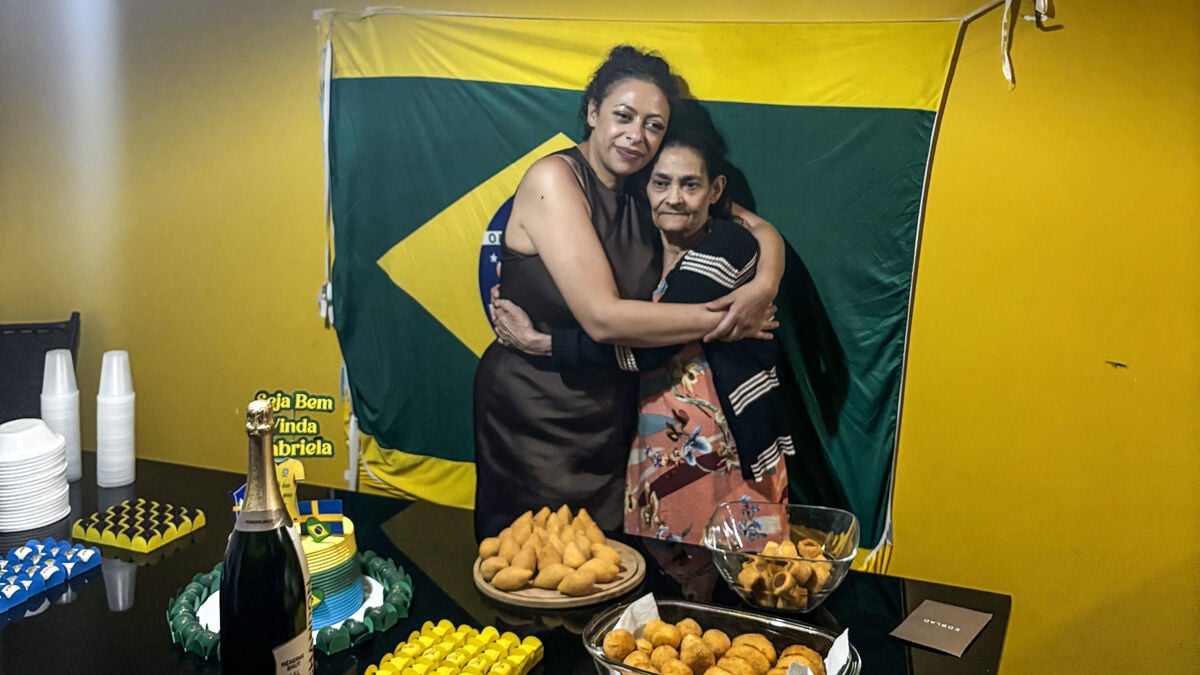
After a three-hour drive, they reached Teixeira de Freitas, where all the relatives had gathered with firecrackers, cake and Brazilian flags.
Then the tears came. You could feel the love, it went straight into your heart. It was like coming home in a way, while I still have my home in Sweden.
At the reunion, Gabriela heard her biological mother's story about how three Dutch women who ran a preschool tried to persuade her parents to adopt her.
When my mother said no, they took me. My mother said she cried for me and tried to get me back, but then they said I was already adopted.
Shortly after that, my father died and my mother was left with all the children without financial support. She and my siblings had an extremely tough time.
Fake documents
What was also eventually discovered was that Gabriela's adoption documents had been forged. According to the birth certificate, which was arranged by the lawyer, Gabriela was born in a hospital in São Paulo at the end of May 1981. In reality, she was already six months old and born in a different place.
The date of birth was the day the documents were signed and the adoptive parents were listed as her biological parents.
My adoptive parents were told by the lawyer that this is how it works. If it were today, I think they might have been more aware, but I don't think they did anything wrong. They did the best they knew how at the time and when they came back to Sweden they were honest with the district court about how the documents were written.
“It has meant everything”
Today, Gabriela has learned her real name: Creuza Pereira Dos Santos. Through her story, she wants to spread hope to others who are searching, but also show the downsides of illegal adoptions.
I am passionate about trying to help others and make the world aware that not all adoption is good adoption. We have the right to our identities and our origins, because many of us are harmed by not knowing. Ask questions, also for the sake of the child, so that in the future there are answers.
Although there is still a lot to process, meeting her family in Brazil has helped Gabriela start to settle down.
"It has meant everything. It has been difficult to get here, but I don't know how I would have felt otherwise. I needed this trip and I think my family needed it too. They want me to stay and not go home again," Gabriela says, laughing.
My sister throws me a kiss, she's cooking in the kitchen.
Gabriela was born in Brazil and adopted to Sweden in 1981. Through a Swedish resident in Brazil, the adoptive parents came into contact with a Dutch lawyer who handled the paperwork for the adoption. In connection with this, they heard the story of Gabriela being found abandoned.
There are several inaccuracies in the Brazilian adoption documents. The birth certificate lists Gabriela's Swedish adoptive parents as her biological parents and says she was born in a hospital in São Paulo. It also states that she was born in May 1981, but in reality she was already about six months old and therefore born in 1980. The date the papers were signed was recorded as her birthday.
In the story that the parents submitted to the district court, in connection with the adoption being formally approved in Sweden, it is clear that the procedure, according to the lawyer, was the only possible one if they wanted to take the child out of the country.
According to the non-profit organization Brazil Baby Affair, this was a method that was put into practice during the time period and many children were deprived of the right to their identity through the false registration of a Brazilian child as the biological child of a foreign couple.
In a 1982 Dutch television interview, the same lawyer involved in Gabriela’s adoption said she had helped register children whose parents had “received at a clinic.” In questioning, the lawyer later admitted that she had been involved in several cases where children were registered with incorrect information. The children ended up in the Netherlands, West Germany, Sweden and the United States, among other places, according to a Dutch police report.
Source: District Court documents and Brazil Baby Affair
Around 60,000 children from different countries have come to Sweden via international adoption since the 1950s. The number has decreased sharply - in 2025, 50 children came via Swedish adoption organizations.
For decades, there have been reports of irregularities linked to international adoption, such as theft of children and forged documents. In the fall of 2021, a state adoption commission was appointed to investigate this, partly after Dagens Nyheter's revelations about crimes in the wake of adoption.
In June 2025, government investigators proposed that Sweden completely stop international adoptions, after several cases of child trafficking were discovered, mainly during the 1970s and 1980s. In many cases, parental consent was also lacking.
In Brazil, international adoptions gained momentum in the 1980s. Even then, there were reports of irregularities and several cases of child trafficking linked to private adoptions, including to Sweden.
In 1990, Brazil passed new regulations that banned private adoptions, which were instead to be carried out through a state agency and regional juvenile courts. The country adopted the 1993 Hague Convention on the Protection of Children and Cooperation in Respect of Intercountry Adoption in 1999.
Source: Family Law and Parental Support Agency, SOU 2025:61, Statistics Sweden (SCB)