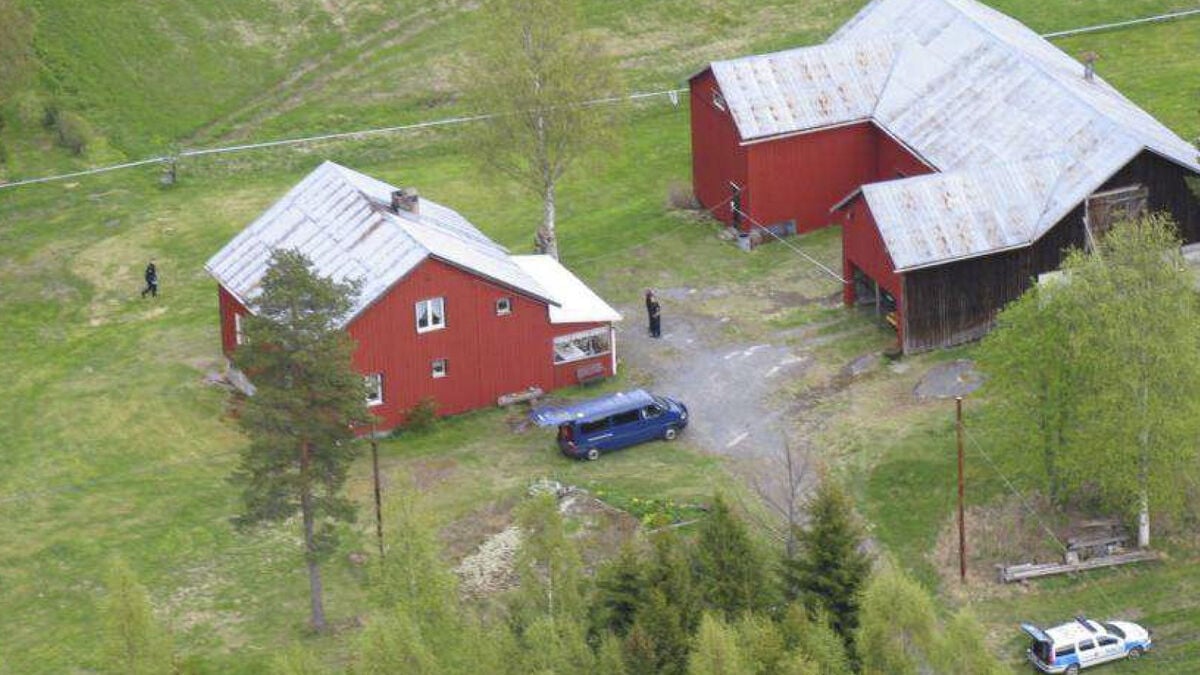
The 45-year-old was charged with two counts of murder, and the prosecutor requested a life sentence. The Ångermanland District Court does not believe it has been proven that he murdered the couple, but he has been convicted of aiding and abetting the murders.
"The investigation has been extensive and the collected evidence means that there is no other reasonable explanation for the defendant's DNA being found on one of the victims than that he was involved in both murders," says Anita Enocksson, former councillor, in a comment from the court.
Even though the 45-year-old left no trace on the man, the court has found that he was also involved in his murder, since the couple were killed in the same place, at the same time and with the same method.
Intense violence
It was on June 2, 2005 that the estranged couple Tor Öberg and Gärd Wiklund were found beaten to death on Öberg's farm in Brattås outside Härnösand. According to the verdict, the couple were killed by blows to the back of the head from an axe or an "axe-like object."
The police found DNA traces at the scene from a suspected perpetrator and over the years hundreds of people have been DNA tested without success.
The turning point came when a new law came into force last year, which makes it possible to use DNA-based genealogy in murder investigations. Searches in genealogy databases led to the 45-year-old man, who was arrested and remanded in custody in April this year. In connection with his arrest, a DNA test was taken that gave a direct match to traces at the crime scene.
The man's DNA was found both in a handbag belonging to Gärd Wiklund and on her trouser leg.
Denies crime
The 45-year-old himself has claimed that he came there by chance after hearing screams during a walk. He has said that two men left the crime scene when he arrived, whereupon he discovered the woman's body. He is said to have "panicked" and dragged her into the barn where the couple were later found.
The 45-year-old will appeal the verdict.
"He has given a completely reasonable explanation that is also supported by the technical evidence. Yet the court decides on a different path, it is strange," says the man's lawyer Johan Lavås.
The motive behind the double murder has eluded investigators. Inside the home, Tor Öberg's wallet, which contained around 10,000 kronor in cash, was untouched. However, Gärd Wiklund's bank card disappeared. On the morning of June 1, three unsuccessful withdrawal attempts were made with the card, after which it was retained by the ATM.
"No motive for the acts has emerged," the district court writes.
A case that may be relevant for genealogy goes through four stages.
1. DNA analysis: An extended analysis of the biological trace is performed and the answer is formatted to be compared with genealogy databases.
2. Comparison in genealogy databases: the DNA data is transferred and the Swedish Data Protection Authority is informed. The handling is done separately, so that no one else can search against the current DNA trace.
3. Hit list and selection: The police receive answers in the form of a hit list and based on this, genealogy research is carried out to see who left the DNA trail.
4. Hit on a person: If a person can be identified as a reasonable suspect, they can be forced to undergo a DNA test, which can then be compared against the DNA trace. DNA testing can also be done voluntarily and result in a hit.
Source: Police.