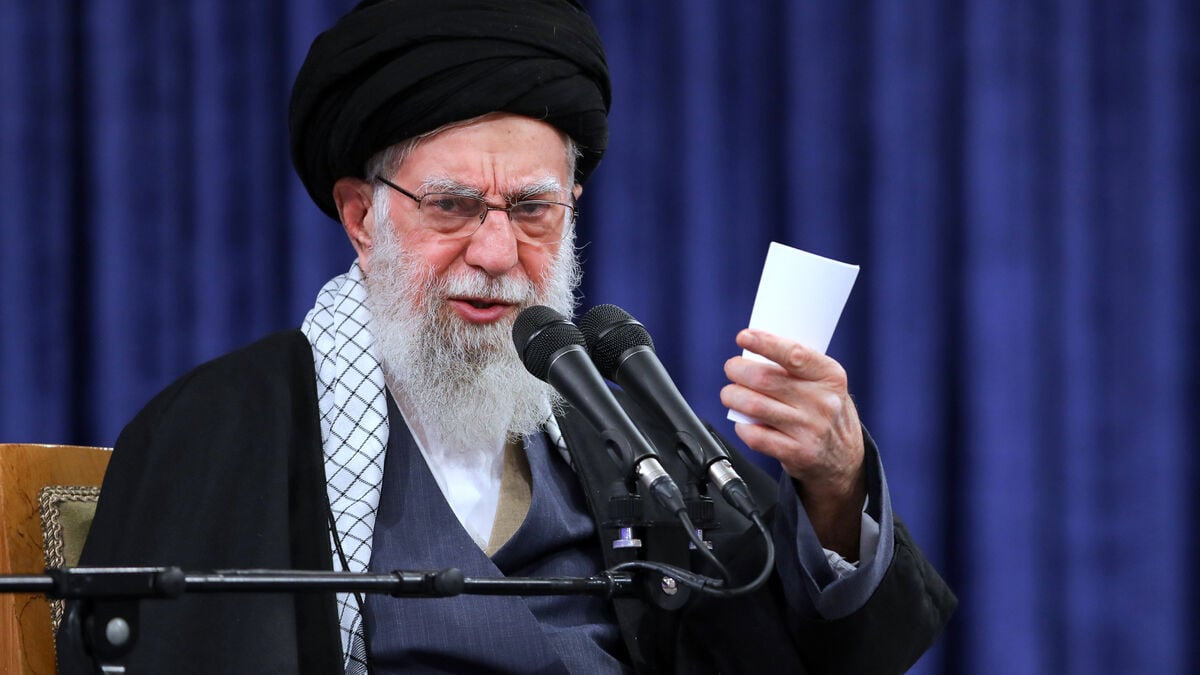
"Mouse Ali" Khamenei, as the Ayatollah is called for his bunker visits, is rumored to be weakened.
He is 86 years old and has large parts of his own people and the world against him.
That does not mean that a regime change is imminent.
"Khamenei is the most important person, but he is not the system," says Saeid Golkar, a researcher at the lobby organization United Against Nuclear Iran (UANI) and co-author of a report on the supreme leader's office, called Bayt, which roughly translates to "the house."
The report shows a complex network with thousands of employees reaching every corner of society.
Demands loyalty everywhere
In each political department, there is a representative from Bayt who ensures that all decisions follow the Ayatollah's line.
Dissenting academics are purged through representatives in universities.
Large parts of Iran's economy, up to 65 percent according to some analysts, are linked to the supreme leader in various ways. Everything from hotel chains and airlines to soft drinks is tied to him, as is state media.
Through a special militia, the regime has also infiltrated the once-autonomous religious schools.
Military power is guaranteed through the powerful Revolutionary Guard Corps, where Bayt maintains control by requiring that every promotion be based on loyalty to the leader, according to the US-based UANI.
"At least on paper, people have tried to ensure that even if you cut off the head, the body will be able to continue functioning for a while," says Mohammad Fazlhashemi, a professor at Uppsala University and an expert on political Islam.
The entire elite
It's not like Venezuela, Saeid Golkar says, referring to how the US captured former President Nicolás Maduro and then claimed control over the country.
You are dealing with a foundation, a network of individuals and actors that exists solely because of Khamenei.
Killing him without dealing with others from the elite and institutions like Bayt will be ineffective, he continues.
According to UANI, the power structure can only be weakened through a combination of sanctions, cyber operations, and military attacks that knock out the entire elite.
Mohammad Fazlhashemi points out that historically, shifts of power have often required the military to change sides, and that an alternative leadership is ready.
To try to achieve this just through aerial bombings, cyberattacks and such... I won't say it's impossible, but it seems difficult.
Power in Iran stems from the supreme leader, who is seen as a representative of the twelfth imam who, according to Shiite Islam, disappeared in the 9th century and is expected to return one day.
The Supreme Leader is elected by the so-called Council of Experts, which can also formally remove him. The Council of Experts consists of just over 80 scribes who are elected in general elections every eight years - but all candidates must first be approved by the so-called Guardian Council, of which six out of twelve members are appointed by the Supreme Leader himself.
The rest of the Guardian Council is appointed by Iran's chief prosecutor (who is chosen by the Supreme Leader) and then approved by parliament. However, all candidates for parliament and the presidency must be approved by the Guardian Council.
The Supreme Leader is the commander-in-chief and appoints all senior positions in the judiciary, state media, and the so-called Mediation Council, which mediates disputes between parliament and the Guardian Council. He also has veto power over all important decisions made in the country.
The system is unique in the world and stands out particularly within Shiite Islam, where the historical view has been that religion and politics should be kept separate.
Source: UI, Uppsala University