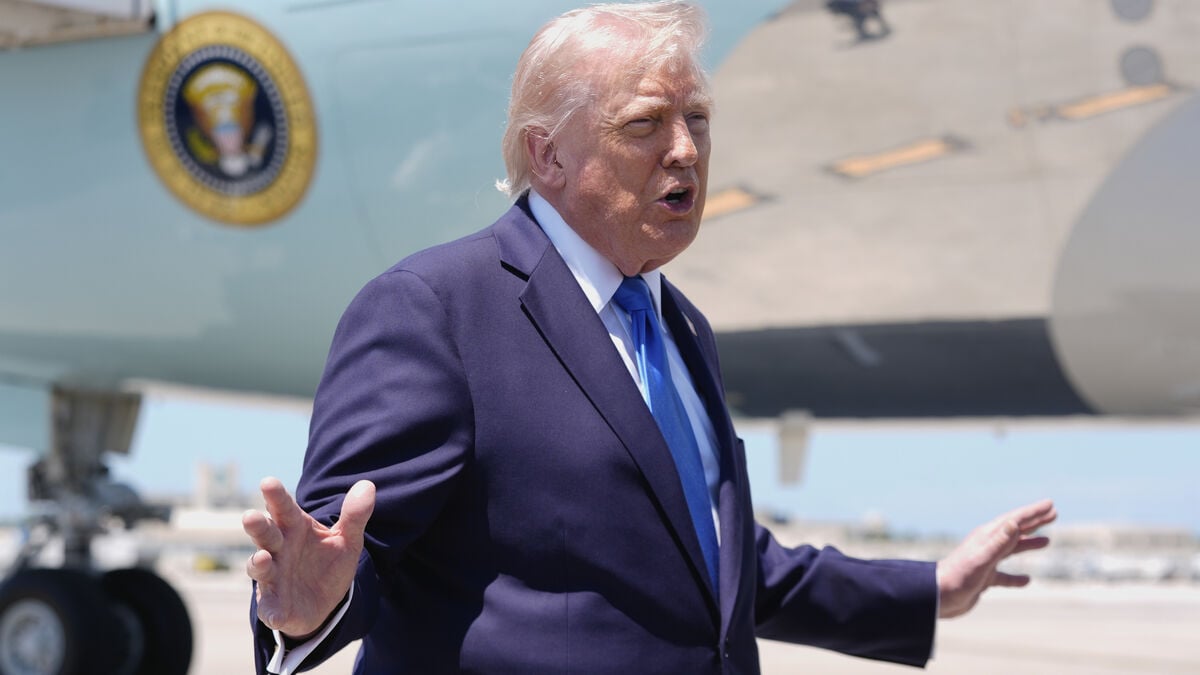
“I have all the time in the world, but Iran doesn’t.”
Judging by the posts on social media, the US president is in no hurry to end the Iran war. The most important thing is a "good deal", he emphasizes time and again.
But the calendar says otherwise. In the United States, the right to declare war is reserved to Congress, according to the Constitution. The president, who is also commander in chief, can only decide on military operations for up to 60 days, according to the War Powers Resolution. It was passed in 1973 with the aim of limiting a president's ability to wage war without congressional approval, in light of the Vietnam War, which had been going on for several years at the time.
Two deadlines
The text of the law contains two explicit time limits: The first is 48 hours. This is how long after “hostilities abroad” begin before Congress must be informed.
Trump did this on March 2, two days after the US-Israeli attack that triggered the Iran war. The president claimed at the time that he was protecting the country's bases in the Middle East and acting in collective self-defense with allies, writes The New York Times.
The next deadline is 60 days after the first report, which is Friday. If the military operation continues for that long, the president must either seek congressional approval or end the operation. There is also an option where the president can request a 30-day extension to safely withdraw forces.
Another path for the White House is to invoke a law, the Authorization for Use of Military Force, which was passed after the terrorist attacks on the US East Coast in 2001. It is primarily aimed at terrorism and was used to obtain congressional approval for, among other things, the wars in Afghanistan and Iraq.
Limited support?
The 60-day limit has been questioned by both Democratic and Republican presidents. It is not impossible that the White House is trying to circumvent it, for example by arguing that the 60 days should not be counted when there is a ceasefire, writes CNN.
How likely is it then that Trump will get the green light if he wants to continue the war?
It's far from certain, but possible given that Republicans hold majorities in both chambers of Congress. Trump's party colleagues have effectively blocked Democratic attempts to hold hearings for the Secretary of Defense and the president.
But several Republicans have said that this only applies until the next deadline.
After the 60-day mark, the vote numbers could look different, Florida Republican Brian Mast, who chairs the House Foreign Affairs Committee, recently warned.
War is unpopular in the United States. Many members of Congress are aware of this, especially those hoping to be re-elected in the midterm elections in November.
Republican Donald Trump took office for his second term as US president on January 20, 2025. Since then, his approval rating has declined, as is common for a sitting president. In recent months, the decline has become more pronounced, in line with the Iran war and the increased fuel costs it has brought.
Currently, 40.6 percent believe that Trump is doing a good job, while 57.7 percent do not think so, according to RealClearPolitics' compilation of 14 current polls.
According to the website Fiftyplusone, an opinion aggregator that weights current surveys using a mathematical model, Trump's support is lower: 37.8 percent. 58.2 percent disapprove of the president's job performance. The figures are in line with those reported on the website Silver Bulletin, started by opinion expert Nate Silver.