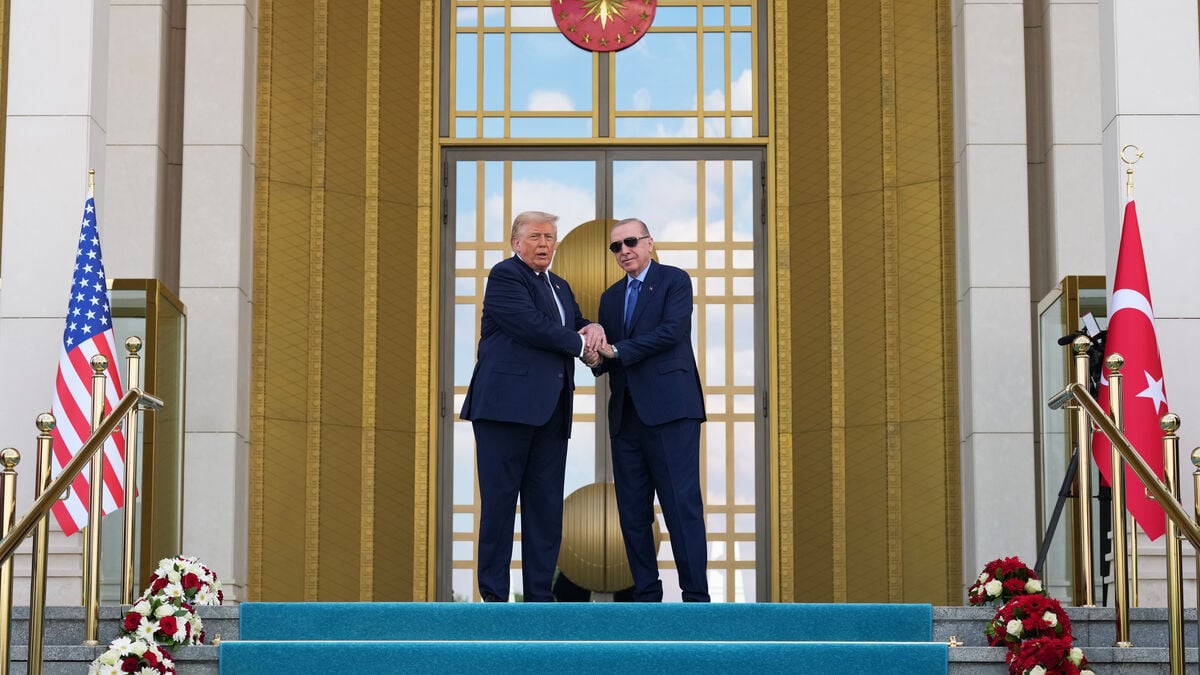
The figures are being released as the alliance's summit in Ankara, Turkey, has begun - and host President Recep Tayyip Erdogan has welcomed the other leaders to Tuesday evening's dinner.
In addition to important discussions about support for Ukraine, defence industrial investments and rearmament, Donald Trump's approval - or disapproval - runs like a common thread through the gathering.
“Very strong person”
Trump said shortly after being received by Erdogan in Ankara on Tuesday that he was "very disappointed in NATO."
"Honestly, if it (the summit) had not been held in Turkey, where my friend happens to be a very strong leader, a very strong person, it is possible that I would not have attended," Trump said.
The dissatisfaction stems, among other things, from the fact that the United States believes the allies' rearmament is going too slowly and that support in the war against Iran is insufficient.
Italy rejected us, Germany rejected us, and France rejected us. And that's okay. But, you know, why are we spending hundreds of billions of dollars when they're not there for us? the president said.
According to NATO's latest report, the European member states and Canada are expected to spend a total of $634 billion, equivalent to over SEK 6,130 billion, on military defence this year. This compares with $571 billion last year. The 11 percent increase is also less than between 2024 and 2025, when it was 19 percent.
Five over goal
NATO's 5 percent target must be met by the countries by 2035. The target is divided into 3.5 percent of GDP in pure military investments (the dollar figure above) and 1.5 percent on infrastructure, for example.
Four countries - Poland and the Baltics - are already well above 3.5. Greece looks set to cross the threshold this year.
At the same time, four countries are struggling to reach the old target of 2 percent of GDP. Belgium, Spain, and the Czech Republic are on the verge, while Slovenia appears to be landing at 1.6.
Sweden is expected to reach just over 3 percent this year.