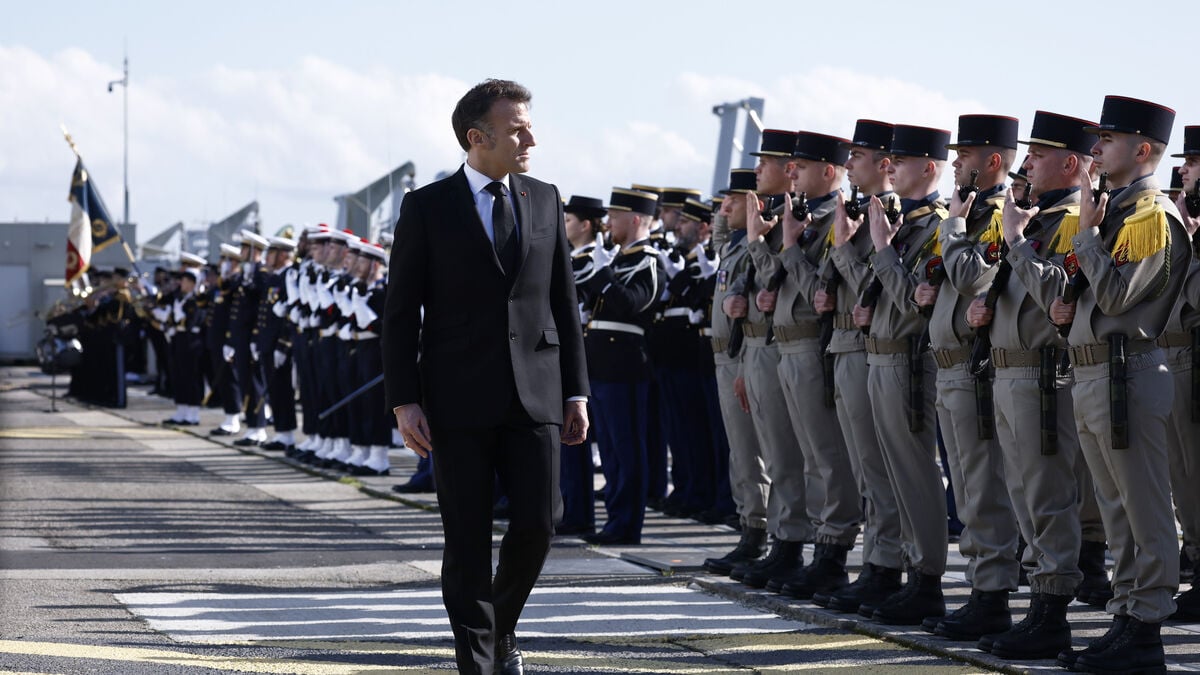
The remarks were delivered at a naval base south of Brest in western France.
"Our nuclear deterrent is robust. Everyone knows the unsustainable price that awaits them (in the event of an attack)," the president says.
At the same time, he warned of French rearmament.
"I have given orders to increase the number of nuclear warheads in our stockpile. We will also no longer announce any figures on our nuclear arsenal, unlike before," Macron said.
A new submarine that can carry nuclear weapons is also to be built, the president says.
Practice with Sweden?
It's all part of a new nuclear strategy being developed in light of Russia's war in Ukraine.
We must see our deterrence strategy in the context of the entire European continent – with the creation of what I call an “advanced deterrence,” Macron says.
This includes, among other things, the opportunity for "European allies" - including countries such as Sweden, Denmark, Poland, Belgium and the Netherlands - to participate in exercising the French "deterrence capability".
Eight countries have reportedly shown interest, the president says. He is also open to "dispersing" nuclear-armed French aircraft to those countries, to "make it more difficult for our adversaries to calculate."
Decisions are made in Paris
Earlier this winter, Western Europe's second nuclear power, Great Britain, practiced its nuclear weapons capabilities with France for the first time.
However, the issue is controversial in France. For example, MEP Philippe Olivier of the far-right National Rally party has threatened to impeach Macron for treason if he shares nuclear weapons with the EU.
However, Macron insists that all crucial decisions about French nuclear weapons will remain in Paris.
"There will be no sharing of ultimate decisions, neither regarding planning nor execution," the president promises.
In 1960, France became the fourth country to acquire nuclear weapons after the United States, the Soviet Union, and Great Britain.
The country is estimated to have around 300 warheads, mostly for four nuclear-armed submarines and, to a lesser extent, aircraft.
In the 1990s, French nuclear tests in the South Pacific led to widespread protests and boycotts. However, no tests have been conducted since 1996.