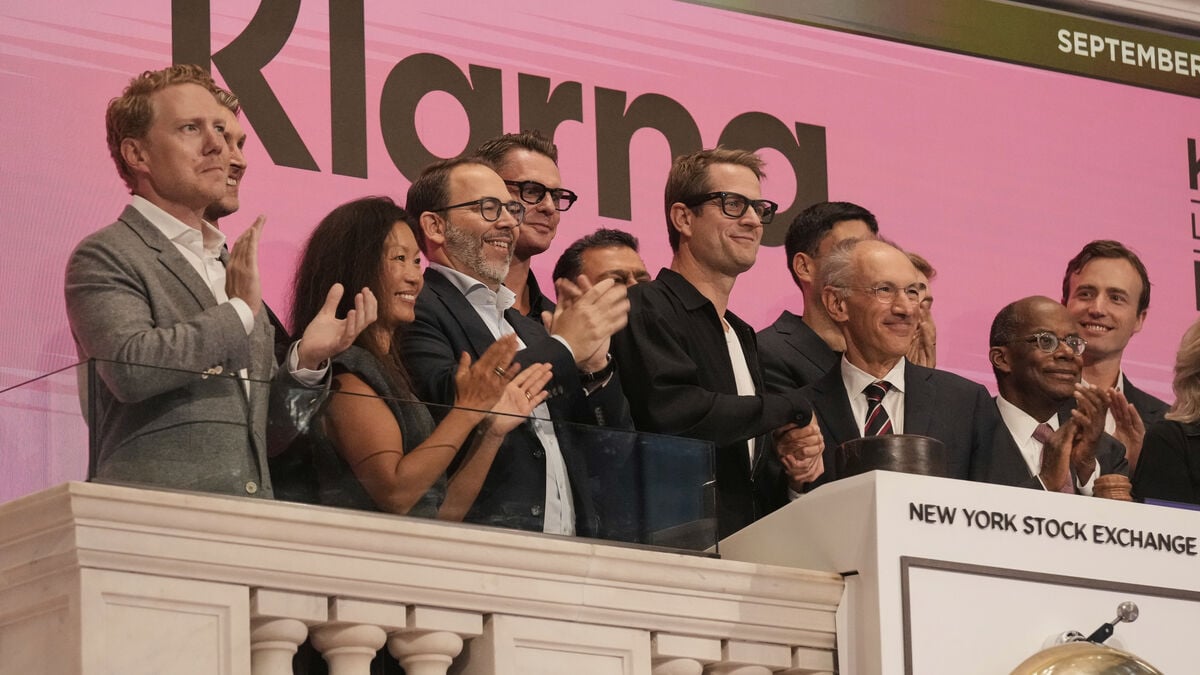
Klarna's stock is rising sharply in futures trading on Wall Street after the report.
"We have delivered above what we guided in basically all parameters. So it feels good," says the Klarna boss.
The growth is most clearly visible in the United States.
"But it's also an incredibly large market. So there's a lot left to do," says Siemiatkowski.
No war effects
The Iran war has so far not had any clear impact on operations, despite the energy price shock and inflation concerns, according to the Klarna CEO:
"From what we can see, everything is very stable, both in customers' repayment ability and consumption."
He describes the growth prospects as favorable. This applies to everyday purchases – including with the Klarna card, which now has five million active users in 16 countries. But also in online shopping, purchases on invoice and credits in connection with larger purchases.
According to Siemiatkowski, Klarna should be seen as an interest-free alternative to credit cards:
"A nicer product. What we see is that there is strong demand for that product."
Loan losses are rising in line with growth. This is because the company must reserve increasingly larger amounts to cover risks in longer-term lending, while income from the same transactions only comes later.
"A growing bank will have larger provisions for losses year after year than it did in previous years. But if we look at losses in actual volume, they are stable."
Headwinds on the stock market
Klarna – which launched its own cryptocurrency this year – has in recent years launched several new products and initiated a number of strategic collaborations with industry giants such as Adyen, Stripe, Ebay, Onepay and – in Sweden – Swedbank Pay.
At the same time, the number of staff continues to decrease as Klarna – which is investing heavily in AI – is not fully recruiting to cover the fifth of staff who choose to leave the company each year.
"We have recruited a little, but to a very small extent and not at all to the same extent as we have natural departures."
"Today we are just under 3,000 and we were over 6,000 2–3 years ago."
The stock has lost over 50 percent since the start of the year to just under $14 per share, compared to the subscription price of $40 per share in September last year.
"I don't determine the share price, I focus on the company and the company's delivery," says Siemiatkowski.
Klarna's revenue in the first quarter of this year rose 44 percent compared to the same quarter last year, to $1 billion. Analysts had expected $942 million on average, according to Bloomberg.
Gross trade volume – the total value of all goods and services sold via Klarna’s payment solutions – rose to $33.7 billion. Expectations were $32.6 billion.
The number of active consumers using Klarna's services during the quarter increased 21 percent to 119 million, which was in line with expectations.
Credit losses, including provisions, increased to $185 million, or 0.55 percent of gross trading volume, in the first quarter of this year, compared to $137 million, or 0.54 percent of gross trading volume, a year earlier.
Adjusted operating income rose to $68 million, from $3 million a year earlier. And net income was a profit of $1 million, compared to a loss of $90 million a year earlier.
Source: Bloomberg, Klarna